
Peter Thiel, the PayPal co-founder and Silicon Valley investor, said artificial intelligence may prove more important than the internet and could help restart economic and technological growth across civilization, even as he kept defending the “stagnation thesis” he has argued for more than 20 years.
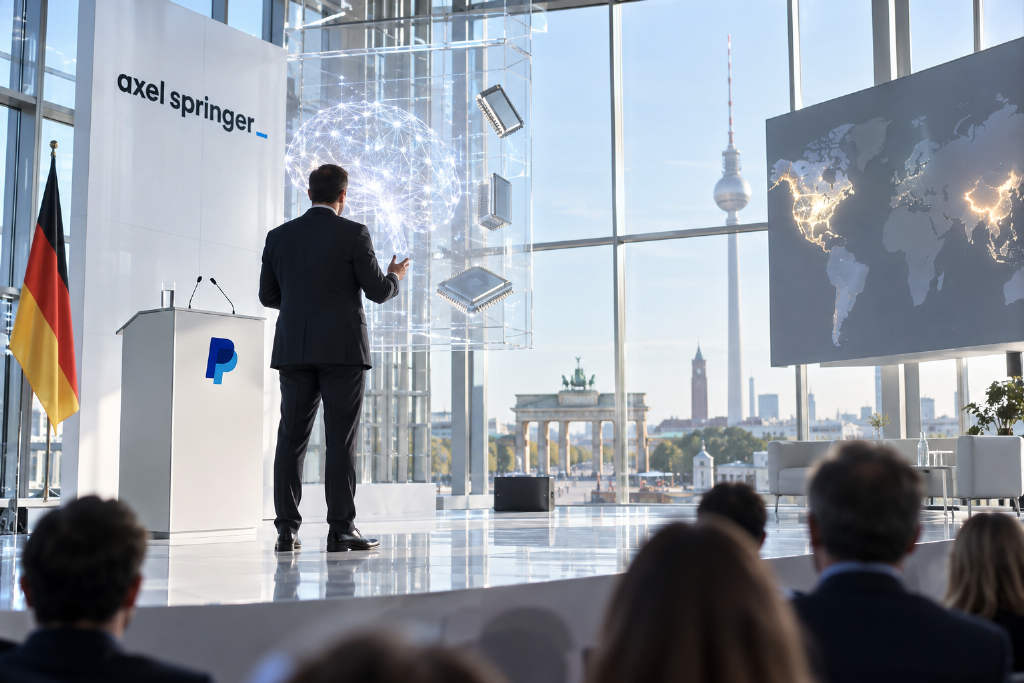
Thiel made the remarks in Berlin during an interview with Axel Springer CEO Mathias Döpfner. The conversation, which lasted about an hour, took place as Thiel received the Axel Springer Award. Döpfner opened by pressing him on a tension that has become harder to ignore: Thiel spent years warning that the West was not making enough technological progress, yet the current fear is almost the reverse — that AI may be moving too fast.
Thiel said he had changed part of his view. He argued that AI could be bigger than the internet and might reaccelerate growth at the level of civilization.
AI does not disprove stagnation, he said. It confirms it.
That shift did not lead Thiel to abandon his broader thesis. He argued instead that AI’s sudden breakthrough strengthens the case that the previous decades were marked by stagnation. As he put it, now that AI has arrived, “nobody disagrees anymore” that the earlier decades contained stagnation.
Thiel revisited the framework he has used for years. Since the 1970s, he said, the West has not been defined by a total lack of progress, but by sharply uneven progress. The world of “bits” kept moving — computers, networks, mobile internet and software advanced quickly. The world of “atoms” slowed down. He placed mechanical engineering, chemicals, aerospace and nuclear energy in that second category, saying progress there was slow and those fields no longer looked like the most promising paths for top talent.
In his view, that long slowdown reaches beyond technology. When growth weakens, resource allocation becomes more zero-sum. Politics grows more polarized, and society becomes easier to destabilize.
AI changes the picture, but not in a way that invalidates his diagnosis. Thiel said AI may be larger than the internet boom of the late 1990s and could bend the growth curve upward again. The very reason people are stunned by AI, he argued, is that society has gone too long without seeing a breakthrough on that scale.
He sees risk in AI, but also in a no-growth world
Asked about the oscillation between optimism and doom in current AI debates, Thiel said scenarios involving loss of control, AI surpassing human intelligence, or outcomes resembling The Terminator or The Matrix should not be dismissed as inherently absurd.
He said that if the probability of some disaster scenario is not 0%, then even a 5% or 10% chance is enough to make people uneasy. Still, he rejected the conclusion that the answer is to slow AI indefinitely.
For Thiel, many critics rely on an unstated assumption: without AI, the world would remain in a peaceful, stable, democratic and socially harmonious low-growth order. He does not accept that premise. A society that stops making progress for a long time does not just produce weaker economic performance, he said. It also breaks confidence between generations. The middle class has accepted the existing system partly because people believed their children would live better than they did. If that intergenerational expectation fails, society starts to come apart in distorted ways.
That is why, in his framing, refusing to develop AI is not a neutral option. It is a different high-risk option. The real question is which risk a society chooses to take.
A coordinated global slowdown is theoretically possible, but he called it unrealistic
When asked whether AI development should at least be slowed, Thiel gave a direct answer: in theory, yes, but only if there is a global governance structure with real enforcement power.
That would mean a coordinating system with authority, coercive capacity and something close to the reach of a world government. Thiel said that solution carries even greater danger. In his view, a classical liberal would find it hard to accept because the cure could be worse than the disease.
He was also dismissive of international cooperation that lacks enforcement and stays at the level of summits, communiqués and moral appeals. The practical result, he said, could simply be that Western societies slow themselves under internal pressure while China keeps accelerating.
Thiel pointed to recent critical comments on AI from the pope, arguing that the Chinese Communist Party would not slow down because of moral advice from the West. The parties most likely to listen, he said, would be the US and Europe. That means such appeals could, in effect, “objectively help China.”
On anti-AI sentiment in the US, he said the West is weakening itself
Thiel also warned about rising anti-AI sentiment in the US. During the interview, he was asked whether he agreed with the idea that China is amplifying anti-AI messages on social platforms to weaken US competitiveness.
He said he had not studied the matter closely enough to speak with certainty, but he was inclined to think the possibility exists. He added, though, that even if outside forces are amplifying the message, the deeper problem lies inside the West. Anxiety and hostility inside the US toward technology, progress and industrial expansion are, in his view, largely produced by Western societies themselves rather than by Chinese propaganda alone.
Döpfner then asked why the US, long seen as the country most open to innovation and technology, now appears to be one of the places where opposition to AI is loudest. Thiel’s answer was simple: AI is most real in the US.
Europe’s weaker reaction, he said, may not show greater calm. It may simply reflect greater distance from the technological revolution, lower participation and less direct exposure to the risk of disruption.
His assessment of Europe was harsh
On Europe’s place in the AI race, Thiel said the current global picture is roughly this: the US leads, China is catching up quickly, and Europe is clearly falling behind.
He used a historical comparison to explain the gap. In the late 1960s, Britain and France worked together on the Concorde supersonic jet. Europe started behind the US, but it could still use strong coordination to catch up and even surpass the Americans in a specific industry. By contrast, France’s Minitel project in the 1990s became, in his telling, a case of being behind and then doubling down on the wrong direction, only to be left behind by the real internet era.
Asked whether Europe’s AI position today looks more like Concorde or Minitel, Thiel said Europe is in an even worse position than it was in the Minitel era.
The implication was clear. He does not think AI is an industry Europe can slowly catch by waiting and spending more time. He sees a structural lag.
Thiel also pushed back on the usual criticism that Germany’s startup culture is too afraid of failure. He said the country may face a deeper problem: not fear of failure, but fear of success.
By that, he meant founders may build something good but still resist scaling it to the limit. Instead of pushing toward global reach in the way Elon Musk or Mark Zuckerberg did, they may choose to sell, exit or remain at a moderate size.
He backed that point with a comparison in wealth formation. Among the 50 richest people in the US, he said, most are older, but among Gen X or younger wealthy Americans, most built their fortunes through entrepreneurship. In Germany’s top 50, by contrast, the younger group is made up almost entirely of heirs rather than founders of new, large and scalable companies.
To Thiel, that signals a shortage of new wealth creation in Germany. The country once had the Mittelstand and built great industrial firms, he said, but some key capability appears to have broken after 1995.