
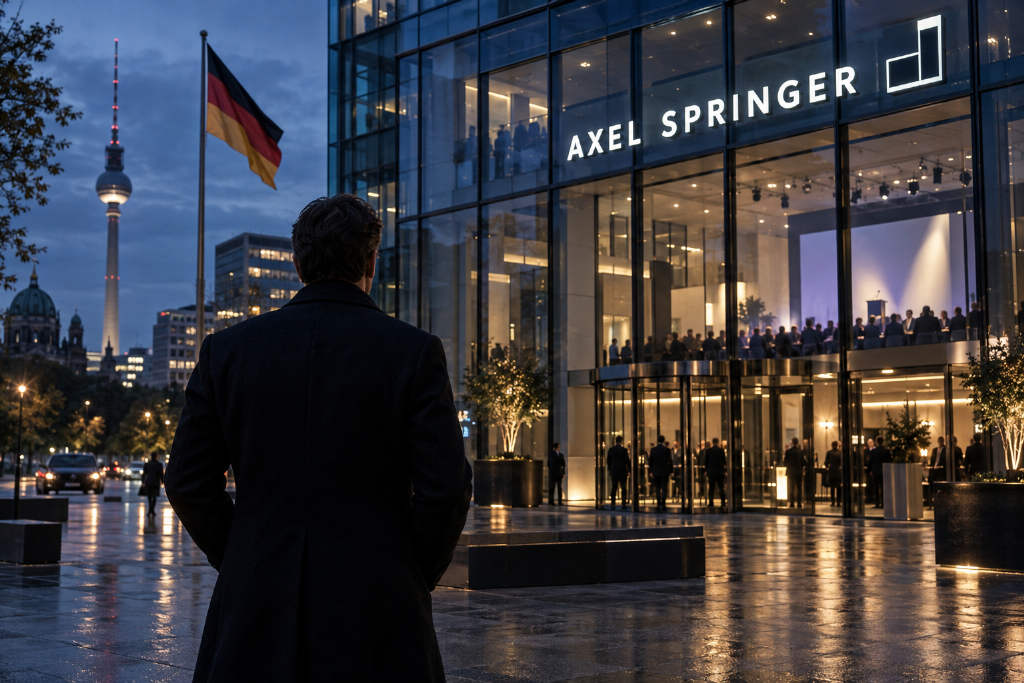
In the back half of his long talk with Axel Springer Chief Executive Officer Mathias Döpfner, Peter Thiel left AI and tech competition behind and turned to U.S. politics, democratic institutions, Donald Trump, J.D. Vance, democratic socialism, Argentine President Javier Milei, and his own thinking on Germany, family, and longevity research.
Thiel, born in Frankfurt and taken to the United States as a child, came back to Berlin to receive the Axel Springer Award. Döpfner said that when Thiel found out he would get the prize, he told him: "For decades, I have tried to remove Germany from my mind. Intellectually, I have done a pretty good job, but I cannot remove it from my heart."
The point, as the report framed it, was bigger than simple support for disruption. Thiel’s deeper worry is that both the U.S. and Europe are sliding toward a state with no clean fix, just extended drift. He tied that anxiety to fraying social cohesion during a long stretch of low growth, even while still backing AI, biotech, and longevity as areas that could shove society onto a very different track.
More worried about a leftward shift than another Trump-style shock
When politics came up, Thiel was asked whether the U.S. still needs another disruptive force, the way he backed Trump a decade ago because he thought the existing establishment had stopped working.
His reply was direct. What he does not want, he said, is a "democratic socialist version of disruption," which he called potentially disastrous. In his telling, the establishment side of the Democratic Party has shown deep dysfunction, much like the establishment side of the Republican Party. The real danger, he argued, is that this dysfunction will not lead to a rational correction but will instead clear space for more radical forces on the left.
So for him, the bigger question over the next few years is not whether Republicans produce another Trump-like figure. It is whether Democrats get pushed farther left by groups such as Democratic Socialists of America, or DSA.
How Thiel sees DSA
Thiel spent a lot of time on DSA. He did not treat it like some fringe oddity. He treated it as a political trend people should watch closely.
He said that when DSA was founded in 1982, it was a small marginal organization with an older membership. Then Bernie Sanders’ 2016 presidential campaign hit, and, as Thiel tells it, both the structure and the scale changed fast. Membership rose from the thousands into the tens of thousands, while the median age fell sharply.
To Thiel, that change means DSA is no longer an old-style movement powered by nostalgia. He cast it instead as a younger, organized left-wing force with emotional appeal and political energy. He even called it one of the few political forces today that still has "energy" and "charisma." By comparison, he sees the Democratic establishment as weak, hollow, and lacking both language and direction.
And he does not dismiss left-wing radicalization as something cooked up by the media. He sees it as one plausible answer to the next phase of political upheaval in the U.S.
Still backing J.D. Vance, but not overly optimistic on Republicans
As an early supporter of J.D. Vance, Thiel also laid out why he had spotted Vance as a political talent long before Vance became one of the Republican Party’s central figures.
He said he has always been drawn to people who are smart, thoughtful, open, and charismatic. Back when Vance was working at Mithril, the venture capital fund Thiel helped create, he said he could already see Vance’s potential and urged him to write Hillbilly Elegy. Thiel later gave financial support during Vance’s 2022 Senate campaign.
Even then, he did not offer a sunny view of Republican prospects.
Asked whether a future Republican nominee would be more likely to win if the party picked J.D. Vance or Marco Rubio, Thiel said he still leans toward Vance. But then he changed the frame. The more important question, he said, is who the Democrats nominate.
If Republicans take a heavy hit in the midterm elections, he argued, Democrats may grow more confident that 2028 belongs to them. If that happens, there may not be enough strength inside the party to block a more left-wing candidate from breaking through. Thiel went as far as to say that the odds of a democratic socialist winning in 2028 may not be the most likely outcome, but could be close to 50%.
Why Javier Milei fascinates him
Thiel sounded more upbeat when the conversation moved to Argentine President Javier Milei. He said many people are fascinated by Argentina because they suspect its past may be the West’s future.
He described Argentina’s problem not as one short-term crisis but as a century-long pattern of suboptimal growth, or even long decline. Around 1900, he said, "as rich as an Argentine" was once a common expression. After Peronism, policy mistakes, and institutional deterioration, the country slowly lost that position.
What pulls him toward Milei is the possibility of a forced turn. If a country has already shown it cannot keep going down the same road, Thiel asked, is there a correction sharp enough to matter and still able to work in the end?
He also admitted that Milei’s success is still uncertain. The point, in his version of it, is that Argentine society has at least started to recognize that some problems have reached a stage where there is no going back.
Discontent is widespread, but not yet enough to produce reform
Although he admires Milei, Thiel said that does not mean he buys into the accelerationist idea that things must get worse before they improve. He attacked what he called a Leninist logic: the worse conditions get, the nearer revolution becomes, so bad developments can be treated as good ones. He called that way of thinking dangerous.
At the same time, he said the U.S. and Europe are packed with dissatisfaction, pessimism, and anger. But here is the catch. Those feelings are still not strong enough to produce high-quality reform. Instead, they look more like grumbling during a long drift.
He pointed to Germany as an example, asking why a leader such as Merz, whom he described as underperforming, could still stay in place for quite a while. To him, that signals a structural problem: broad dissatisfaction does not mean a workable alternative appears right away. That, he suggested, is one of his deepest worries about the West. The problems are getting easier to see, yet the existing system may still keep postponing any real response.
Welfare states, deficits and the end of the zero-rate era
From a macroeconomic view, Thiel said the West faces a structural choice. European and American governments, in his view, are carrying large welfare commitments, tax burdens that are already high, and widening fiscal deficits.
For roughly the past 20 years, he said, these problems could be kicked forward mostly because interest rates were low. Now rates are not at zero anymore, and the compounding effect of deficits is becoming dangerous.
He set out three broad paths:
- deep spending cuts, in the style of a harsh Milei-type fiscal tightening;
- large tax increases, at the cost of choking growth even more;
- or continued borrowing, pushing the problem down the road again.
According to Thiel, the U.S. and Europe have in practice chosen the third option for nearly two decades. His instinct is that this path is close to its limit. Once borrowing can no longer continue, societies will be forced to choose among options that are more aggressive and less centrist.
Germany as something he cannot fully leave behind
In a more personal stretch of the interview, Thiel came back to the question of German identity. Because he was born in Frankfurt and moved to the U.S. as an infant, Döpfner raised a line Thiel had used before: "For the past several decades I have tried, intellectually, to remove Germany from my mind, and I have done a pretty good job; but I cannot remove it from my heart."
Thiel said it would be stranger if he felt nothing for Germany. He has spent almost all his life in the U.S., but his grandparents stayed in Germany and German was spoken at home. So yes, his upbringing was always set between two worlds.
Founders as insiders and outsiders at once
Talking about former collaborators such as Alex Karp and Max Levchin, Thiel offered a view about entrepreneurship: many exceptional founders are insiders and outsiders at the same time.
He applied that idea to both men. Karp got into elite educational institutions, but also carried the outsider dimension of Jewish identity. Levchin came from a Ukrainian immigrant background and grew up in a poor area of Chicago, yet also became a very high achiever.
That tension, Thiel said, may help explain why many founders see the world from odd angles. They are part of the system. But they also keep some distance from it.
He tied that to his own reputation for pushing against consensus. Still, he said the point is not to oppose consensus just for the sake of it. What matters is not slapping a minus sign in front of whatever everyone else believes, but thinking for oneself.
Why he insists on being a generalist
Asked how he has kept such a strong habit of independent thinking, Thiel said the answer is simple: he has always been interested in too many things. History, politics, economics, science fiction, the future, psychology, and technology all matter to him because he wants to know how they fit together.
Modern society, he said, tends to shove people toward narrow specialization. The price of that model is losing the wider view.
That is why he sees himself, at least partly, as someone insisting on being a generalist in a highly specialized world. It also explains why his comments often jump across the lines separating technology, politics, religion, and history. Sometimes that style can sound extreme. In his telling, though, that is simply how he thinks.
Children, death and longevity
The interview ended on more private ground: children, death, and longevity. Thiel said having four very young children has changed the time horizon through which he views the future. If his children may live beyond 2100, then "the future" is no longer just next year’s economy or the next election. It becomes a question of what the 22nd century will actually look like.
That takes him straight to longevity, a field he has followed for years. He said he is surprised by how easily humanity accepts aging and death. One of the original promises of modern science, in his view, was to use knowledge and technology to remove suffering and limits from the human condition. Seen that way, he said, the fact that society has retreated to a point where it no longer assumes Alzheimer’s can be cured is itself a regression.
Thiel added that he does not know why the laws of nature would necessarily require a fixed upper limit on human lifespan. Medical progress is still hard, he said, and cancer has resisted true cures for decades. Even so, he believes that if biology can be understood more fully as part of information science, then reversing aging is not entirely beyond imagination in theory.
He was more cautious on the transhumanist idea of uploading consciousness into a computer. His view is that a program simulating him inside a machine would not be the same as his actual self. Personal identity, he said, remains deeply tied to the physical body.
If he had to pick one concrete area he most wants solved, his answer was dementia and cognitive decline. Stopping people from gradually losing brain function in old age may be the most urgent priority in longevity research, he said.