
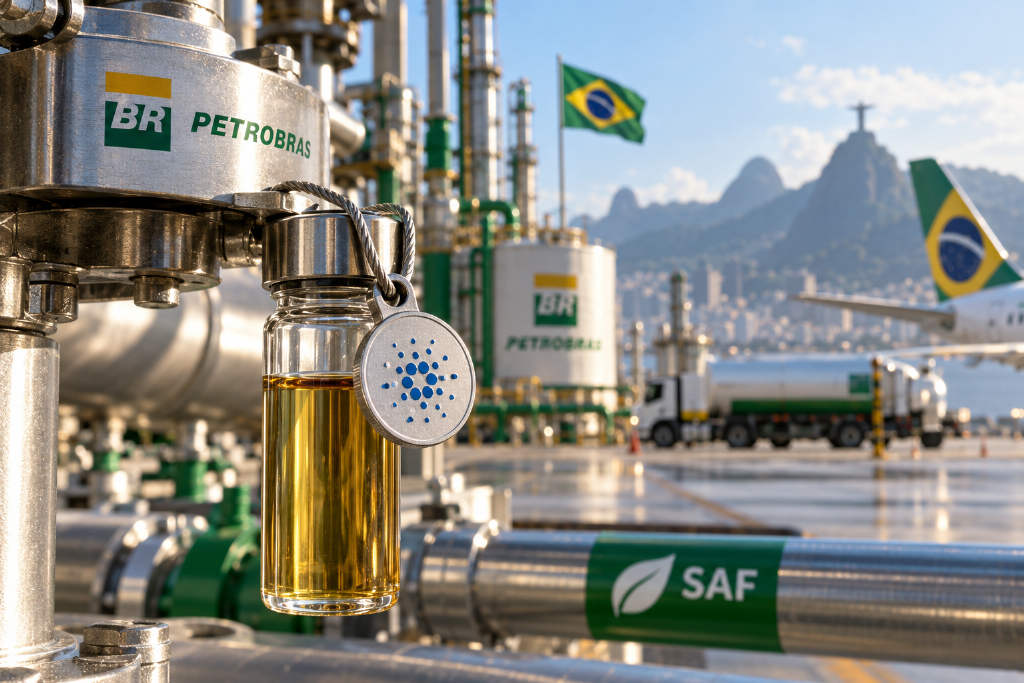
Brazilian state-controlled oil company Petrobras has developed two Cardano-based blockchain applications to track sustainability data tied to sustainable aviation fuel, or SAF, and its Diesel R renewable fuel.
According to a Wednesday announcement from the Cardano Foundation, the first application was built with PUC-Rio’s Ledger Labs and tokenizes environmental attributes associated with SAF into digital tokens meant to prevent the same claim from being used more than once.
SAF claims are separated from the physical fuel
The application uses a Book-and-Claim model. Under that structure, the environmental benefit can be separated from the physical fuel itself and assigned to an airline, company or passenger even if the SAF is consumed elsewhere.
The tokens are known as CS-SAF. The Cardano Foundation said they include metadata aligned with the Carbon Offsetting and Reduction Scheme for International Aviation, or CORSIA. Passengers can also claim CS-SAF tokens through an application and receive a certificate linked to their journey and the related environmental claim.
The source cited in the announcement was the Cardano Foundation.
Second tool tracks Diesel R across production and transport
The second application creates digital checkpoints to follow the production, transportation and use of Diesel R, Petrobras’ renewable diesel fuel. The Cardano Foundation said the resulting data could support Scope 3 reporting, which covers indirect emissions across a company’s value chain.
Research partnership began in 2023
The projects are part of an ongoing research and development collaboration. That work began in 2023 with blockchain education for Petrobras employees, then expanded in 2025 into energy-sector research with PUC-Rio’s Ledger Labs.
The Cardano Foundation did not disclose the fuel volumes covered by the applications. It also did not provide a timeline for broader deployment.
Other companies have used blockchain for SAF tracking
Blockchain has already been used in sustainable aviation fuel tracking elsewhere. Shell has used blockchain through Avelia, a Book-and-Claim platform launched in 2022 to track environmental claims and prevent double counting.
In a September update, Shell said Avelia had contributed to more than 84 million gallons of SAF entering the global fuel network since its 2022 launch. The company said that led to more than 780,000 tonnes of CO2e abatement through June 2026.
More recently, Australia’s Viva Energy signed an agreement with NoviqTech in January to study digital Book-and-Claim systems for sustainable aviation fuel, including how blockchain could support emissions reporting and track environmental claims.