
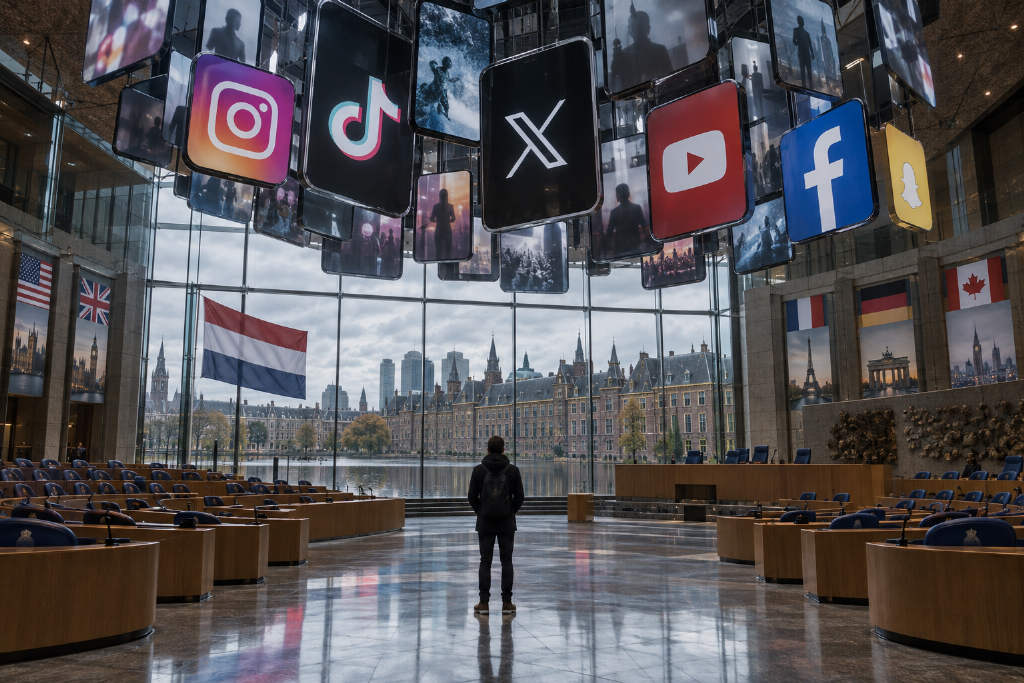
A Pew Research Center survey released on Oct. 1, 2026 found that people in a growing number of wealthier countries see social media as harmful to democracy.
In the Netherlands, 70% of respondents said social media is bad for democracy in their country, up from 54% four years earlier. The U.S. stood at 64%, unchanged from 2022. France, Germany, the U.K. and Canada also recorded clear increases in negative views.
Negative views rose in 16 of 26 countries with earlier data
Among 26 countries with comparable results from 2022 or 2023, 16 saw a significant increase in the share of respondents saying social media is bad for democracy.
Seven countries had majorities holding that view: Australia, Canada, France, Germany, the Netherlands, the U.K. and the U.S. All are among the richer countries in the survey.
France rose to 65% from 51% in 2022. Germany climbed to 61% from 41%. The U.K. moved to 56% from 48%, and Canada to 55% from 47%. Australia came in at 52% in the latest survey.
Other countries also shifted. Hungary rose from 22% to 42%, Poland from 15% to 35%, Sweden from 32% to 47%, and Spain from 35% to 47%.
Asia showed mixed results, with Japan and Indonesia turning more negative
Asia was not uniform. In Japan, the share saying social media is bad for democracy rose to 43% from 23% in 2022, while the share saying it is good fell to 48% from 57%. Indonesia rose to 43% from 24% in 2023.
South Korea looked less pessimistic. There, 38% said social media is bad for democracy and 52% said it is good. Japan and South Korea are both high-income countries, but their responses diverged.
Singapore stood out in the other direction. There, 77% said social media is good for democracy and 22% said it is bad. Israel, also a high-income country, posted the same 22% negative reading.
Across income groups, the median share saying social media is bad for democracy was 46% in high-income countries and 28% in middle-income countries. Pew’s numbers suggest a link between wealth and pessimism, though Singapore and Israel show it is not universal.
Concern over polarization and false information also ran high
Pew asked a separate question about what internet use and social media do to people more broadly, and the pattern pointed in the same direction.
On whether they make political opinions more divided, Poland rose to 79% from 50%, Germany to 82% from 65%, France to 69% from 52%, and Japan to 64% from 47%. Among 18 countries with trend data, 11 moved higher.
In the U.S., 81% said online use and social media make political views more divided, up from 79% in 2022. The figure was 83% among Republican-leaning respondents and 82% among Democratic-leaning respondents, with no significant gap between the two groups.
On whether people become more vulnerable to false information and rumors, the Netherlands reached 93%, the U.K. 91%, Sweden and Australia 90%, and the U.S. 87%, matching the median for high-income countries.
Across all 37 countries, the median view was still more positive than negative
The broader picture was less one-sided than the shift in richer countries might suggest.
Across the 37 countries surveyed, the median result was 55% saying social media is good for democracy and 35% saying it is bad. In most countries, positive views still outnumbered negative ones.
Nigeria was the most positive, with 80% saying social media is good for democracy and 11% saying it is bad. Thailand and Singapore both posted 77%, Kenya 75%, the Philippines 74%, and Ghana 72%.
Respondents often saw benefits and risks at the same time. By median, 77% said internet use and social media help people stay informed about current events, and 60% said they help people speak out meaningfully in politics. On the other side, 79% said they make people more vulnerable to false information and rumors, while 68% said they make political opinions more divided.
In 29 countries, more than one-third of respondents agreed with all four effects at once.
Age was another clear dividing line. In the U.K., 60% of people ages 18 to 34 said social media is good for democracy, compared with 31% of those 50 and older. In the U.S., the figures were 44% versus 28%. In Japan, they were 61% versus 40%.
Pew said the age gap was statistically significant in 23 countries besides the U.K., including the U.S. It also found that people who use more social media services tend to be more positive than those who use fewer. At the same time, Pew noted that older adults, people with less education and those who do not use social media at all were more likely not to give an opinion, which should be considered when reading subgroup results.
Usage stayed high even as criticism increased
The same survey included a section on platform use across countries, adding another layer to the findings.
The 37-country median showed Facebook at 69%, Instagram at 51%, TikTok at 40%, and both X and Snapchat at 18%. The survey asked only about those five services and did not include YouTube, WhatsApp, Telegram or LINE.
The age gap was large here as well. Among people ages 18 to 34, 78% used Facebook, 77% used Instagram and 64% used TikTok. Among those 50 and older, the figures were 59%, 29% and 26%.
Country differences were sharp. Japan had the highest X usage rate in the 37-country sample at 51%, while Facebook there was only 42%. Malaysia had the highest TikTok usage rate at 81%. In Germany, 39% said they used none of the five services.
Compared with 2023, TikTok grew quickly in emerging markets: Nigeria rose from 25% to 57%, Indonesia from 35% to 62%, Mexico from 41% to 62%, and Kenya from 37% to 58%. In Brazil, X usage fell from 22% to 7%.
Put together, the numbers show a tension. In richer countries, more people are saying social media hurts democracy, but most have not gone offline. In the U.S., only 14% said they use none of the five services. Even in the Netherlands, where negative views were the highest, that figure was only 28%.
The report also noted that the TikTok growth figures came from eight middle-income countries. This survey did not provide comparable earlier data for high-income countries on that point.
The findings add public-opinion context to regulation debates
The report drew a distinction between judging social media’s overall effect on democracy and policy debates over whether children should face restrictions. The survey data do not show a direct link between those two questions.
What the data do show is that in seven wealthy countries, more than half of respondents now say social media is bad for democracy. That gives regulation and legislative debates a broader layer of public-opinion context.