
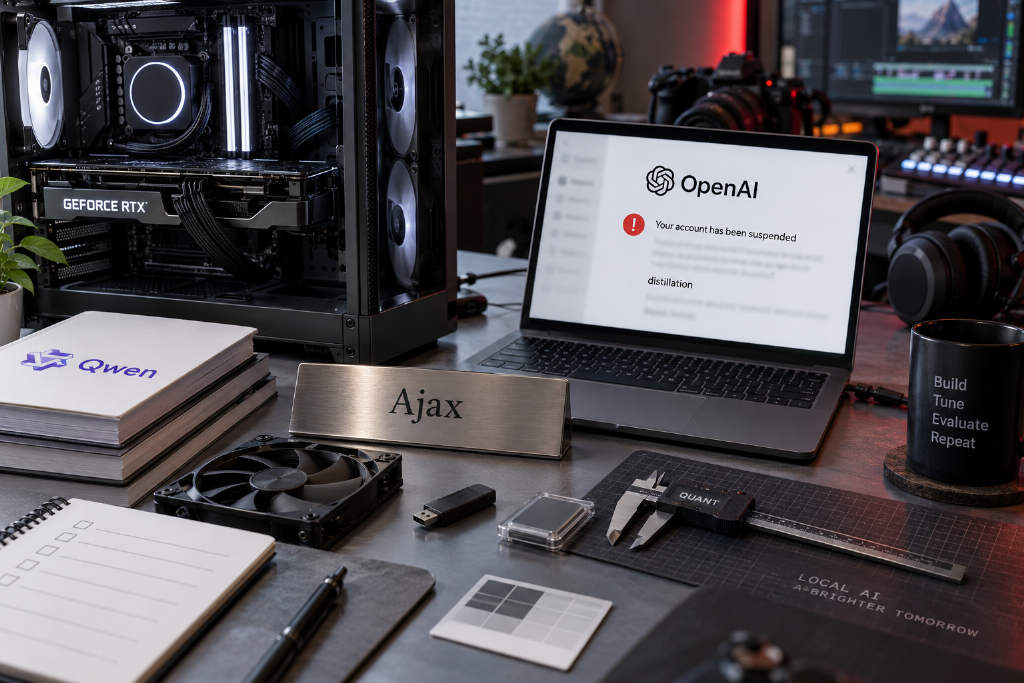
YouTuber PewDiePie has released Ajax, a self-made AI model he describes as uncensored and able to run on a home computer. In a new video, he said OpenAI banned his accounts twice while he was building it, and one of the emails he showed explicitly cited “distillation” as the reason.
According to Tom’s Hardware, the video, titled I seriously should NOT be dropping this., went live on the morning of Oct. 1, Taiwan time. PewDiePie said Ajax was fine-tuned from Alibaba’s Qwen3.5-9B, with 9B referring to roughly 9 billion parameters.
Ajax was built for Odysseus and runs on consumer hardware
Tom’s Hardware reported that Ajax was built for PewDiePie’s self-hosted AI workspace, Odysseus, where it is meant to act as a persistent, autonomous agent and assistant. Odysseus was introduced in May, and the new video presents Ajax as its first version.
Ajax’s introduction page says it can handle daily tasks ranging from search and web browsing to email and calendar work, while keeping the setup “fully private.” Tom’s Hardware said the design is similar to OpenClaw and Hermes Agent from Nous Research.
The report also noted that Ajax is an opponent of Odysseus in mythology, making the name a fitting match. PewDiePie, for his part, joked that the name came from the cleaning product.
The introduction page also says Ajax’s refusal settings have been removed in exchange for what it calls a freer AI experience with fewer limits, while asking users to use it responsibly. PewDiePie said he used open-source tools to remove those safeguards and drew his own line at not harming others or himself.
Following legal advice, he said Ajax was “not designed to provide dangerous actionable instructions.” In the video, he used nuclear weapons as an example and said the real boundaries imposed by major AI companies are still unclear.
One OpenAI email reportedly named distillation as the cause
On the account bans, PewDiePie said he wanted to “distill just a little bit” to improve the model. Distillation generally refers to using the outputs or reasoning process of one model to train another.
He said the first account was restored after the initial ban. The second ban happened after he ran a model again “to create my seed data,” referring to the initial data used for training. In the video, he asked, “How did they even know?”
PewDiePie also said, “They worked hard stealing all of our data to make their AI machines.” He argued that some forms of distillation are not very different from how those models were trained in the first place.
As of now, OpenAI has not made a public response on the matter.
The next Ajax version still needs two more days of reinforcement learning
PewDiePie said in the video that he wants fans to donate training data. He said that would be better than collecting it directly from Odysseus users, though he added that no one has submitted anything so far.
He also said the next step is two more days of reinforcement learning, followed by another pass of de-censoring, quantization, and evaluation. Quantization lowers numerical precision and reduces file size so a model can run more easily on a standard computer.
PewDiePie said he “strongly believe[s]” in training small models for a specific harness and suggested they should replace large models with “one trillion parameter[s].” Tom’s Hardware noted that one trillion parameters refers to the rumored scale of frontier models. In this context, a harness is the software layer wrapped around a model to call tools and carry out tasks.
He added that he cannot wait to release the next version of Ajax and Odysseus, and said Odysseus has also had one major update.
What Ajax is and why the bans happened
According to Tom’s Hardware, one of the two OpenAI bans shown by PewDiePie was attributed to distillation, though the email did not include a specific example. PewDiePie also said he wanted to “distill just a little bit” to improve Ajax.
Ajax is a model fine-tuned from Alibaba’s Qwen3.5-9B for Odysseus, the AI workspace he introduced in May. It is presented as a system that can handle search, email, and calendar tasks, with refusal settings removed.