
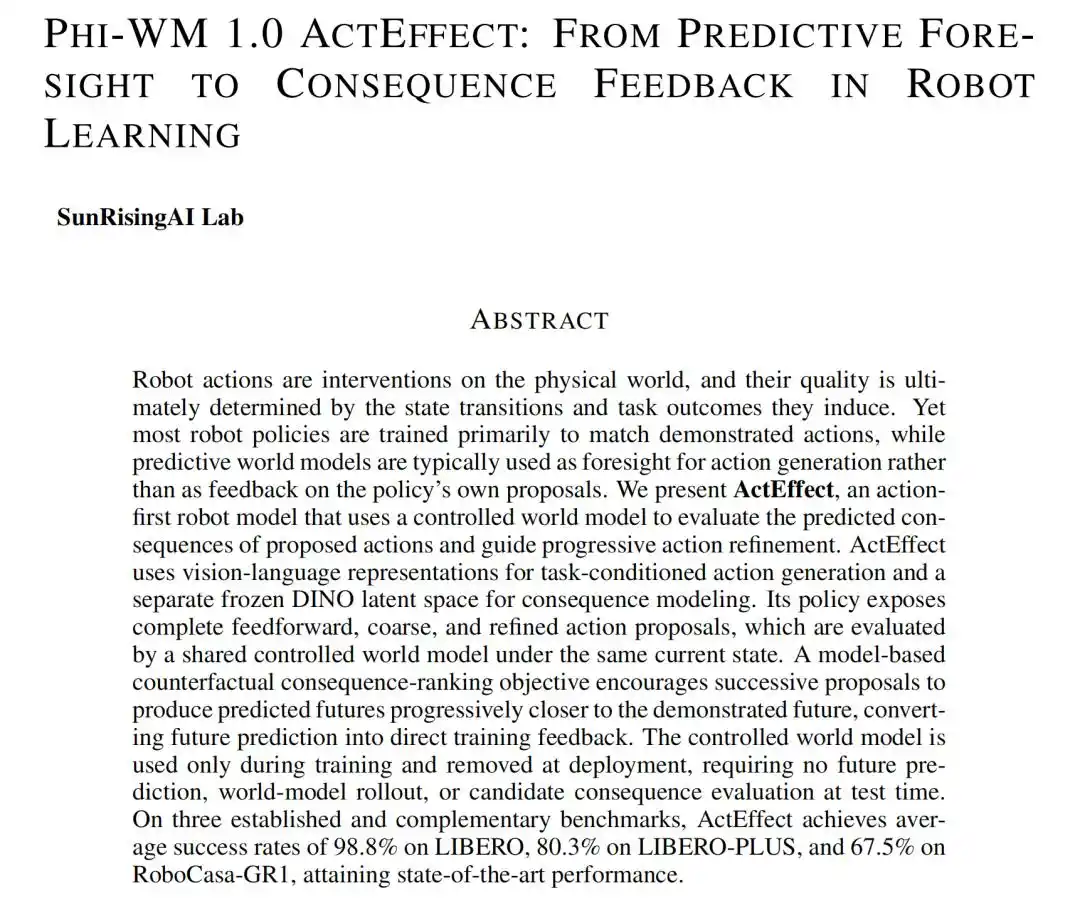
Photon Matrix and a research team led by Professor Li Shengbo at Tsinghua University have released Phi-WM 1.0 ActEffect, described in the article as a first-generation physics-native world model. Its defining feature is simple but unusual: the world model helps during training, then exits the deployment pipeline before the robot starts working in the field.
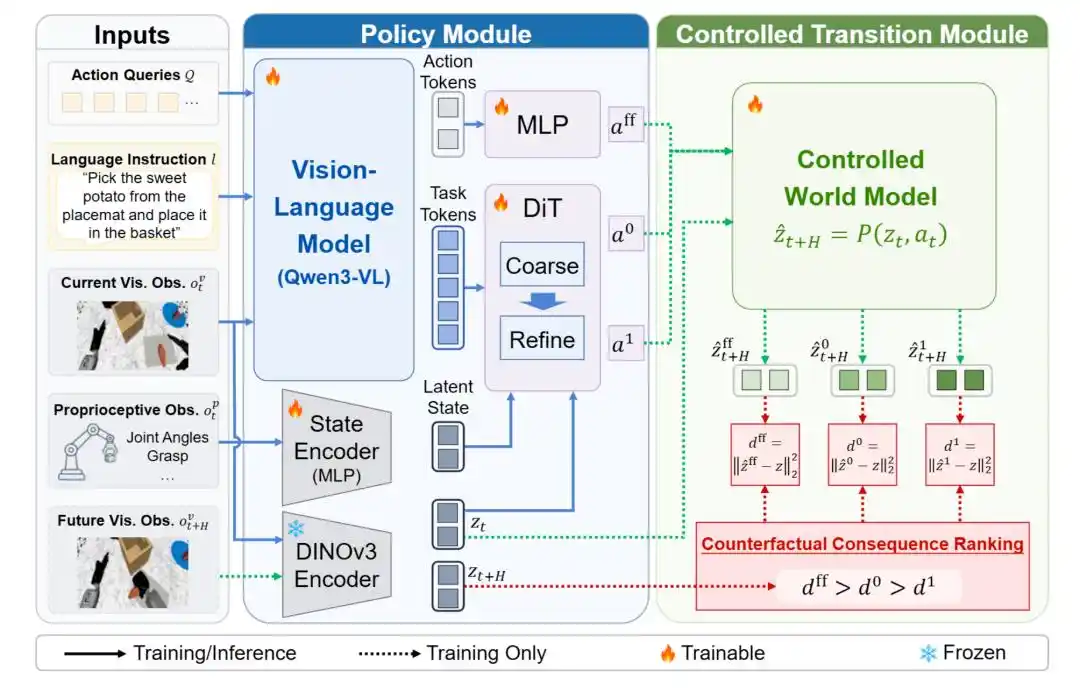
Rather than keeping a world model online to roll out future outcomes and search over candidate actions at execution time, ActEffect uses a controlled world model to inspect what the robot’s own proposed actions would cause during training. That consequence check is then turned into policy feedback. Once training is done, the controlled world model is removed, and the robot runs without that extra future-expansion step.
A different role for the world model
In many earlier setups, a world model functions like an internal simulator the robot carries with it. The robot predicts what may happen next, then decides how to move. The more planning and prediction the model performs, the longer the inference chain usually becomes.
ActEffect changes that arrangement. It stays in the training ground, where it checks the effects of candidate actions and feeds the result back into policy optimization. After that, it steps out of the deployment path. During execution, the robot does not need to keep unrolling future states or searching through action candidates with the world model still attached.
The article frames this around a long-running question in embodied intelligence: if a robot has already learned what actions look like from demonstration data, can it also learn from the consequences those actions produce and use that signal to improve its policy.
That matters in industrial deployment because every extra model layer a robot runs can add latency, compute demand and cost. The article argues that a world model has stronger deployment value if it can contribute during training while keeping the execution stack light.
Three action proposals instead of a longer online reasoning chain
The method starts from imitation learning. A large number of general robot policies today are built on top of VLA systems, where cameras describe the scene, language instructions specify the task, and the model generates actions by learning from demonstrations. In standard training, outputs that stay closer to the demonstrated action typically receive higher scores.
ActEffect begins from a different observation. In the physical world, numerical similarity between two actions does not guarantee the same outcome. If a gripper closes slightly too early, the part may not be secured. If the wrist angle is just a little off, an insertion that should be smooth can jam. Actions may look close in value space and still produce very different results on a real arm.
So instead of extending the inference chain online, ActEffect asks the policy to submit three versions of an answer during training:
- the first comes from a feedforward branch, described as the robot’s first reaction;
- the second is a coarse proposal produced by the MIP action head;
- the third refines that coarse proposal into the final action that would be executed.
The article stresses that all three proposals are complete actions. Diffusion-based and flow-matching policies pass through noisy intermediate states during training, which makes it hard to send each intermediate step into the world model as an executable action. ActEffect instead compares three full proposals from the same starting point, making the downstream consequence comparison much cleaner.
The controlled world model looks at vision and action, not task language
Once those proposals are available, the controlled world model takes the current visual state plus one action proposal and predicts how the scene will change if that action is carried out. Since there are three proposals, the model runs through three predicted futures. In effect, the robot gets to preview three possible outcomes during training.
ActEffect also separates semantic instructions from physical consequence modeling. Language remains on the VLA policy side and tells the robot what to do. The controlled world model does not read the task language. It only sees the current scene and the action.
The article gives a straightforward example: if the robot pushes a cup, the way the cup moves depends on its current position, the surrounding environment and the action applied by the arm. It does not depend on whether the instruction says “move the cup away” or “clear the table.” In other words, task semantics and physical state transition are handled in different places.

Another design choice is where future states are represented. ActEffect places them in the frozen DINOv3 visual feature space rather than trying to generate a photorealistic future image. What matters here is how object position, pose and scene structure change. That is where the “physics-native” label lands in the article: task semantics are handled by the VLA policy, while action-driven state changes are learned separately.
How consequence feedback is written into the policy
Seeing three predicted outcomes is not enough by itself. The training loop still needs a way to push those differences back into the policy.
The dataset already contains real observations after the demonstrated action is executed. The controlled world model compares each of the three predicted futures with that real future. Training then enforces an ordering: the refined proposal should be closer to the true future than the coarse proposal, and the coarse proposal should do better than the initial feedforward proposal.
That gives the policy a direct signal about whether each modification actually moved the result in the right direction.
To keep the model from gaming the objective, ActEffect adds gradient truncation to the ranking loss. As described in the article, a worse answer cannot simply become even worse to make a better answer look stronger by comparison. Training is allowed to push only the better proposal closer to the true future.
Once training ends, both the controlled world model and the future-observation branch are removed. The deployment-time policy keeps only the MIP action head for coarse proposal generation and refinement. The judgment about “consequences” is no longer carried by an external online module. It is stored in the policy weights.
Benchmark results on LIBERO, LIBERO-PLUS and RoboCasa-GR1
The article reports results across three simulation benchmarks.
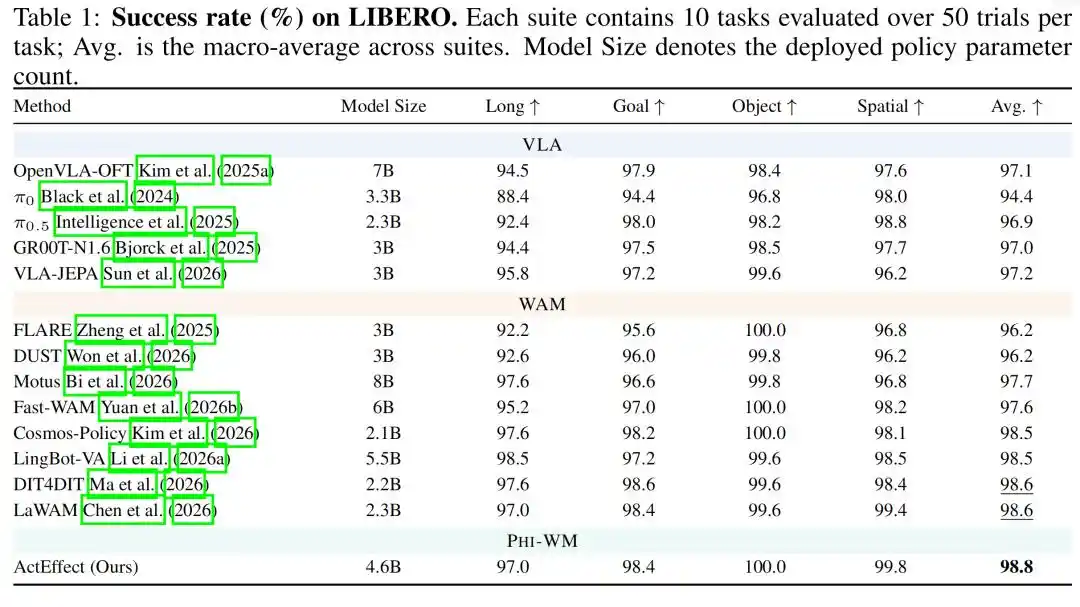
On LIBERO, which covers four groups of single-arm, multi-task tabletop manipulation, ActEffect posted an average success rate of 98.8%. That is 0.2 percentage points above DiT4DiT at 98.6%. The gap is not large, but the article says the more important takeaway is that the robot’s base manipulation capability was not lost after consequence feedback was introduced.
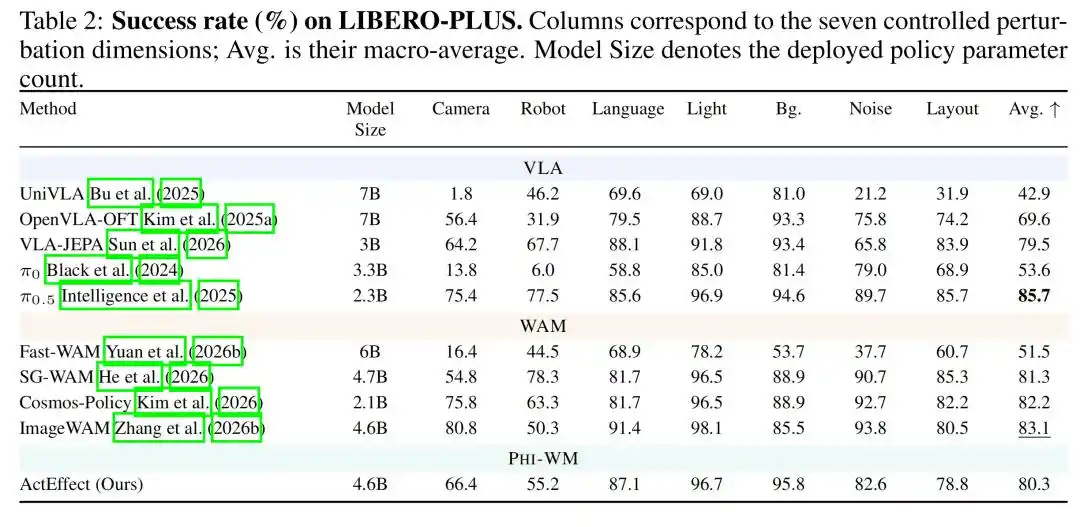
On LIBERO-PLUS, the benchmark becomes harder by adding seven kinds of distribution shift. These include changes in camera viewpoint, robot initial state and language phrasing, along with variation in lighting, background, sensor noise and object layout. ActEffect reached an average success rate of 80.3%, well above Fast-WAM’s 51.5%.
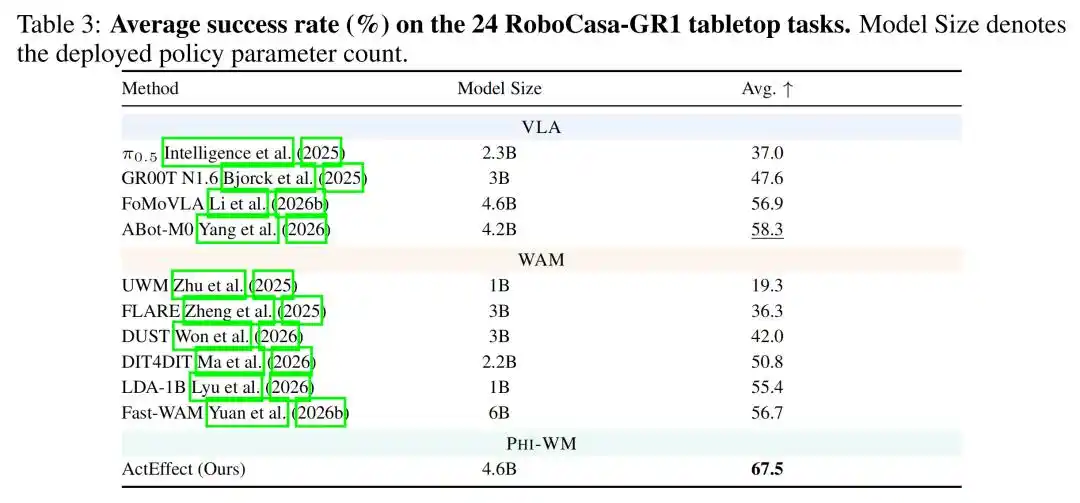
On RoboCasa-GR1, the task changes again. The model controls a GR-1 humanoid robot with dual arms, dexterous hands and waist degrees of freedom, performing 24 tabletop tasks in a 29-dimensional action space. ActEffect achieved an average success rate of 67.5%, beating the second-best method listed in the table, ABot-M0, by 9.2 percentage points and Fast-WAM by 10.8 percentage points. The article notes that as action dimensions rise and body structure becomes more complex, the value of consequence feedback becomes more visible.
Ablation results
The article also breaks the method apart through ablation studies.
- Removing consequence feedback lowered the LIBERO average success rate from 98.8% to 97.0%.
- Replacing the DINOv3 feature space with a VLM representation resulted in 97.3%.
- Removing the ranking loss brought the score down to 98.1%.
Taken together, those results are presented as evidence that the training scheme itself is effective.
Why the deployment question matters
The article then shifts from benchmark tables to factory economics. In the lab, the main metric is usually task success rate. In a production environment, though, each extra model stage becomes part of the manufacturing cost structure.
If one robot performs one more future rollout per step, the added overhead may still look manageable. But once the same system is replicated across dozens of workstations and hundreds of machines, extra GPUs, power consumption and maintenance become material costs.
Keeping the controlled world model only in the training phase avoids that online burden. The idea is to extract another layer of supervision from existing demonstration data, let the robot absorb the experience of action consequences ahead of time, and then deploy without dragging the whole world-model stack into execution.
The article puts it plainly: ActEffect leaves the “thinking longer” part in training and reserves the shorter chain for execution.
Industrial scenarios, real-world validation and company background
That technical route is tied to the scenarios Photon Matrix is targeting. The article points to tasks in automotive manufacturing such as loading and unloading scattered parts and inspection of complex curved surfaces. Traditional automation is often built around fixed stations, where one set of fixtures and one trajectory serve one part. If part positions change or the workspace becomes tight, a process that used to be stable can break down. Embodied intelligence is supposed to add adaptability at exactly that point.
Photon Matrix said it has already completed real-world validation around welding loading and unloading and mobile inspection, both described as high-value workstations, and has launched commercial cooperation with multiple leading automotive companies in China and overseas.
At the 2026 ATC exhibition, the team placed Phi-Bot X1 in a NIO welding loading and unloading scenario. The robot ran continuously for three days, completed 21.5 hours of cumulative operation, and recorded zero errors and zero interruptions.
The article adds an important qualifier. ActEffect has now been verified as a training method across three simulation benchmarks. The next step is hardware-side validation along the industrial embodied system already connected to Phi-Bot X1. The 21.5-hour record came from that full industrial embodied setup. The new model still has to be tested on the same real chain.
Photon Matrix was founded in April 2025 and incubated jointly by Tsinghua University’s School of Vehicle and Mobility and School of Artificial Intelligence. Founder and CEO Zhang Tao holds a PhD from Tsinghua University and was a postdoctoral researcher at Politecnico di Milano. He previously served as technical director at Alibaba’s Amap and head of its spatial perception engine, with related technologies entering mass-production automotive systems. Co-founder Li Shengbo has worked for years on autonomous driving and embodied intelligence, and multiple technologies from that work have entered industrial applications.
The article says the company is developing reinforcement learning and world models while also building robot hardware, a data and algorithm stack, and a development platform. Once a system enters a factory, the model is only one part of the whole stack. Hardware has to withstand continuous operation, deployment has to stay manageable, and maintenance has to be fast when problems occur. If any one piece is missing, benchmark results alone are hard to carry all the way to a production line.
What still needs to be proven
The closing argument in the article is that embodied intelligence will ultimately be judged by delivery and replication. In the past two years, the field has produced no shortage of impressive demos. Robots can run, jump, fold clothes and follow long instructions. But once they move from a short video clip to a customer site, those few seconds expand into a day, a month or even a full year of continuous operation.
Factories are not going to sign off on a system because of one benchmark score. After delivery, the robot still has to pass checks on cycle time, precision, safety and failure rate. Then the same capability has to move from one workstation to similar ones, and from one plant to more plants.
As replication expands, another set of questions appears. How much has to be customized for each new customer? How long does deployment take? Can the cost of robots and compute be covered by the labor savings and avoided line stoppages? The article links that commercial logic directly to ActEffect’s design choice.
If consequence feedback makes the policy more stable on real hardware while removing the need for a deployment-time world model, then compute costs will not scale up in lockstep with a longer inference chain as robots spread to more stations. For an industrial system meant for large-scale deployment, the article argues, that matters more than finishing one more action in a one-off demo.
Still, the final part of that case has not been filled in yet. The article says Photon Matrix has completed part of the real-scene validation work and reached commercial cooperation with leading carmakers. It has chosen stations with clear demand, and the team combines academic research with automotive industry experience. That gives it a path toward delivery. But validation, acceptance and replication still have to be cleared one step at a time.
ActEffect has already shown in simulation that a world model does not necessarily need to stay attached to the robot forever. It can repeatedly inspect action consequences during training and leave that experience behind in the policy. According to the article, that offers another way to position world models inside embodied intelligence, while putting two very practical industrial questions at the center: stability and cost.
Source: MarsBit. The original article states that the piece came from the WeChat public account QbitAI, written by Jin Lei.