PHP issued an emergency security update on Oct. 21 to fix two vulnerabilities, both carrying severity scores of 9.2 out of 10. Across websites where the server-side language can be identified, roughly 70% run on PHP. The two flaws meant attackers could execute code on internet-exposed servers without needing an account or password. Details of the bugs leaked a day earlier than planned, and security researchers had already logged attack attempts before the official disclosure.
For the crypto sector, the warning quickly turned into a live test. A blockchain security firm found 793 crypto-related domains with PHP fingerprints out of 1,488 it examined. Five days later, no losses at exchanges or wallets had been confirmed as linked to the two vulnerabilities. The article's conclusion is blunt: that result had less to do with luck than with the fact that major platforms had already separated their websites from their money-moving systems.
The risk sat outside the chain, at the layer users actually touch
The vulnerabilities mattered to crypto not because they affected any blockchain, but because many services people use every day still run on ordinary web servers. A protocol's smart contracts may have gone through several rounds of audits, yet the pages users open to call those contracts, the APIs behind mobile apps, airdrop claim portals and merchant payment plugins often sit on traditional web stacks.
If those servers are compromised, an attacker may not need to break the contract at all. Replacing a contract address or an approval target on a page could be enough to get users to sign transactions they never intended to authorize.
The domain scan, though, needs careful reading. It shows how widely PHP is used across the industry, not how many sites were actually vulnerable. Some of those fingerprints came from official websites and blogs with no direct connection to funds. For any platform, the real question is whether an intrusion at the web layer can keep moving inward.
A breached server does not automatically mean drained wallets
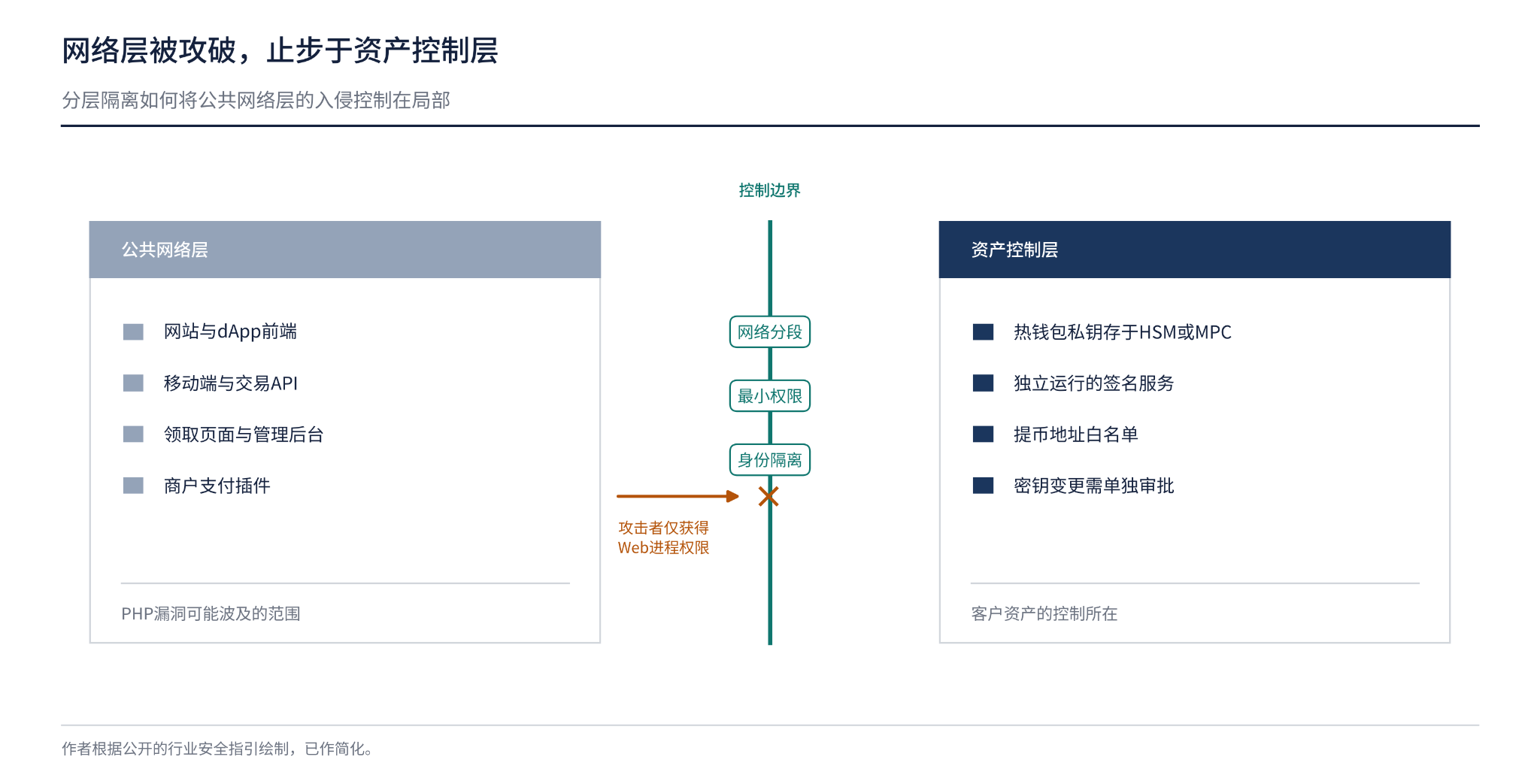
How far a web-layer intrusion can go depends on system architecture. That has been one of the main areas of security spending in crypto in recent years. The article says this class of flaw gives an attacker the privileges of the web process, and no more. Whether that turns into an asset problem depends on what that process can reach.
On platforms built for institutional custody, the answer is often very little. Hot-wallet private keys are stored in hardware security modules or multi-party computation setups, not on web servers. Signing services run inside separate network segments. Sensitive actions such as changing withdrawal whitelists or creating new API keys require their own approval flows.
The piece compares that design to traditional finance. A bank's public website does not share a network with its payment gateway, and a defaced homepage is not treated as a direct path to moving funds. Large crypto platforms have been building toward the same kind of separation, and the PHP incident became the first broad, internet-scale test of that model.
Platforms and infrastructure providers moved before and after the official patch
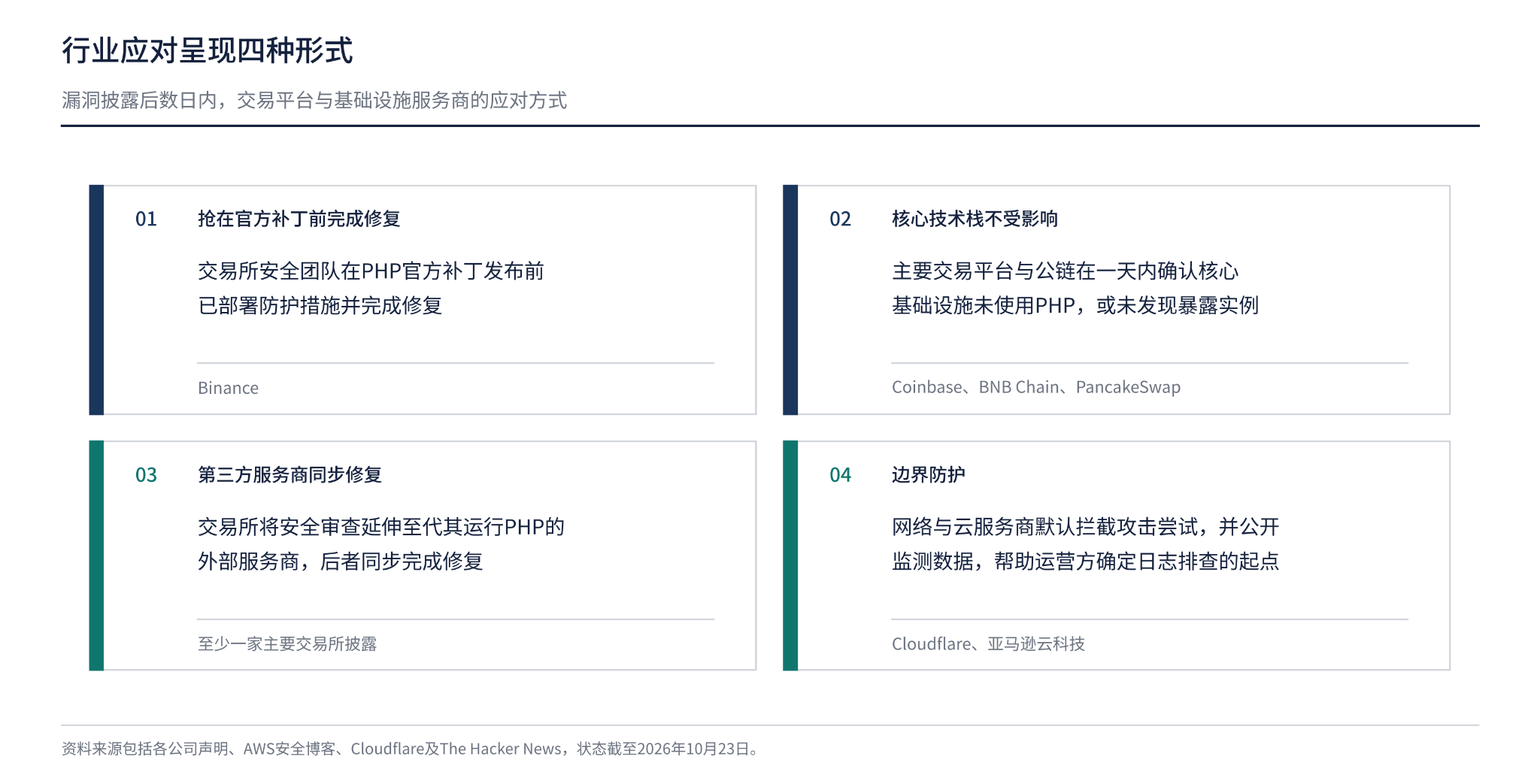
The article argues that the response from major platforms said more about operational maturity than any single statement could. Binance said its security team had deployed protections and completed remediation before the official patch was released. Coinbase said it found no exposed PHP instances, and a large institutional custodian also said its platform was not affected.
Several public blockchains, wallets and decentralized exchanges said within a day that their stacks did not use PHP at all. At least one exchange said an outside service provider running PHP on its behalf had already completed remediation, showing that security review had extended into the supply chain.
Infrastructure providers also reacted quickly. Cloudflare said its web application firewall had been blocking attack attempts by default since the early hours of Oct. 21, using a new detection method that analyzes both requests and server responses. Amazon published monitoring data that traced the first attack attempt back to Oct. 17, giving operators a clear point from which to review logs.
Disclosure is becoming part of the defense
The article points to a more durable shift: the industry is starting to expect projects to say quickly and clearly whether they are affected. Several well-known figures in the sector publicly urged teams to issue short statements on whether their infrastructure used PHP. Within a day, exchanges, public chains and wallets had begun doing exactly that.
In traditional markets, listed companies and banks already report major cybersecurity incidents under formal rules. Crypto still relies on voluntary disclosure and lacks a standard framework, but the practice is moving in the same direction. During an event like this, clear disclosure works as a risk-control tool in its own right because it narrows the window in which fake "security update" pages and phishing links can exploit user uncertainty.
The incident also left a warning for smaller projects. PHP 8.1 and earlier versions no longer receive regular upstream security fixes. A full inventory of legacy systems, partner-hosted pages and plugins now belongs in the same security conversation as smart-contract audits.
A test of where crypto's security boundary now sits
The article closes by arguing that the PHP alert was less a story about a software flaw than evidence of where the industry's security boundary now lies. The most exposed part of crypto is no longer only the contract code that drew so much attention in earlier cycles. It is also the ordinary web infrastructure wrapped around that code.
The platforms that came through the week without confirmed damage did so because they had already drawn a clear line between websites and asset-control systems. As institutional participation rises, that separation, along with the habit of timely disclosure when systems are tested, may shift from a competitive advantage to a basic industry requirement.