
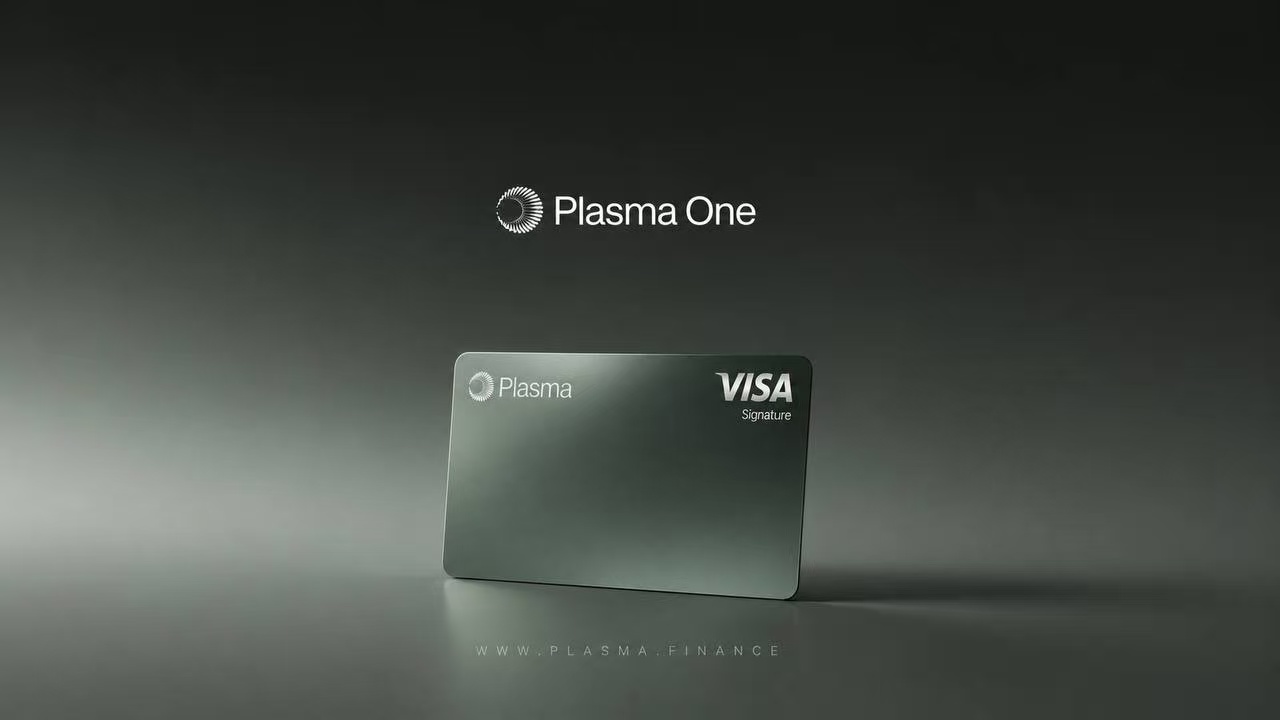
Plasma One is being framed less as a simple stablecoin payment tool and more as a stablecoin neobank-style account. On Plasma’s website, the product is presented as an account for moving money globally, built around three functions: Spend, Earn, and Send. Users can spend with the Plasma One Card and receive XPL cashback on eligible purchases, route balances into Earn, and send USDT with zero fees through Plasma routing.
The point is not just the launch of another stablecoin card. Stablecoin growth has largely come from trading, on-chain settlement, DeFi collateral, and cross-border transfers, while user experience has remained split across wallets, exchanges, bridges, chains, and gas fees. Plasma One tries to repackage stablecoins as an everyday financial account: one that can hold dollar stablecoins, support spending and transfers, allow withdrawals to a local bank or wallet, and attach higher benefits through a membership system.
WuBlockchain said Plasma One is one of the fastest-growing stablecoin neobanks and reached $1 million in cumulative transaction volume and $1 million in weekly transaction volume in a short period. The article treats that as a sign that early users are not only registering or waiting for an airdrop, but are generating activity through actual spending, transfers, and account usage.
Stablecoins still need an account layer
Stablecoins have already shown their value as on-chain dollars. They can move around the clock, cross regional boundaries, and function as settlement assets for exchanges, DeFi, market makers, and cross-border users. For some users in emerging markets, dollar stablecoins have also taken on savings and remittance functions.
A broader consumer market asks for something different. Users care about whether transfers are cheap, whether cards work at merchants, whether withdrawals are easy, whether they can keep dollar balances, whether fees are transparent, and whether the account experience feels close to a traditional finance app.
On-chain wallets solve asset control. Exchanges solve trading and liquidity. Bank cards solve merchant acceptance. DeFi solves yield. Plasma One combines those pieces into a single account model so users do not have to jump between separate apps to top up, transfer, convert, spend, and manage yield.
How Plasma One structures the account
The product can be broken into three layers.
Spending account
The first layer is the spending account. According to the website, the Plasma One Card is issued by Rain as a Visa Principal Member under Visa licensing. Plasma says the card can be used at online and offline Visa merchants in more than 200 countries. On iOS, Apple Pay is supported where local rules allow it. Android and Google Pay support are still being developed.
The site also says users can freeze their card or lock their account inside the app, and can cash out to a local bank through off-ramp rails that vary by region.
Stablecoin transfers
The second layer is stablecoin transfers. Plasma One says users can send and receive stablecoins across borders, while Plasma routing enables zero-fee USDT transfers. The goal is to make stablecoin transfers feel closer to ordinary account-to-account money movement.
Yield and rewards
The third layer is yield and rewards. Plasma’s website shows up to 4% cashback on eligible spending and up to 6% yield on balances. Cashback is paid in XPL, and the actual rate depends on membership tier.
Earn is not described as a traditional bank deposit or savings account. Based on the currently available information, the Plasma One Earn vault connects to Aave’s USDT0 market, and returns change with supply and demand, interest rates, and on-chain conditions in Aave.
Together, those three layers create Plasma One’s account logic. Users enter the account, hold a dollar balance, spend through the card or transfer funds, connect balances to yield, earn XPL from spending, and then use that token inside a tiered membership structure.
Plasma also states that it is not a bank. Account services for Plasma One are supported by Bridge, the card is issued by Rain, and stablecoin balances are not bank deposits protected by deposit insurance. That places Plasma One closer to a stablecoin fintech account than to a direct on-chain copy of a conventional bank account.
Lite, Core, and Platinum
Plasma One currently displays three membership tiers: Lite, Core, and Platinum.
Lite as the base entry point
Lite is the basic tier. It includes 2% base cashback, $0 card cost, a 0.25% referral reward, standard fees, standard support, and one free virtual card. Its role is straightforward: lower the friction for first-time users to open an account, get a card, and start spending.
Core for frequent AI-related spending
Core is aimed at users with higher-frequency everyday AI spending. Plasma describes it as “the card for everyday AI users.” The tier offers 5% AI cashback, 3% cashback on other spending, a 1% referral reward, a ChatGPT Go subscription, priority support, lower fees, and up to two free virtual cards.
The 5% AI cashback applies to up to $500 in purchases per month. Core can be obtained either through a $199 annual subscription or by locking 20,000 XPL for 12 months.
Platinum for higher-tier XPL holders
Platinum is positioned as a higher-end benefits layer for XPL holders and is described on the website as “exclusively for XPL holders.” To qualify, users must lock 100,000 XPL for 12 months.
The tier includes 4% base cashback, 10% AI cashback, 10% cashback on flights, up to $600 in eligible annual flight cashback, Claude Pro and ChatGPT Plus, a 1% referral reward, VIP support, no additional fees, and up to three free virtual cards.
The Platinum page also lists travel-related benefits including lounge access, Visa concierge, auto rental insurance, travel insurance, baggage delay protection, lost luggage protection, and global eSIM.
This tiering system does more than use cashback as a customer acquisition tool. Lite is designed for low-friction growth. Core targets frequent digital subscriptions and AI spending. Platinum targets higher balances, higher spending, and deeper XPL holders. In that structure, XPL becomes the asset that moves a user from a standard account into a higher-value relationship.
XPL sits at the center of the model
One of Plasma One’s key design choices is to embed XPL into rewards, membership, and account benefits.
Rewards are paid in XPL. Cashback first accrues in dollar terms and is converted into XPL at distribution using a market price supplied through the CoinGecko API. Users can convert XPL rewards into dollars for card use or choose to withdraw them. The app also allows users to buy and manage XPL, and locking XPL can unlock Platinum status.
That creates a fairly direct growth loop. Users spend through Plasma One and earn XPL on eligible transactions. They manage XPL in the app. Users who want higher cashback, AI benefits, travel benefits, and service perks can lock XPL. Locking raises retention and switching costs. Better benefits can then drive more spending and larger balances.
XPL cashback still comes with the characteristics of a digital asset. XPL is not fiat, is not backed by a government, and its price can fluctuate. Rewards are limited by eligible transaction categories and monthly caps. ATM withdrawals, peer-to-peer transfers, foreign exchange, taxes, gift cards, gambling, quasi-cash transactions, crypto purchases and sales, wire transfers, and cash advances do not earn rewards. Plasma One’s reward rules also vary by membership tier and eligible spending category.
According to the latest project information cited in the article, Core and Platinum no longer use a fixed monthly cap. Instead, the effective reward rate gradually declines after spending passes certain thresholds. Referral rewards are calculated separately under project rules.
XPL also has a second role at the network layer. It is the native token of the Plasma blockchain, used to facilitate transactions and reward participants who validate transactions and support the network. Plasma plans to start inflationary rewards after external validators and staking delegation go live, with an initial annual inflation rate of 5% that declines by 0.5% each year until it reaches a long-term baseline of 3%.
The protocol also uses a base-fee burn mechanism similar to EIP-1559 to help offset long-term inflation. Team- and investor-locked XPL is not eligible for unlocked rewards.
Seen this way, XPL links three separate tracks: network security and transaction activity on Plasma, cashback and membership levels in Plasma One, and broader ecosystem growth and liquidity incentives. If Plasma One continues to attract real consumer activity and account usage, demand for XPL would no longer come only from on-chain transactions but also from account-related benefits.
Plasma as a Layer 1 built for stablecoin payments
Plasma describes itself as a Layer 1 built for stablecoin payments. The published feature set includes a 1-second block time, 3-second deterministic finality, zero network transfer fees, and high throughput aimed at stablecoin payment activity. Its partner page lists Bridge, MoonPay, Shift4, Rain, Ramp, and Whop among its payments and financial infrastructure partners.
In its technical documentation, Plasma is defined as a payments-focused Layer 1 aimed at high-frequency money flows, payment applications, and a stablecoin-first user experience. PlasmaBFT, its consensus protocol, is based on Fast HotStuff and is meant to provide fast finality and high-throughput payments. The execution layer is EVM-compatible, allowing developers to use Solidity, Foundry, Hardhat, wallets, SDKs, and existing EVM tooling to deploy applications.
Plasma is also working on protocol-level infrastructure for stablecoin gas payments, privacy-preserving transfers, and other payment workflows.
Plasma One is presented as the network’s flagship product. Plasma says it is the first flagship product built on Plasma and is designed to provide individuals and businesses with a global dollar account, letting them deposit stablecoins, access dollars, send instantly, earn on eligible balances, and spend with the Plasma card. The network handles low-cost transfers, fast settlement, deep liquidity, EVM compatibility, and payment-specific capabilities. The account layer turns those functions into spending, transfer, and yield experiences users can actually see and use.
Why AI subscriptions and travel benefits matter
Both Core and Platinum make AI-related spending a central part of the offer. Core emphasizes 5% AI cashback and ChatGPT Go. Platinum raises that to 10% AI cashback and adds Claude Pro and ChatGPT Plus.
The design appears tailored to a specific early user base: globally active users who subscribe frequently to AI tools, SaaS services, cloud services, and digital products. AI subscriptions fit the stablecoin account model in several ways. They recur monthly, are priced in dollars, often involve cross-border billing, and tend to come from digitally native users.
Many users run into card region restrictions, payment failures, foreign exchange costs, or billing management issues when paying for AI services. By making AI spending a high-cashback category, Plasma One is choosing a frequent, global, and dollar-denominated spending entry point.
Platinum’s travel benefits line up with another higher-value spending category. Flights, hotels, car rentals, insurance, eSIM services, airport lounges, and concierge support are all areas where cross-border financial accounts can try to win usage. For high-spending users, cashback may be the hook, but retention depends on whether the account can cover a continuous set of use cases across travel, subscriptions, business, and daily spending.
A product strategy built around account ownership
The core value of Plasma One is not simply that it offers a stablecoin card. It combines stablecoins, a spending account, Visa payments, DeFi yield, XPL cashback, and membership benefits inside one product structure. What the user sees is a dollar account, card spending, AI subscription rewards, travel benefits, yield on balances, and zero-fee transfers. Underneath sit the Plasma network, Bridge, Rain, payments partners, and the XPL token model.
In WuBlockchain’s framing, the stablecoin sector is moving into a phase where account ownership matters. Plasma One is trying to move stablecoins beyond exchange balances and on-chain addresses into spending, subscriptions, travel, transfers, and balance management. XPL sits in the middle of that system, connecting cashback, membership locks, network security, and ecosystem growth.
If Plasma One can keep expanding real transaction volume and persuade users to hold, manage, and lock XPL over time, Plasma may end up with more than a consumer-facing app. It would have an entry point into a global payments network built from the stablecoin account layer.