
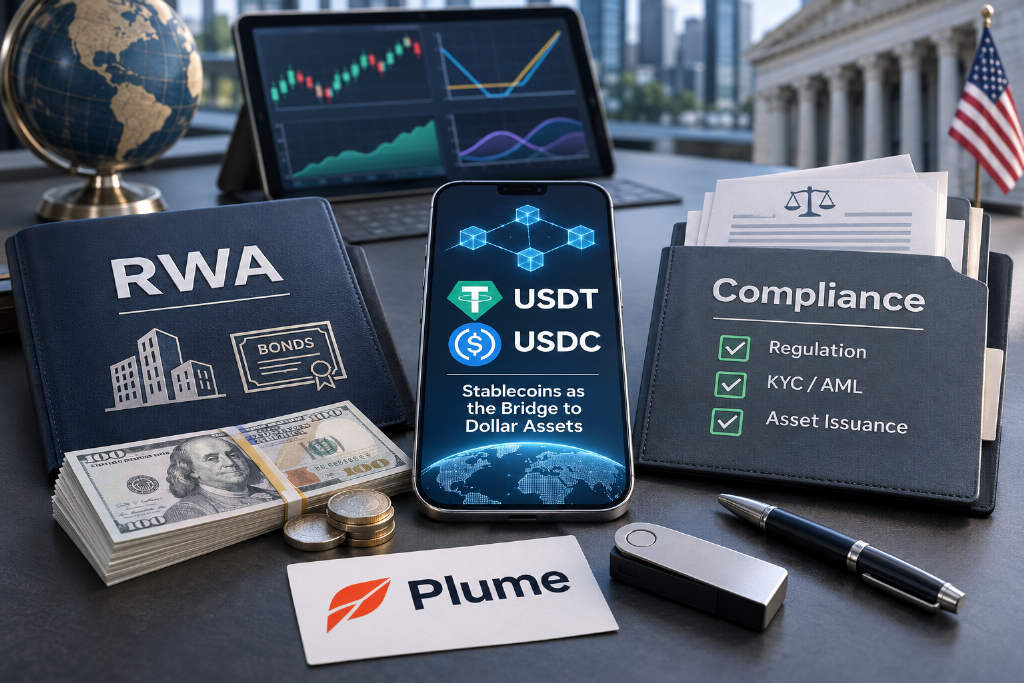
Stablecoins have shown how RWA distribution can work
Plume co-founder and CEO Chris Yin said stablecoins have provided one of the clearest examples of a successful real-world asset application. Speaking on the WuBlockchain podcast, Yin said their core value is making dollar assets easier for users around the world to access, hold and transfer.
The discussion covered the development of the real-world asset, or RWA, market, sources of on-chain yield, liquidity risk, regulatory constraints and the competitive environment that may emerge as traditional financial institutions enter the sector.
Yin said the next stage of RWA development is not simply putting more traditional assets on blockchains. The sector must distribute those assets to users and create liquidity that can continue to function over time.
Plume is building an Open Finance ecosystem intended to bring real-world assets on-chain and distribute them to users globally. Yin said Plume’s Vault products currently hold more than $250 million in assets. The company also works with Bybit, Binance Wallet and ether.fi.
Before founding Plume, Yin worked mainly in venture capital. His co-founder Teddy had worked on RWA initiatives at BNB Chain. The founders found that many projects faced the same problem: asset tokenization was not especially difficult, while liquidity, use cases and user acquisition were much harder to establish.
Plume’s team combines traditional finance and crypto experience, with members from JPMorgan, Citigroup, Coinbase and BNB Chain. Yin said that background helps the company connect asset issuers with on-chain users.
Putting an asset on-chain does not guarantee access
For U.S. users, buying stocks or U.S. government bonds may be relatively straightforward. Users in many other regions do not have the same access. Global investors may follow South Korea’s SK Hynix, for example, without being able to buy the company’s shares directly from their own markets. U.S. Treasuries can present a similar issue for ordinary investors outside the United States.
Yin said stablecoins succeeded because they made dollars easier to hold and move across borders. RWA products face a comparable access problem. Before composability, collateralized lending or DeFi applications can matter, someone must actually hold the underlying asset.
Tokenization by itself does not create value if there are no users. Yin described distribution as the largest bottleneck for RWA, rather than the technical act of creating a token.
Traditional financial products cannot simply be copied onto a blockchain and expected to attract crypto users. Issuers need to understand what different groups want and redesign products around those requirements. U.S. Treasuries may offer annual yields of 3% to 4%, which can look less attractive to users accustomed to higher on-chain returns. Complex verification, extensive paperwork and a six-month lockup can make the product even less compatible with their habits.
Crypto users also have different priorities. Meme coin traders, yield farmers, market makers and institutional funds do not seek the same balance of yield, risk and liquidity. There is almost no asset that can offer a 20% annual return while remaining fully liquid, permissionless and low risk. Product structures may need asset tranching, liquidity pools and DeFi tools.
Plume’s Opal product illustrates that approach. Its underlying exposure involves Brazilian credit card receivables, with relatively high yield and short duration characteristics aimed at the needs of some on-chain users.
Yin said Plume’s job is not simply to help issuers put assets on a blockchain. The company wants to redesign traditional assets for on-chain users, then distribute them through exchanges, wallets and DeFi protocols. Issuers also want a stable, long-term holder base rather than a large inflow of capital that leaves just as quickly.
Where 12% to 15% RWA yields come from
Some RWA products offer annual yields of 12% to 15%. Yin said the source of that return depends on the product. Credit card receivables generate income from consumer credit. Private credit generates interest paid by borrowers. Reinsurance products may generate income from premiums. Products developed with firms such as Figure involve home equity lines of credit, or HELOCs, with returns tied to the underlying loans.
Different sources of yield create different risk structures. Crypto users are familiar with smart-contract and protocol risk, but RWA products can also carry underlying credit risk, issuer risk, custody risk and maturity risk.
Some users once viewed Treasury products that paid only a few percentage points as unattractive. They later moved toward higher-yield private credit without paying enough attention to lockups or redemption limits. Yin said some private credit products may offer yields of 9% to 10% while requiring a minimum 90-day holding period or limiting the amount that can be redeemed at one time.
Investors should not compare APYs alone. They need to understand where the yield comes from, when the underlying assets mature and under what conditions losses could occur. Plume also has to help exchanges, asset managers and users understand those risks.
Tokenization does not change an asset’s liquidity profile
Whether an RWA product can be redeemed during a market decline depends on the underlying asset. U.S. Treasuries can generally be sold more easily, while private credit is usually difficult to exit quickly. Tokenization does not automatically change an asset’s existing liquidity characteristics.
The industry is working on RWA secondary markets. Liquidity pools could support trading, while professional institutions could purchase assets at a discount from holders who need to exit early. Yin said the market has overestimated the maturity of RWA secondary liquidity. Even tokenized U.S. Treasuries do not yet have a sufficiently deep secondary market.
Not every financial product needs to offer instant redemption. A workable exit mechanism matters more: users who need liquidity should be able to find a counterparty, while investors willing to hold until maturity can continue receiving the asset’s returns.
Yin expects secondary liquidity to develop first around standardized assets such as U.S. Treasuries. It could later expand to more complex products, including collateralized loan obligations, or CLOs, and private credit. For now, investors should not assume that an on-chain asset can always be sold at face value simply because it has been tokenized.
Compliance remains central to global RWA distribution
Putting an asset on a blockchain does not remove restrictions on investor eligibility, geography or transfers. Each asset can have its own requirements for who may hold it and how it can be traded or transferred. Plume has treated compliance infrastructure as a core part of its business from the start.
Yin said the company’s team includes professionals from the U.S. Securities and Exchange Commission, the Commodity Futures Trading Commission, the Financial Industry Regulatory Authority and related legal institutions. Plume is also building around frameworks that include transfer-agent registration, Bermuda licensing and the Abu Dhabi Global Market, or ADGM.
The objective is not to bypass regulation. Plume wants to build KYC, AML and investor-protection requirements into its product architecture so that more assets can enter on-chain markets within applicable rules.
Stablecoins show that global distribution channels can be built gradually even when regulatory restrictions remain. Yin said RWA needs to follow a similar path instead of relying on short-term regulatory arbitrage.
Traditional finance may bring cooperation as well as competition
Banks, asset managers and large crypto exchanges are expected to build out their RWA businesses. Yin said the market is still at an early stage, making cooperation more important than a purely competitive approach.
Bringing traditional assets on-chain requires legal structures, regulatory permissions, custody, product design, operations and liquidity. Those foundations are not easy for a new entrant to reproduce quickly. Traditional financial institutions have assets and customers, but they may not understand on-chain users. Some institutions are only tokenizing existing financial products and have not yet worked out how those products should function inside DeFi.
Plume’s stated advantage is its understanding of both traditional finance and crypto, together with a long-term focus on distribution. The company can work with asset issuers and reach users through exchanges, wallets and DeFi protocols.
On-chain assets still represent a small amount compared with the global financial market. Yin said the main opportunity is not taking market share from other RWA projects, but bringing more traditional assets and capital on-chain. If another platform expands the overall market, that would also benefit Plume.
RWA may move from tokenization to native on-chain finance
Over the next two to three years, Yin expects more traditional assets to enter the blockchain economy, including stocks, fixed-income products and other financial assets. Stablecoins have already reached a market size of about $300 billion, showing traditional institutions that on-chain finance cannot be ignored.
The next phase may involve native on-chain issuance rather than tokenizing an asset that was first issued off-chain. Assets could eventually be issued and managed directly on-chain.
Secondary markets and broader financial applications will need a sufficiently large base of underlying assets and holders. Potential applications include collateralized lending, derivatives, asset tranching, yield splitting and maturity transformation. Many projects already discuss these functions, but they are difficult to sustain without enough real assets and users.
Portfolios could combine crypto and traditional securities
Yin said RWA could produce new portfolio and index products. Many investors currently gain exposure to U.S. equities through the S&P 500. Younger investors might want a single portfolio containing Bitcoin, AI-related assets, GPU computing capacity, mining assets and shares of technology companies such as Nvidia and Google.
If those assets can all trade and combine on-chain, new indexes could place crypto, traditional stocks and other real-world assets in one portfolio. This would be more than tokenizing a traditional exchange-traded fund. It would use on-chain composability to create products that are difficult to build within conventional finance.
Derivatives and yield splitting could add more native on-chain financial instruments. Yin said this is where the long-term value of RWA may lie. Users may eventually stop treating on-chain and off-chain assets as separate categories. They could simply hold, trade and combine them as financial assets.
Plume’s broader goal is to build one financial market connecting users, assets and liquidity across regions.
Plume is pursuing a U.S. broker-dealer license
One of Plume’s main compliance goals is to obtain a U.S. broker-dealer license. Over the past several years, the company has built compliance infrastructure that includes transfer-agent registration and a Bermuda licensing structure.
A broker-dealer license would allow Plume to work with more traditional financial institutions and bring additional assets on-chain within regulatory requirements. The company already works with Apollo and WisdomTree, and has recently begun working with Fidelity. Yin said a broader licensing structure would help Plume deepen those relationships and attract more issuers.
For the RWA sector, the challenge is not only the technology needed to tokenize assets. Access to high-quality underlying assets is also critical. Plume plans to keep building compliance infrastructure while connecting traditional issuers with crypto-native users and linking asset supply with market demand.
Guest views do not represent those of WuBlockchain and are not investment advice. Readers should comply with the laws and regulations applicable in their jurisdiction.



