

Crypto is entering a phase where shutdowns matter as much as launches, according to a commentary published by Foresight and written by imToken. Its main message is blunt: in Web3, users should not assume any project will last forever, and they need to keep both asset control and the right to exit in their own hands.
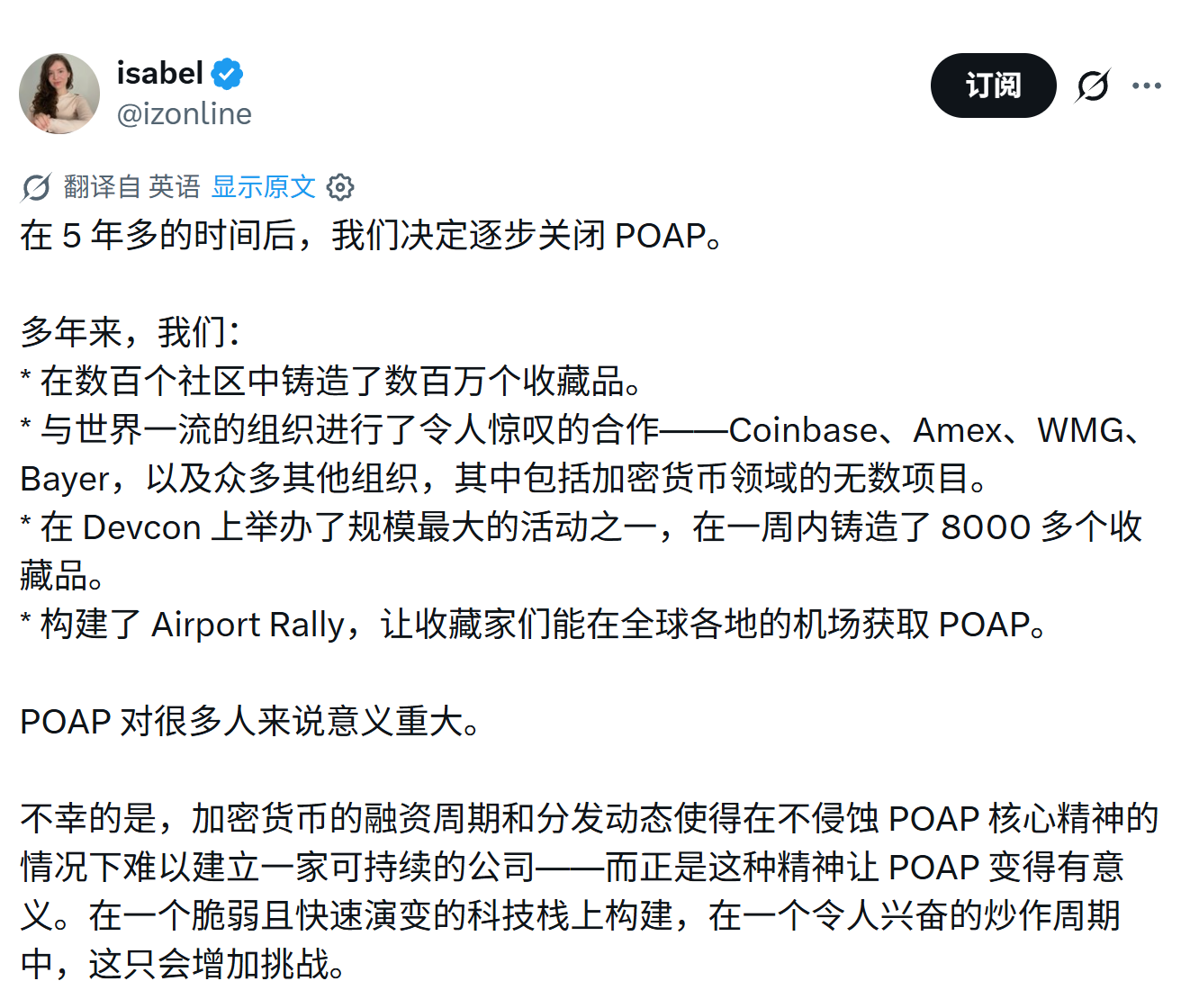
The article says the industry has moved into a dense stretch of farewells. Familiar names have stopped operating across trading platforms, DeFi, wallets, NFTs, and infrastructure. It cites BitMEX, which ran for 11 years and helped define perpetual crypto derivatives, and Satori Finance, which had backing from Polychain and Coinbase Venture, as part of that broader pattern.
POAP, in the author’s view, stands out emotionally and symbolically. Anyone who lived through the previous cycle and attended Devcon, ETHDenver, hackathons, DAO community events, or online and offline meetups likely still has a few POAPs sitting in a wallet. Most were never worth much money. That is part of the point. The article argues those tokens often came closer to the original idea of collecting than many expensive NFTs did. POAP’s exit, then, feels representative precisely because it did not collapse in a hack, was not a rug pull by an anonymous team, and did not depend on a native token whose price expectations had to be constantly defended. It had real users, a clear use case, and broad recognition, yet still failed to find a business model that could support the company over the long run.
A new shutdown wave is moving through Web3
The piece traces the problem back to the last expansion cycle. In that environment, it was not especially hard for a crypto project to prove it had "arrived." A funding round, a mainnet launch, a token issuance or airdrop, and a round of liquidity incentives could be enough to draw an initial user base. TVL, address counts, and transaction volume could rise quickly. For a long time, whether the project actually generated revenue was not always the most urgent question.
That changed once the cycle turned. If token prices and liquidity can no longer perform a financing function, the article says the simplest question comes back into view: if no new money comes in, can the project support itself?
That is what makes the 2026 shutdown cycle notable, in the author’s telling. Many of the projects disappearing now were not empty concepts with no product. They had raised money, launched, attracted real users, and in some cases continued to work well on a technical level.
BitMEX is one example. On July 23, the exchange said it would formally close its trading platform on Sept. 23, 2026. Founded in 2014, BitMEX was one of the most recognizable companies in crypto derivatives. Perpetual contracts, 100x leverage, and a product design framework later adopted broadly across the sector all had close ties to its early development. Even so, it did not become permanent infrastructure. The commentary notes that BitMEX emphasized in its shutdown notice that over more than 11 years of operation, it never lost user funds because of a hack.
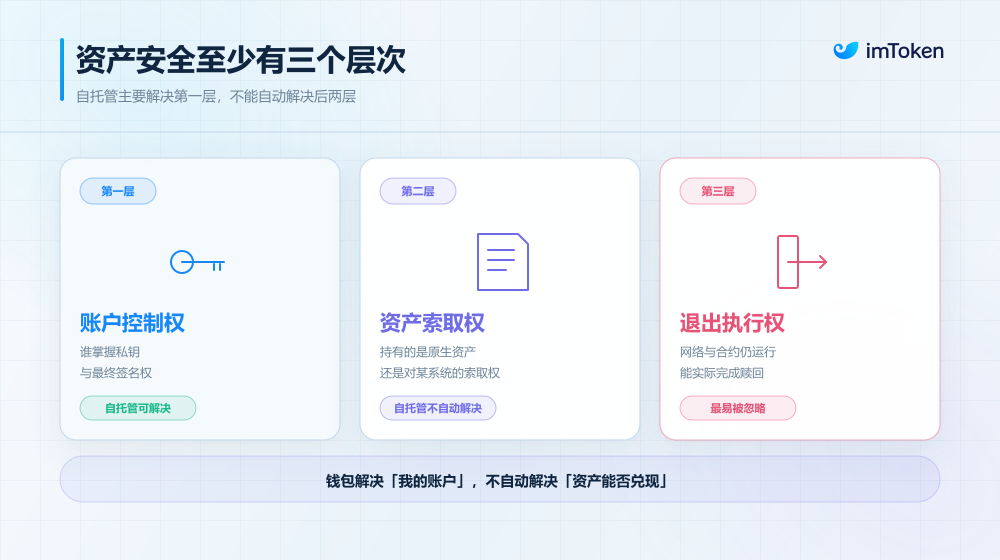
The same pattern appears in DeFi and infrastructure, the article argues. It uses Botanix as a case study. The Bitcoin layer-2 project had been under construction for nearly four years. By its own disclosure, its mainnet had maintained 100% uptime with zero security incidents, processed about 25 million transactions, seen 200,000 wallet addresses, attracted tens of millions of dollars in assets, and integrated with infrastructure and DeFi products including Chainlink and Morpho.
Measured by standard crypto KPIs, the article says, Botanix would be hard to describe as a total failure. The chain was built, the product worked, users came, and capital flowed in. Yet Botanix still chose to shut the network down. In its own post-mortem, it said genuine transaction demand did not produce enough fee revenue to cover the infrastructure costs required to keep an independent network running over time.
That exposes a broader blind spot. Crypto has spent years relying on TVL, address growth, and transaction counts to judge whether an ecosystem is healthy, while often skipping the final question: how much real revenue are those users actually creating?
As the sector matures, the article argues, projects with weak real usage, no sustained income, and continuing maintenance costs leaving the field look more like structural clearing than a sign that the industry has suddenly lost all value. In that context, a team that stops adding new business, publishes a timetable, and leaves users a migration window after deciding it cannot continue is acting more responsibly than a project that has effectively lost development capacity while pretending to remain operational.
Self-custody solves only part of the problem
From there, the article shifts to user risk. Crypto’s long-standing security maxim, "Not your keys, not your coins," remains valid, but the author says it covers only half the issue. Controlling the private key solves account control. It does not automatically guarantee that the asset in the wallet remains redeemable or that the user can actually exit.
The article illustrates this with four different forms of assets that might all show up in a wallet with a value of $10,000: native ETH on Ethereum, a deposit receipt from a lending protocol, an LP token, or a BTC representation minted through a bridge. Each appears in the wallet. Each requires a signature from the user’s own key to move. But if the underlying protocol, or the network beneath it, stops functioning, the outcomes can diverge sharply.
Case one: the product shuts down, but users can still exit through contracts
dYdX v3 is presented as a relatively ideal example. In 2024, dYdX decided to stop v3 and shift development toward the new dYdX Chain. Users were asked in advance to close positions and withdraw USDC. After the product stopped operating, the relevant contracts entered a frozen state, but an exit path remained available for users who had not yet withdrawn funds.
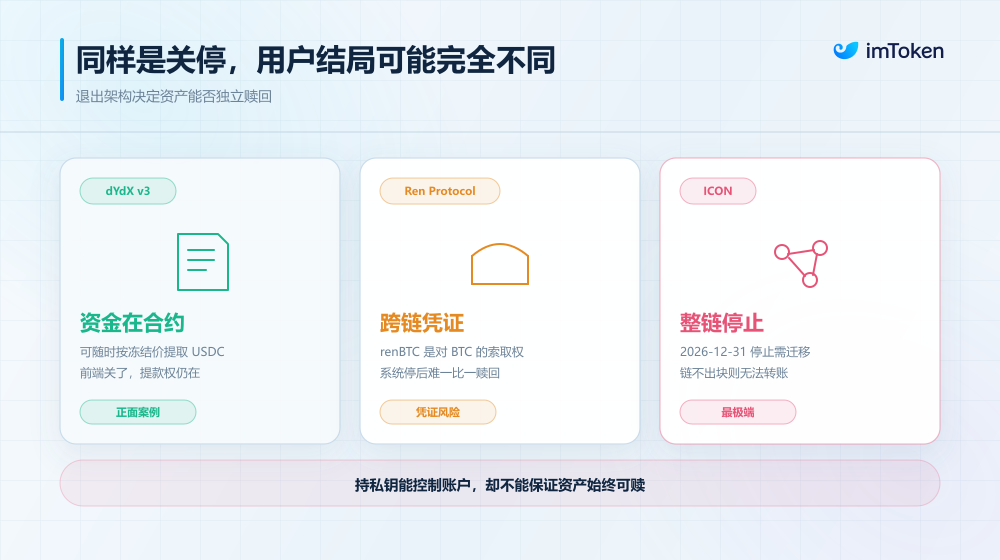
The article calls this a near-perfect example of a "walkaway test." A team can stop running the product, but the user’s right to withdraw funds does not fully depend on the team staying in business. That, the author says, is a practical way to judge how non-custodial a DeFi protocol really is: if the development team stops maintaining the product one day, can an ordinary user still rely on on-chain contracts to retrieve funds?
Case two: the token is in your wallet, but it is only a claim on something else
Ren Protocol shows the other side. The article notes that Ren was a major BTC bridging infrastructure project in the previous DeFi cycle. Users who moved BTC to Ethereum through Ren received renBTC, which could then be used as collateral in Ethereum-based DeFi protocols for yield generation or borrowing.
At first glance, renBTC looked safely self-custodied. It sat in the user’s wallet, the private key stayed with the user, and the blockchain recorded the balance. But renBTC was not native BTC on the Bitcoin network. It was a redemption claim tied to BTC held behind the Ren bridging system.
That distinction became critical in 2022, the article says, after Alameda Research collapsed and Ren lost key financial support. Ren 1.0 then began winding down. Projects including BadgerDAO issued urgent reminders for users to reduce renBTC exposure, because once Ren 1.0 stopped operating, holders would no longer be able to use the original bridge system to redeem those assets back into BTC on Bitcoin mainnet.
In other words, the renBTC could still be sitting in the wallet. No one else could simply destroy it or move it away. Yet the user could not, with a private key alone, make a discontinued Ren network bridge it back into actual BTC.
The same logic, the commentary says, applies to many bridged assets, wrapped assets, LP tokens, lending receipts, and some liquid staking derivatives. What the user controls is often a certificate. Whether that certificate can still be redeemed for the underlying asset depends on whether the smart contracts, reserve assets, oracles, cross-chain validators, liquidity, and redemption systems behind it are still working.
Case three: if the underlying network itself shuts down, keys cannot keep blocks coming
The article then pushes the issue one layer lower. Some chains can be shut down directly or drift into near-abandonment, to the point where stable block production can no longer be assumed. The author cites Eclipse and AO as examples from personal experience. If an entire network stops running, users may still possess the private key and may still have a record in historical blocks showing how many tokens they owned, but that does not mean they can continue sending those assets as before.
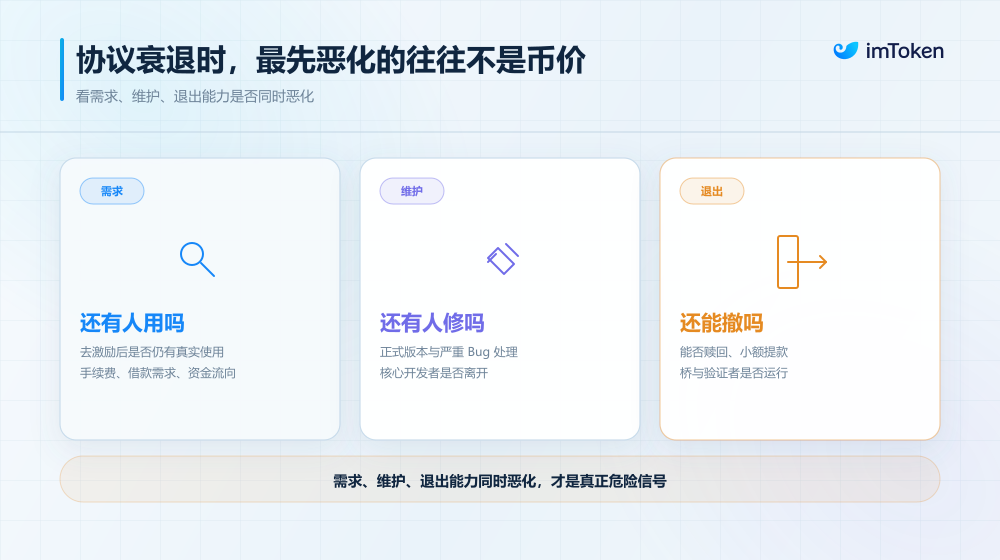
From there, the commentary breaks asset control into at least three layers:
- account control: who holds the private key and seed phrase;
- claim on the asset: whether the wallet balance is a native asset or a receipt issued by a protocol, bridge, custodian, or asset pool;
- execution of exit: when a user decides to leave, whether the underlying network, smart contracts, liquidity, and required infrastructure still allow the asset to be redeemed and moved.
"Not your keys, not your coins" addresses the first layer, the author says. When a project enters decline, stops being maintained, or heads toward closure, the second and third layers are often where the real problems appear. In a structural clearing cycle like the one the article describes, the more useful question is simple: if this project stops operating tomorrow, can I still take my assets out today in full?
A fuller reading of self-custody
Most projects do not jump from normal operation to total death in a single day, the article says. Real decline usually plays out over a much longer period.
The author proposes a practical framework: do not watch only the token. Watch people, money, code, and exit routes at the same time.
Start with the money. Once liquidity incentives are gone, is there still real demand? TVL is not automatically safety, and a high transaction count does not by itself prove lasting value. The key question is how many users remain after token rewards are removed, and whether protocol income can cover team survival and other costs.
Then look at the people. The article warns against mistaking social media activity for active maintenance. Many projects never formally announce that nobody is still building. A more common pattern is that GitHub sees no core code updates for six months, serious bugs go unanswered, the roadmap keeps slipping, and community channels are left unattended.
Finally, there is the exit path, which the author describes as the easiest thing for users to overlook and one of the most valuable things to understand. For any meaningful on-chain position, users should know which chain it is on, the contract address, whether the wallet balance is a native asset or a receipt, how to convert it back into the most basic underlying asset, and whether there is another way to interact if the official front end goes down.
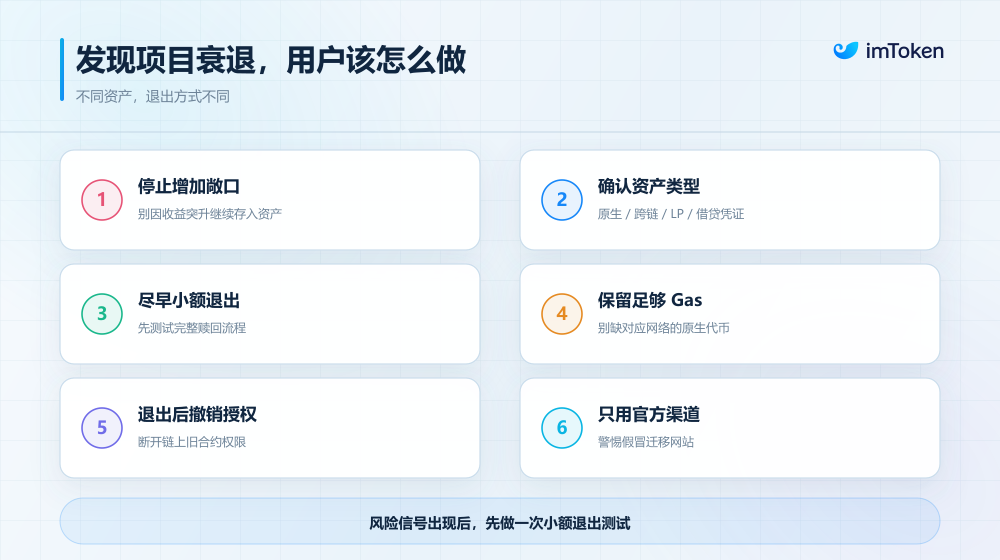
That is why self-custody needs a broader definition, the article argues. For long-term holdings of base assets, keeping them in a wallet controlled by the user’s own private key remains one of the most important security baselines. But once users enter DeFi, bridging, staking, and other on-chain products, one more question becomes necessary: where did my asset actually go?
Depositing ETH into a protocol and receiving a token in the wallet does not mean that ETH is still sitting at the original address. Seeing a BTC L2 asset after bridging BTC does not mean the user still holds native BTC. Moving funds into an LP, vault, or lending market and seeing a balance on screen does not guarantee that the user will be able to exit at face value later.
POAP’s departure leaves a marker for this cycle
The article closes by returning to POAP. Its exit resonates with long-time users, the author writes, because it reminds people still in Web3 that a product can have no token, no oversized financial game, and genuine affection from users, and still reach the end of its operating life.
That is not an anomaly in blockchain, the article argues. If anything, it may mean crypto is beginning to look more like a normal industry: products have life cycles, teams are replaced, failed business models leave the market, and limited developers, capital, and users move toward places where they are used more efficiently.
The author expects more farewells in the years ahead. Some projects will leave behind on-chain memories of an era, as POAP did. Some protocols will shut down in an orderly way, as dYdX v3 did, leaving users an on-chain way out. Others will resemble renBTC, where holders only realize what they actually own once the infrastructure underneath is preparing to close.
Protocols can disappear. Projects can fail. Even a chain can reach its endpoint. What should not change, the article says, is the basic logic of crypto asset safety: users should not tie their ultimate control over assets to the assumption that any single project will keep operating forever.