
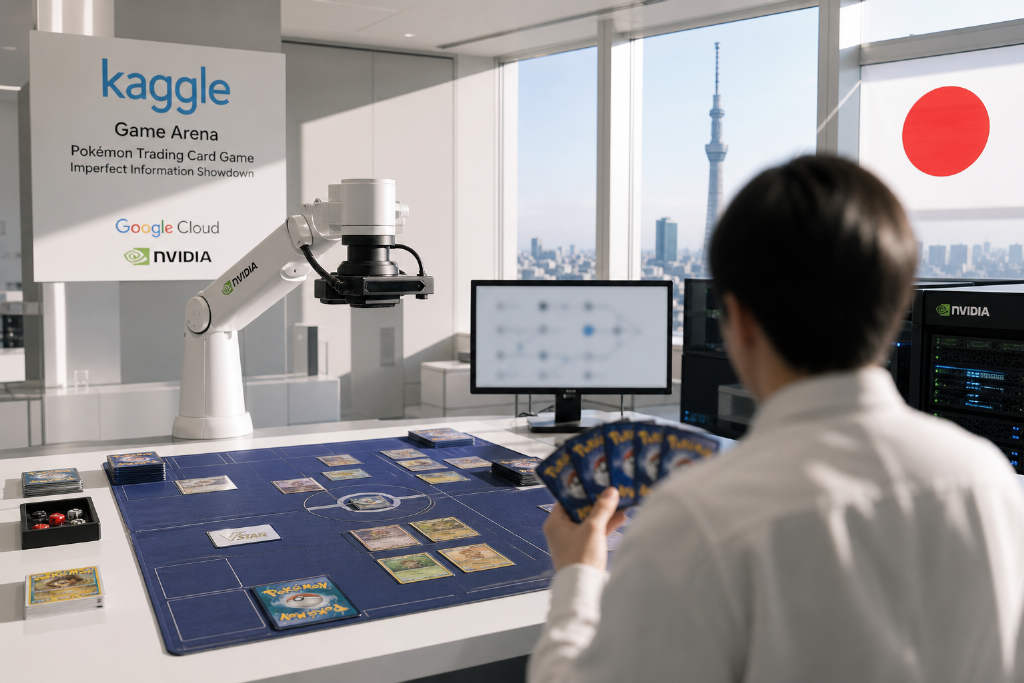
Pokemon Trading Card Game is becoming a new testing ground for AI. According to the event details, more than 6,000 teams worldwide have spent over two months training AI agents to play the card game, with total prize money exceeding $300,000.
The competition’s full name is the Pokemon Trading Card Game AI Battle Challenge, known in Japanese communities as "ポケカABC." The official Pokemon competition website announced the event on June 16. Kaggle is hosting it, while The Pokemon Company, Matsuo Institute and HEROZ are listed as co-organizers. Google, Google Cloud and NVIDIA are providing technical support.
In its announcement, the organizers said board games such as chess, shogi and Go have already been conquered by AI, and Pokemon TCG is being positioned as the next challenge.
Two divisions with different roles
The competition is split into two divisions. The simulation division ran on Kaggle from June 16 to Aug. 17. Participants could upload AI agents for automated matches, with each team allowed up to five submissions per day. Rankings were updated in real time based on results. This division carries no prize money and serves as a testing ground.
The strategy division opened on June 16 and runs through Sept. 14. Each team can submit only one strategy report explaining the design logic behind its AI agent. Judging takes into account AI stability, deck concept and performance in the simulation division. The top eight teams each receive $30,000 and advance to the finals. Every member of a qualifying team also gets $3,000 in Google Cloud credits.
The official schedule says the finals will take place after the end of 2026, with the location to be announced later. The matches will be streamed on the official YouTube channel. The format is best-of-three, with a 30-minute time limit per game and losses awarded on timeout. In the first round, single games are limited to 10 minutes. New cards will be added to the card pool for the final stage. The champion will receive $50,000 and the runner-up $30,000.
Why Pokemon TCG is a different AI problem
The report notes that chess, shogi and Go all share one trait: everything on the board is visible to both sides. In this type of complete-information game, AI can search deeper and calculate faster to approach an optimal solution.
Pokemon TCG works differently. The organizers describe it as an imperfect-information game. Players cannot see the opponent’s hand, card draws are random, and opposing deck composition has to be inferred from cards already played and from the opponent’s pacing. In that sense, the article says, the technical path is not simply an extension of AlphaGo. It is closer to poker-style systems that must deal with probability, bluffing and asymmetric information.
Deck-building complexity adds another layer. The official description says players must build a 60-card deck from more than 1,000 cards. The article also mentions that some foreign media outlets estimate the pool is closer to 2,000 cards, though that figure is identified as a third-party estimate rather than official data.
The environment itself is also in motion. Decks are built to check one another, creating a shifting metagame rather than a fixed puzzle. That is one reason the strategy division asks teams to explain why their approach should win instead of relying only on simulation scores.
Team count climbed to 6,835 in two months
According to a two-month community observation compiled by Japanese community outlet pokebros.net, a third-party dataset rather than an official release, the number of registered teams started at 2,671 and reached 6,835 by Aug. 15, about 2.5 times higher. Participants came from Japan, South Korea, China, Vietnam, Indonesia, Italy and Russia, among other places.
The leaderboard changed constantly during the event. On June 22, keidroid became the first No. 1 team. After that, ShumpeiNomura and Majkel1337 also rotated through the top spot. The article says the top five scores stayed tightly packed for much of the contest.
Large overnight swings were common. One team moved from No. 3,213 into the top 60, while another jumped from No. 4,889 to No. 349.
Deck trends shifted fast
Deck usage rates also changed quickly over the two-month stretch. In mid-July, Alakazam decks rose above 33% usage. In late July, Marnie’s Grimmsnarl ex climbed from 27% to 51% in a single week, meaning more than half of teams were using the same list at that point.
By early August, usage of that deck fell back to 32%, Alakazam regained ground, and Dragapult ex started to emerge.
An even sharper example came from Mega Lopunny ex. Its usage rate rose from just 0.85% to 12% in two weeks, lifting it from an off-meta option to the third-most common deck in the field.
From contest structure to technical difficulty to rapid metagame rotation, the event is pushing Pokemon TCG into the next wave of AI game competition after traditional board games. Under the current schedule, the finals will be held sometime after late 2026, with qualified teams facing an updated card pool that includes new cards.