

PolicyTrim, a new post-training framework from a team led by Professor Lei Yinjie at Sichuan University, aims to make Vision-Language-Action robots complete tasks with fewer detours and fewer physical steps. The method does not change the VLA architecture and does not require new expert data collection.
VLA models combine visual observations, language instructions and robot actions in a single policy model. Systems such as OpenVLA, OpenVLA-OFT, π0.5 and GR00T have become a major path in embodied intelligence. The paper argues that once these models move from benchmarks to deployed robots, total task time is shaped not only by inference latency per step but also by how many inferences and real physical actions a policy needs to finish a task.
Why faster inference alone is not enough
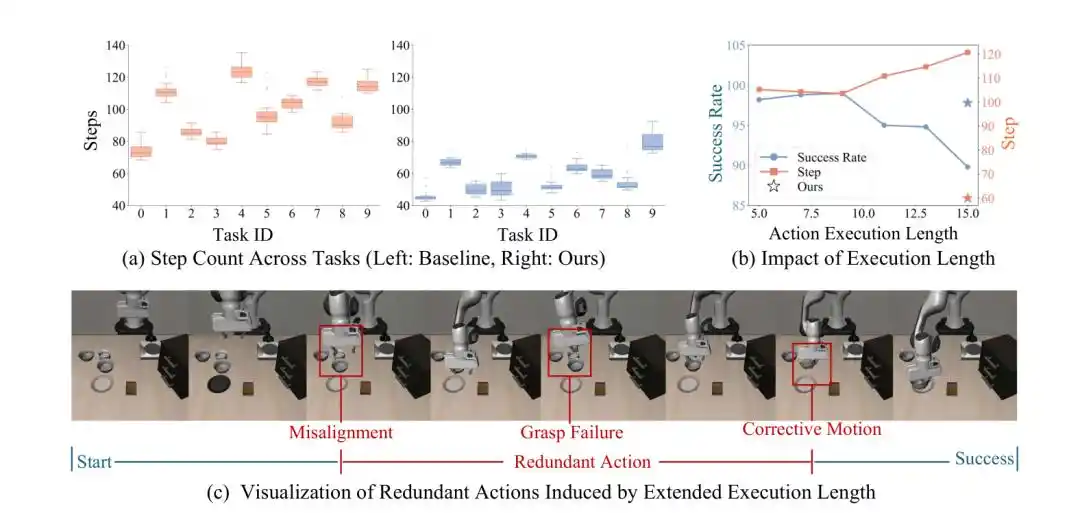
According to the paper, rollout lengths for the same task can vary sharply across runs. That suggests shorter and more direct successful paths are reachable, but the policy only finds them occasionally.
Another issue sits at the tail of the action chunk. A VLA model may predict multiple actions at once, yet later actions in the sequence are more likely to accumulate error. That forces the system to replan often. The paper says simply executing longer chunks is unreliable: as forced execution length increases, success rate can fall and physical step count can rise because low-quality tail predictions push error into the physical world and trigger more corrective motions later.
Even when a task succeeds, the trajectory may still include a large amount of correction, backtracking and repeated motion. The authors frame this as a policy efficiency problem rather than a pure compute problem.
How PolicyTrim works
The paper contrasts PolicyTrim with optimization methods that focus on compute, including visual token pruning, quantization, KV-cache reuse, distillation and inference engine tuning. Those approaches can reduce latency for a single forward pass, but they do not remove redundant physical steps if the policy still takes an inefficient path.
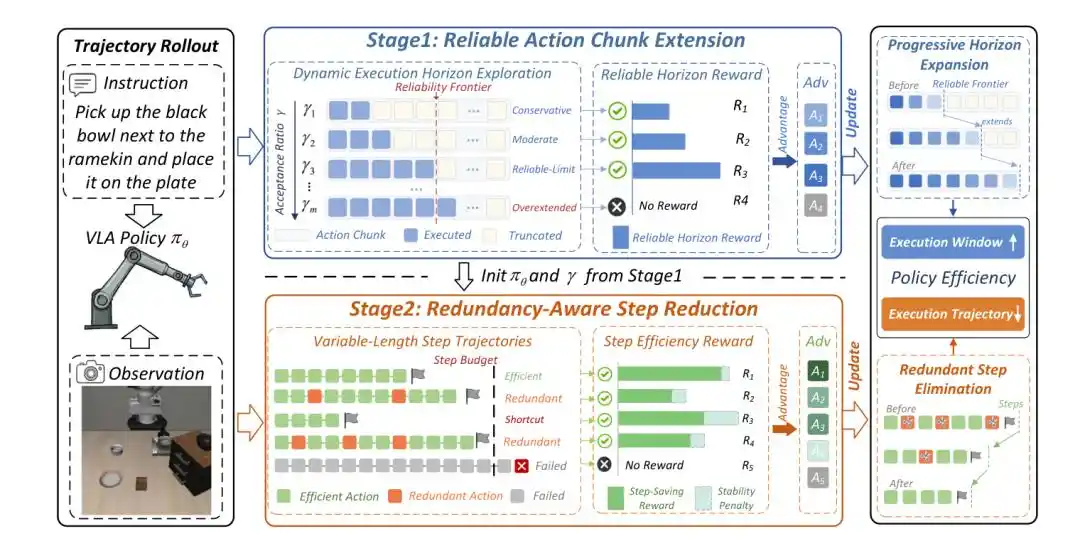
PolicyTrim breaks the problem into two targets: extending the reliable action chunk, then shrinking redundant physical steps.
Stage one: Reliable Action Chunk Extension
In the first stage, PolicyTrim uses dynamic execution horizon exploration. Different acceptance ratios are assigned within the same rollout group so the model can explore reliable boundaries across short, medium and long execution windows in parallel.
Trajectories that both finish successfully and execute longer windows receive higher reward. The goal is to make the tail of the chunk more usable. Horizon reward is activated only when a successful trajectory appears inside the group, which is meant to stop the policy from chasing longer chunks blindly under failure cases.
Stage two: Redundancy-Aware Step Reduction
Once the reliable horizon has been extended, the second stage cuts the total number of physical steps. PolicyTrim introduces a step-saving reward so that successful trajectories completed with fewer steps receive higher reward.
The paper says this directly writes the objective of a shorter, more direct successful trajectory into optimization. It also adds group-anchored regularization to suppress brittle shortcut behavior that may reduce step count but hurt reproducibility or success rate.
The two-stage order matters. The authors say it prevents the objectives of longer chunks and shorter paths from interfering with each other and lowers the number of forward passes needed to complete a task.
Results across benchmarks and architectures
The study evaluates PolicyTrim on LIBERO, ManiSkill, Meta-World and real-world robot tasks, spanning π0.5, OpenVLA-OFT and GR00T.
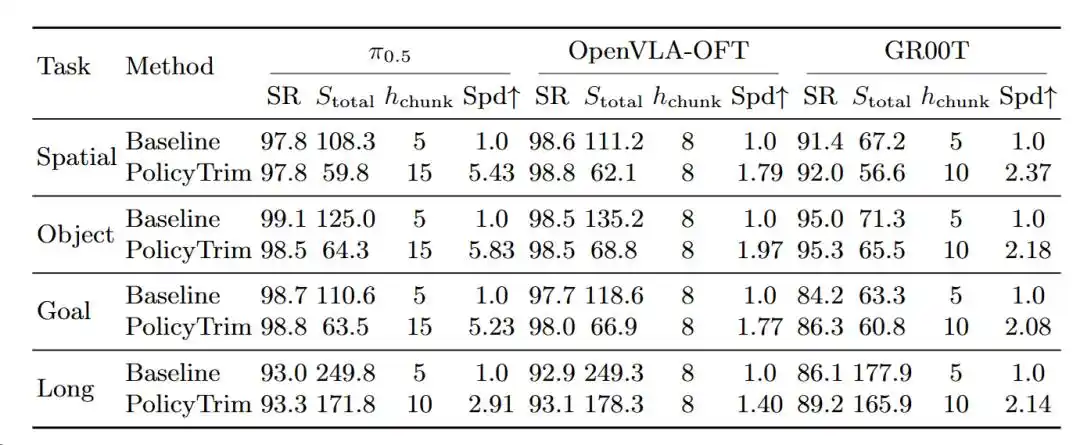
Across the reported results, PolicyTrim improved execution efficiency while keeping task success rate stable. On LIBERO, π0.5 reached a peak end-to-end speedup of 5.83x while maintaining success rate above 98%.
On ManiSkill, the top reported speedup was 2.36x. On Meta-World, it reached 2.52x.
For cross-architecture comparisons, a retrained OpenVLA-OFT with the full two-stage pipeline reached 2.97x speedup, while OpenVLA using only the second stage still reached 1.41x.
The paper also lists three headline metrics:
- 3x action chunk utilization, enabling more reliable long-horizon execution;
- 51.4% fewer physical steps by removing redundant corrective motion;
- up to 5.83x end-to-end acceleration for LIBERO Object with π0.5.
Qualitative behavior change
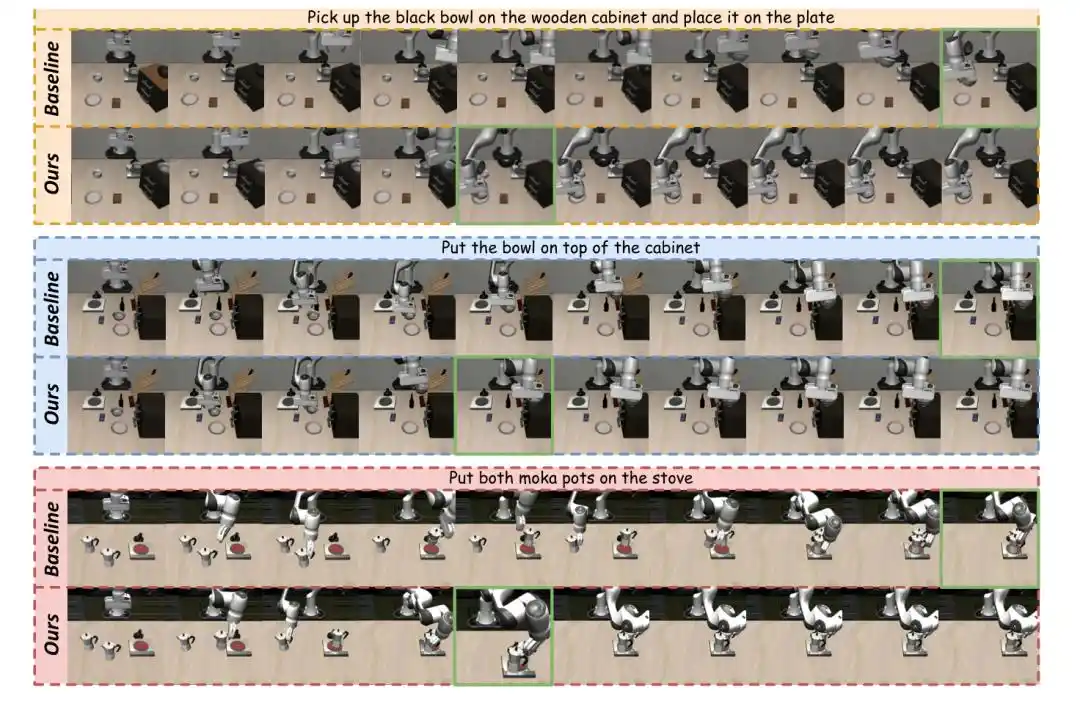
In randomly sampled LIBERO tasks, the baseline often shows redundant corrective actions and hesitation or jittering near the target, according to the paper. PolicyTrim produces smoother and more direct trajectories and completes the same task with fewer physical steps.
The authors say the physical step count can often be compressed to around half of the original level.
Real robot deployment
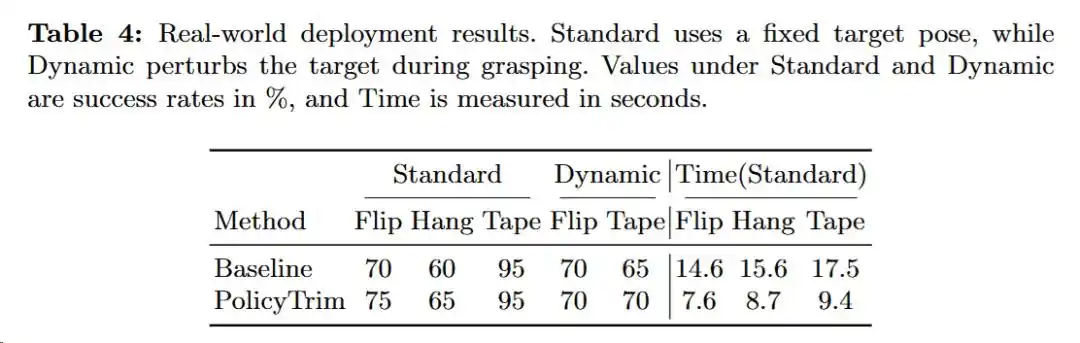
The paper also tests the method on an Agilex Piper robotic arm equipped with two Intel RealSense D435i cameras. The real-world tasks include FlipMug, HangMug and TapeBox.
Experiments cover both a standard setting with fixed target positions and a dynamic setting where the target is randomly disturbed during grasping.
PolicyTrim maintained or improved success rate in both settings while shortening execution time. Under the standard real-robot setup, the average end-to-end speedup reached 1.86x.
The paper says the gains are not limited to benchmark scores. On a physical robot, task completion time can be reduced to around half of the baseline level, while robustness is preserved in dynamic disturbance scenarios.
Why the authors say it works
The paper gives four reasons. First, PolicyTrim improves the policy itself by reducing redundant action and unnecessary replanning instead of only cutting single-step inference latency.
Second, it works as a post-training framework and can optimize existing VLA models without training from scratch, reducing data collection and training cost.
Third, it is designed to balance speed and success rate: reliable horizon expansion avoids blindly lengthening the chunk, while stability constraints reduce shortcut behavior.
Fourth, it can be combined with compute-side acceleration. The paper cites VLA-Cache as an example of methods that cut the time per inference, while PolicyTrim reduces the number of forward passes. The two routes are presented as orthogonal and stackable.
Project links
Project page: https://inceptionwang.github.io/PolicyTrim/
Paper: https://arxiv.org/abs/2606.22540
Code: https://github.com/INCEPTIONwang/PolicyTrim
Model: https://huggingface.co/INCEPTIONwang/PolicyTrim
Reference: https://arxiv.org/abs/2606.22540
The source text cites the WeChat public account "AI Era" (Xinzhiyuan), with Xinzhiyuan credited as author and LRST as editor.