

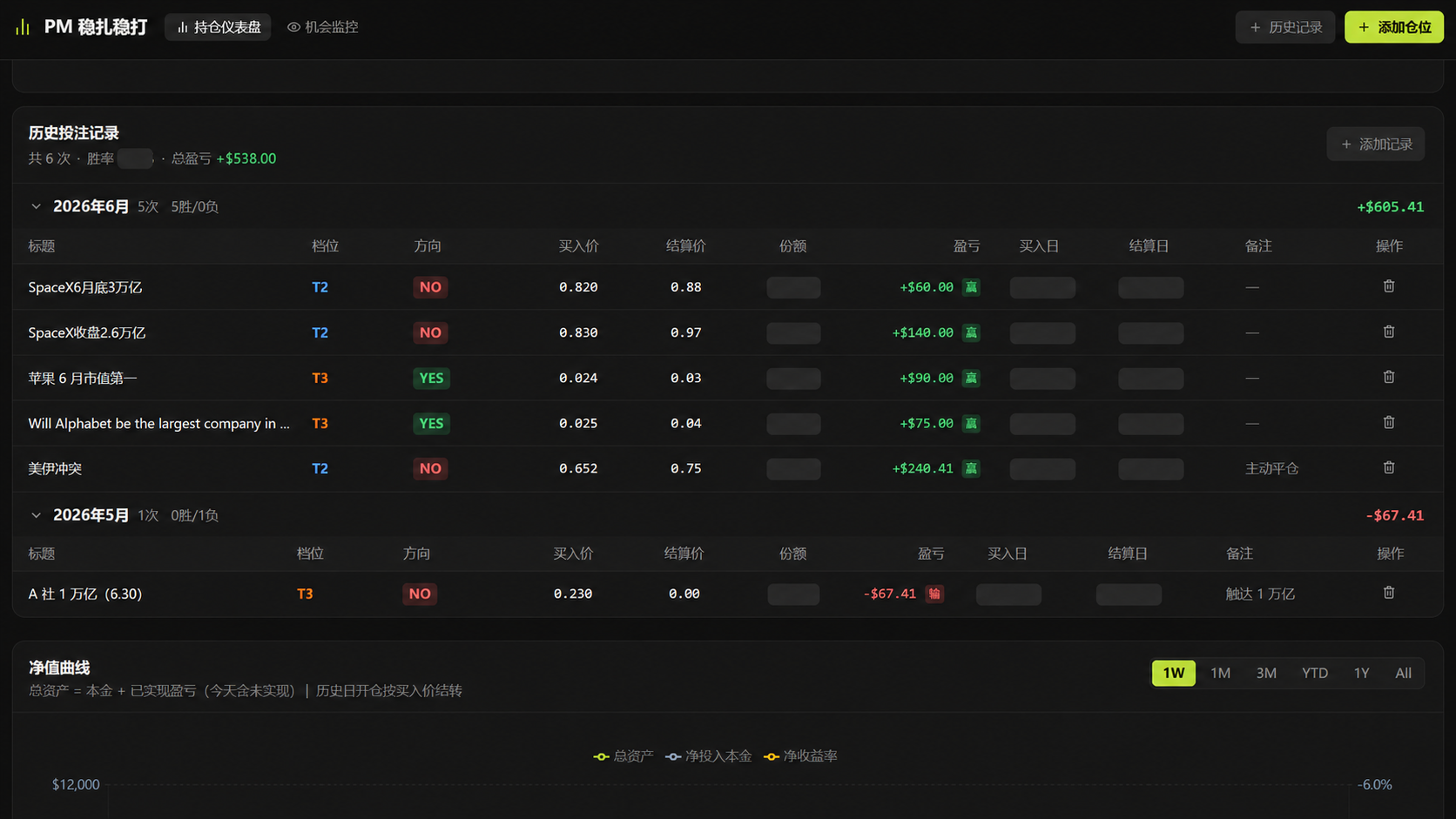
In a previous article titled “I Used AI to Build Myself an Investment Workbench,” the author introduced several tools built through Coding: a cross-market asset dashboard, an investment map, a personal content operations console, and a Polymarket betting monitoring panel that has recently become one of the most frequently used modules. Over more than half a month of live testing, the author deployed around $1,600 of principal and generated more than 30% in returns. The dashboard’s real-time statistics were broadly aligned with the final actual net profit, with only about 6U of difference, mainly attributed to small discrepancies such as open orders and liquidity rewards.
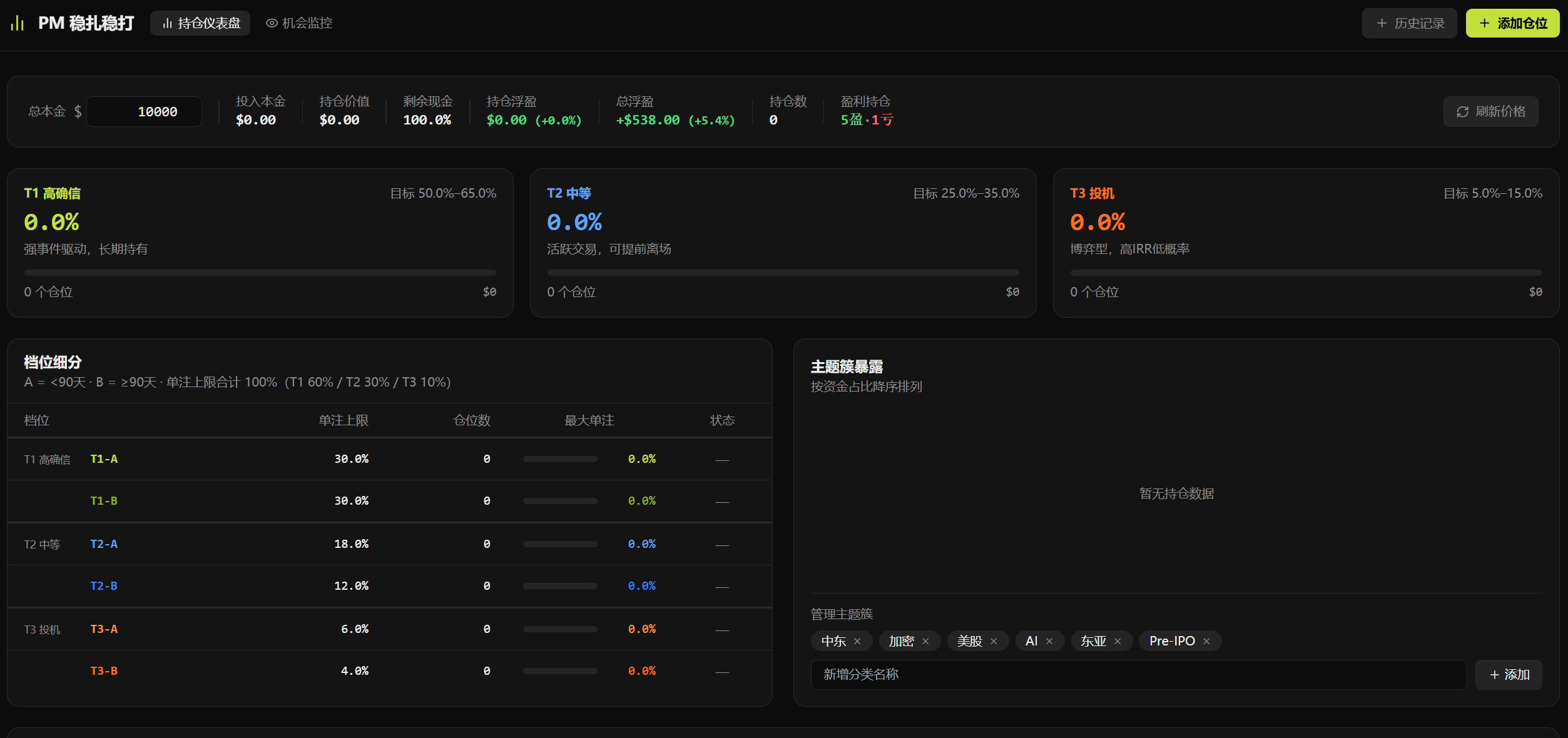
Yet the article’s core message is not that Polymarket is easy money, nor is it framed as an arbitrage tutorial. The author’s conclusion is almost the opposite: after completing this round of testing, the author became more convinced that Polymarket is not a venue suitable for rushing in with an arbitrage mindset, especially not with concentrated positions.
From Manual Excel Tracking to a Two-Tab Dashboard
The author began hand-building the panel around May 21. The initial need was simple: avoid opening more than a dozen betting pages to check yes/no price changes, and stop relying on Excel to manually record buys and sells, unrealized profit and loss, settlement dates, and event categories. Before the dashboard, that was exactly how the author managed the process. The problem, as the author describes it, is that many Polymarket bets can easily get out of control when records are maintained by hand. A user may initially intend to buy only a small amount, then add more after the odds move because there is no intuitive overview. Or a market may suddenly fluctuate, and if the spreadsheet is not updated in time, the user can miss a stop-loss or add-position window.
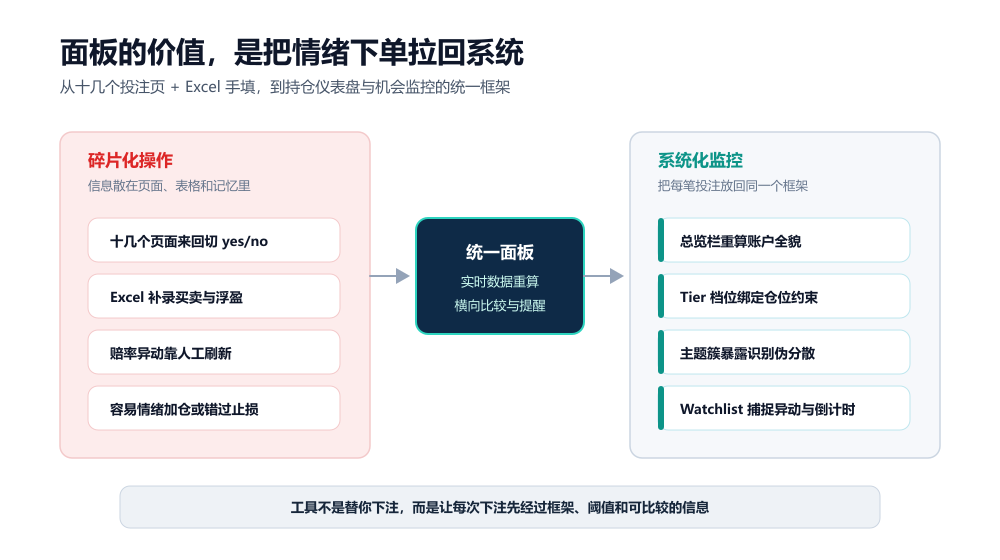
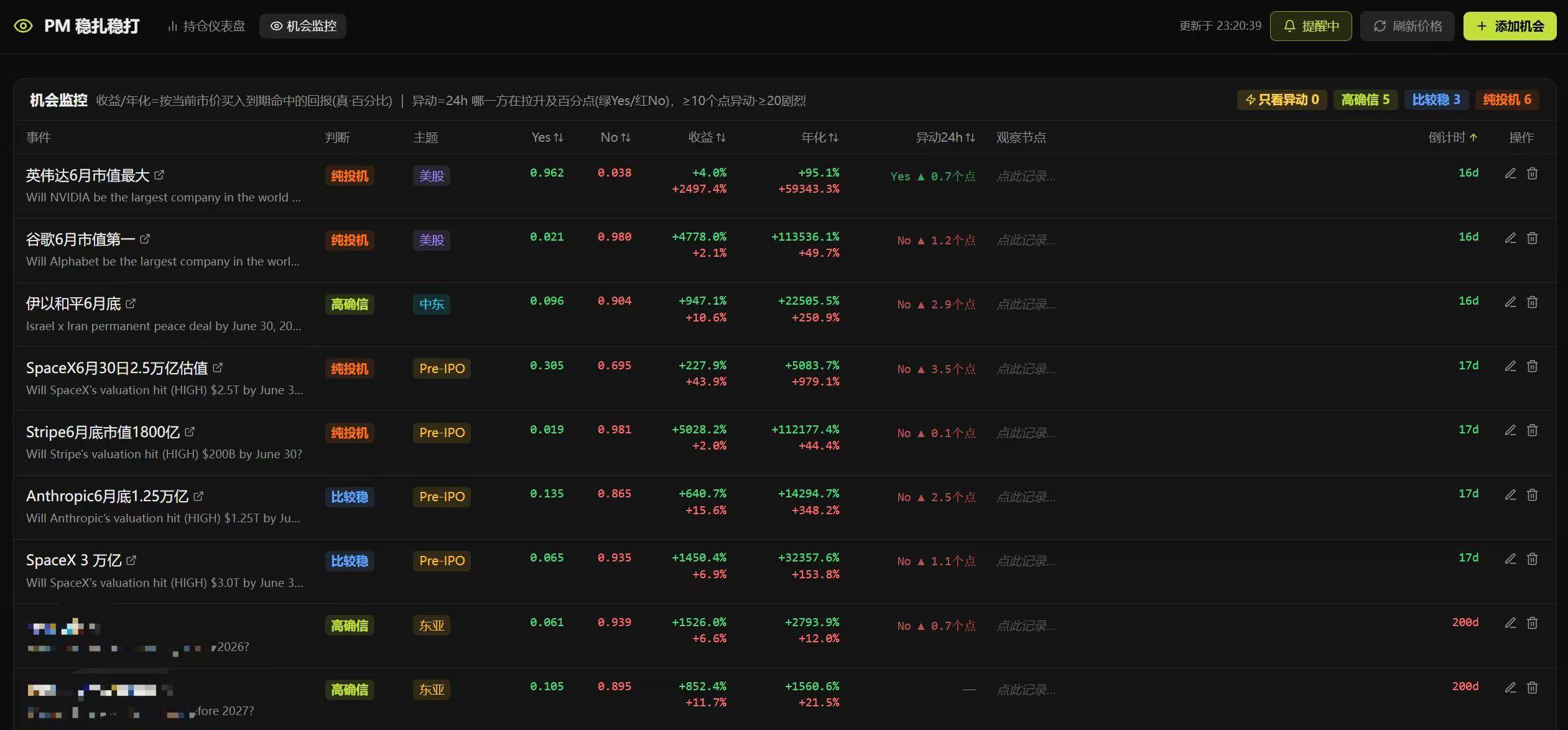
The dashboard was therefore designed to place every bet back into one unified framework. Instead of scattered impressions and fragmented tabs, the author wanted a visual and comparable information layer. After several iterations, the panel was split into two tabs: “Position Dashboard” and “Opportunity Monitoring.” The Position Dashboard is the core. It can fetch real-time PM data and recalculate positions dynamically. For each market, it records several fields: the event name with a hyperlink to the trading page, T1/T2/T3 tier judgment, current yes/no prices, returns, annualized returns, unusual movement alerts, observation checkpoints, and a countdown to settlement. The alert threshold can be customized; for example, if a market moves by more than 20% within 24 hours, a pop-up reminder appears as long as the webpage remains open.
The author highlighted two design details. First, after identifying a suitable PM interface, the dashboard can parse a betting event simply by receiving its webpage link. It automatically displays yes/no options, corresponding prices, and the categories of different options under the same event, greatly reducing manual input. Second, the Tier assignment of the same bet automatically reorders itself as the remaining time changes. Before Anthropic released Mython, the watchlist had already shown an obvious price move. The author regarded that as a high-certainty event, and entering at that point could have captured roughly 10 percentage points of return. In the author’s view, this kind of opportunity is difficult to identify consistently without a watchlist.
The EV Looks Attractive, but the Loss Can Be 100%
After the live test, the author’s deeper reflection focused on the structural trap in binary markets like Polymarket. Such markets are unfriendly to players who prefer a single heavy position, but more compatible with users who spread capital across many bets. The author illustrates this with a simple example. Suppose the yes price c of an event is 0.80, meaning the market prices the event at roughly an 80% probability of occurring. If the author’s own probability judgment q is 0.90, then the expected return can be roughly calculated as EV = q / c - 1 = 0.90 / 0.80 - 1 = 12.5%.
That 12.5% looks appealing, but Polymarket is not a bond. Behind that expected return is sharp tail risk: if the judgment is wrong, the loss is not 12.5%, but 100%. For this reason, the author does not only monitor expected return in the dashboard. Two other factors are tracked at the same time. The first is the gap between the author’s own probability judgment and the market price, or q - c. The author also set an automatic take-profit reminder target at the midpoint between the purchase price and 100. The second is the impact on the total account if a single position goes to zero.
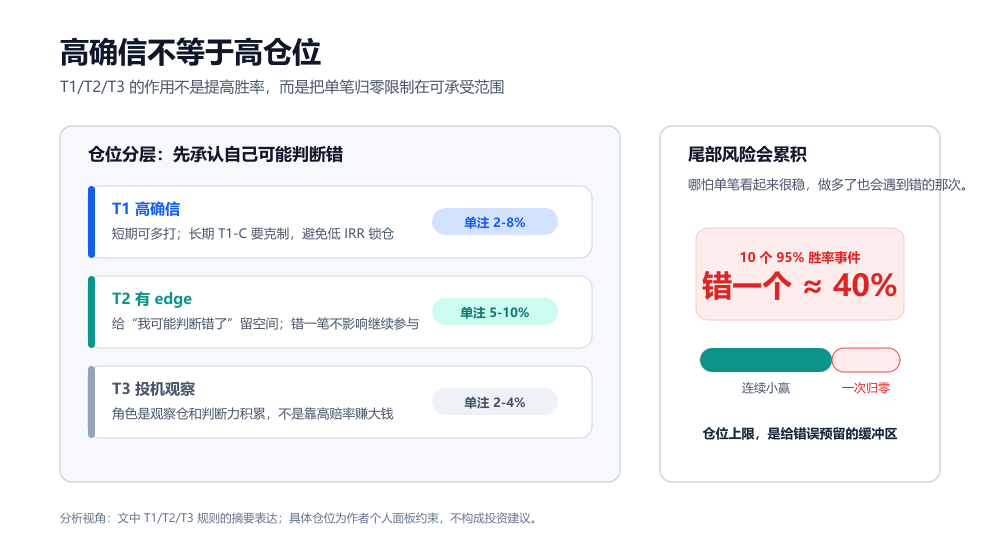
This is also where the T1, T2 and T3 framework comes from. T1 represents high conviction. For the author, the comfort zone includes East Asia-related events and some geopolitical topics where an information gap between Eastern and Western contexts can exist, but only after repeated verification. T2 refers to relatively steady opportunities, where the author believes the actual probability is clearly higher than the current yes or no price. T3 is pure speculation: high-odds bets that should not be held frequently or for long periods, and are better used for counter-moves and short-term mean reversion.
The author also notes that T1 carries hidden costs, especially for long-dated markets. If a T1 bet has an 18% static return but only settles in 180 days, its annualized IRR may be just 3–4%, which may be less attractive than leaving the cash unused. During that period, the principal is locked and later high-IRR opportunities can be missed. For that reason, the author further splits T1 by time buckets, with short-term T1-A positions allowed more room and long-term T1-C positions requiring restraint. T2 bets may have an edge, but room must be left for being wrong, so the single-bet cap is 8–10%. Even if such a bet loses entirely, the account-level loss remains within 10% and does not prevent participation in future opportunities. T3 positions are kept very small. The goal is not to make major profits from them, but to observe high-odds events continuously and build a sense for those order books.
High Conviction Is Not the Same as High Position Size
In the author’s framework, position limits are essentially the price paid for being wrong while keeping that price bearable. One counterintuitive but important point is that high conviction does not equal high allocation. Even if an event feels 95% likely to occur, as long as there is still a 5% chance of going to zero, position size must be constrained. The author gives an extreme example: if someone makes 10 bets that they each believe have a 95% win rate, each individual bet sounds stable. But if the bets are independent, the probability that at least one is wrong is about 1 - 0.95^10 ≈ 40%. With enough repetition, the losing event eventually arrives.
Real Polymarket markets are often not independent either. They may be highly correlated. The author cites “whether U.S.-Iran talks reach an agreement,” “whether the Strait of Hormuz reopens,” and “whether the Middle East situation escalates within the month.” These appear to be three separate markets, but their underlying variable is nearly the same: the direction of Middle East geopolitical policy. If that direction is misjudged, all three positions can bleed at the same time. For the author, the dashboard’s biggest contribution is not improving the win rate, but limiting large mistakes. Its core value is risk control rather than profit statistics.
After more than half a month of deep testing, the author’s main takeaway is that Polymarket does have opportunities, but it is not the arbitrage venue many people imagine. In on-chain arbitrage, the rules are usually clear and price dislocations can often be locked in. Polymarket is different. It tests the user’s understanding of how the logic behind a betting event changes across narratives and information flows. In East Asia-related political and economic developments, Chinese-language users can indeed have an information edge worth exploring, but that does not guarantee a win. Polymarket ultimately settles not according to the reality as a trader understands it, but according to market rules and designated data sources. The author also points to repeated UMA manipulation issues and notes that what looks certain in a Chinese-language context may not match the wording of the English rules. Many markets contain traps in their rule definitions.
A Training Ground for Judgment, Not a Stable Yield Product
Based on this experience, the author now holds a more conservative view of PM. First, it should not be treated as a stable income tool. Even for high-conviction positions, and especially after several consecutive wins, users should not start thinking they have found a cash machine. Binary markets are dangerous because after a winning streak, they can make someone believe they can judge everything, leading to an oversized final trade that gives back previous profits. Second, high win rate should not be equated with a good trade. A 90% win-rate event priced at 0.95 can be negative expected value. Conversely, an event with only a 40% win rate can be positive expected value if the market price is 0.20.
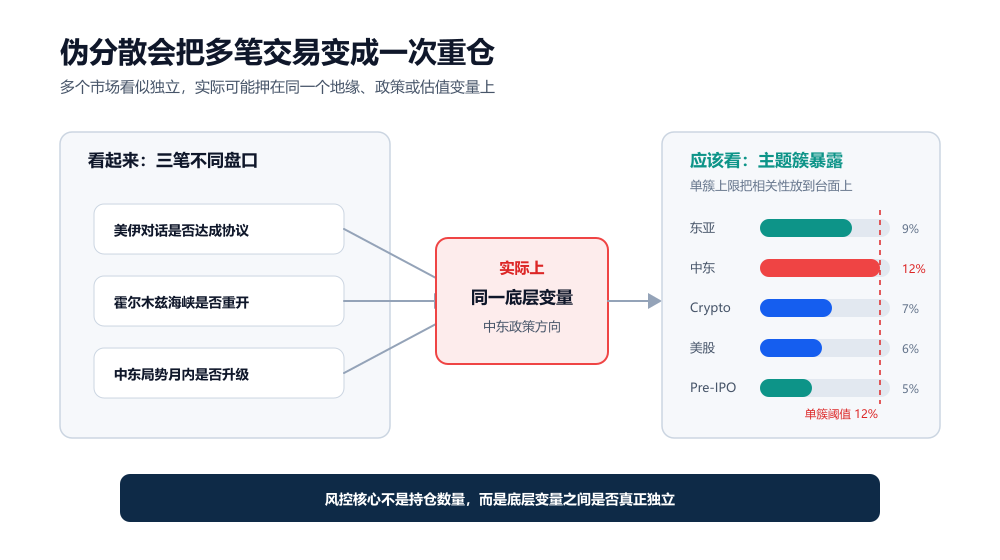
Third, tail risk cannot be ignored. Many people see a 10% or 20% return and treat it as stable, but if the wrong outcome means the position goes to zero, it is not low-risk income in the traditional sense. From this perspective, the author even says there are no so-called low-risk opportunities on PM; every one is high risk. Fourth, users should avoid fake diversification. Buying multiple different markets is not necessarily diversification if those markets share the same underlying driver, as in the earlier examples involving U.S.-Iran talks, the Strait of Hormuz and Middle East escalation. A friend’s line summarizes the attitude: “In investing, even if there is only a 1% probability of going to zero, one should not rely on luck.”
The author now prefers to treat PM as a training ground for judgment. It fits with a daily habit of reading political, economic, technology and financial information, and turns judgments that would otherwise remain at the level of “I think” into something that can receive feedback. Those abilities are useful outside PM as well.

The author also mentions another Codex-built tool: a private-market valuation monitoring dashboard. It tracks valuation changes of unlisted unicorn companies such as Anthropic, OpenAI, Stripe and Kraken in the private market, and compares those changes with corresponding Polymarket bets. Polymarket is, in essence, an expectations market. Sometimes signals in the private market have already changed while PM prices have not moved. At other times, PM prices move first while real-world data has not yet caught up. The mismatch between the two is an area the author plans to keep observing. Still, this is not risk-free arbitrage either. Private-market valuations are not fully transparent, and different data sources can differ. As an observation framework, however, the author finds it interesting and may write about it separately later.
The article’s final point is that the lesson is not “I made 30% with a dashboard, so you can too.” What the author considers more useful is the ability to build a tool that turns feelings into a framework and a framework into discipline. In many cases, making money does not prove that a secret method has been found; it only shows that this round of judgment happened to be right.