

Last week, prediction market leaders Polymarket and Kalshi both made significant strides in the perpetual contracts space. Polymarket opened its Perps Beta to a select group of users, with plans to gradually expand access over the next four weeks. Meanwhile, Kalshi obtained approval from the U.S. Commodity Futures Trading Commission (CFTC) to list BTCPERP, a Bitcoin perpetual futures contract. While the two platforms are pursuing different paths, the underlying signal is the same: prediction markets are no longer content with event-based trading and are now aggressively moving into higher-frequency, standardized derivatives markets.
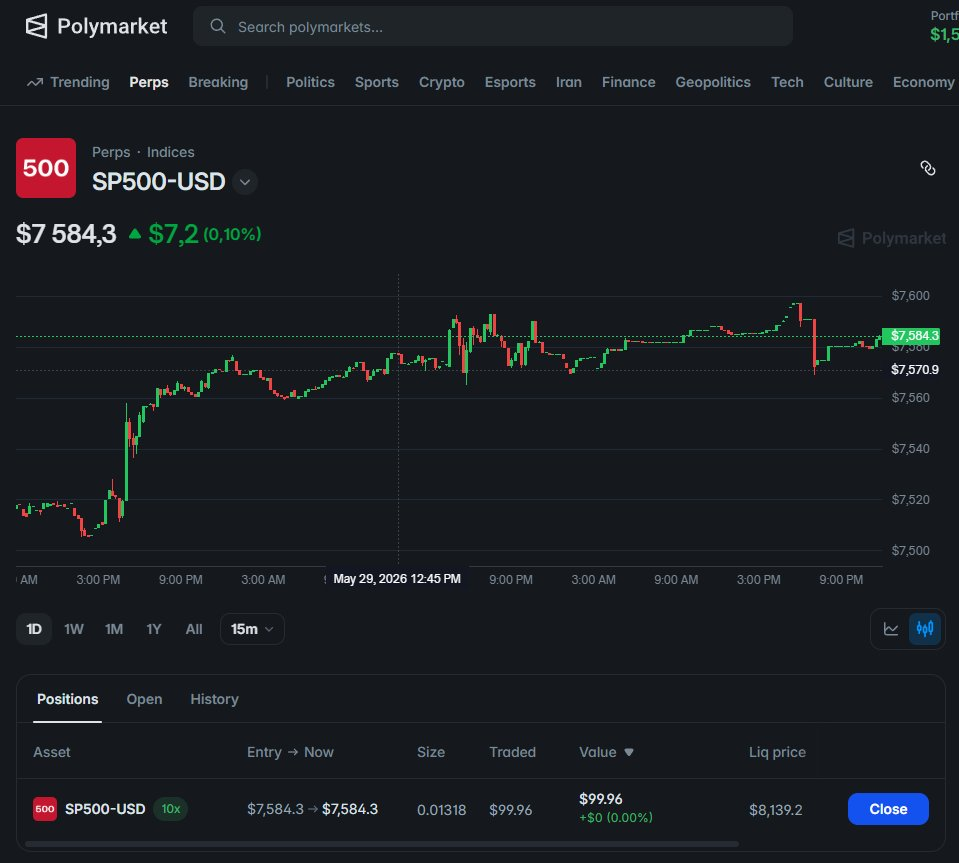
Polymarket’s DeFi VP of Engineering, Josh Stevens, announced on X that the Perps Beta is already accessible to a portion of users who had been added to the testing list via direct message. While access will be broadened over the next month, no additional testers will be onboarded for now. Early feedback indicates that users can already open leveraged long positions on BTC and that the interface displays crypto assets and indices, but the full list of trading pairs, leverage ratios, margin rules, and funding rates has yet to be disclosed. This beta phase is more about verifying technical stability than drawing immediate trading volumes.

The process for obtaining testing eligibility has already sparked discontent. Early applicants had to reach out via X DMs, and some were required to complete KYC verification. Although the community speculates that restrictions might be relaxed after the official launch, concerns about verification requirements and potential impacts on airdrops or points are surfacing. A more fundamental worry is liquidity—perpetual contracts rely on order book depth, slippage control, and execution reliability during volatile moves, and one user bluntly stated that “Perp liquidity is the real test.”

Polymarket’s existing user base is accustomed to binary event contracts, buying “Yes” or “No” and awaiting settlement. Perpetual contracts, however, introduce leverage, liquidations, funding rates, and ongoing position management. Professional traders will adapt quickly, but for the large cohort of prediction market novices, the learning curve and risk of losses are substantially higher. Moreover, Polymarket has faced past complaints about delays, lagging orders, and ghost fills—issues that, if replicated in a high-leverage environment, could cause far greater damage than missing a slightly better price. At this stage, Polymarket Perps is in an iterative testing phase where access restrictions, liquidity, leverage risks, and trading stability must be addressed before a full-scale launch.

Kalshi’s Bitcoin Perpetuals: Compliance First
In contrast to Polymarket’s limited testing, Kalshi made a direct regulatory breakthrough. On May 29, the CFTC approved Kalshi’s listing of BTCPERP, a perpetual contract that references the spot price of Bitcoin and will be offered as a futures product. The CFTC reviewed the application under Section 5c(c)(4) of the Commodity Exchange Act and Regulation 40.3, and found the contract in compliance with relevant rules and core principles for designated contract markets (DCMs). For the first time, a product that has long existed mainly on offshore exchanges and crypto-native platforms is being brought into a U.S. regulated exchange framework.
This move aligns with Kalshi’s long-standing approach: secure regulatory clearance first, then use that compliant status to expand product categories. Previously, Kalshi used its DCM license to offer event contracts on politics, economics, weather, and sports as regulated financial instruments. Now it is replicating that model for crypto perpetuals, aiming to position itself as a broader regulated derivatives exchange rather than just a prediction market. However, the CFTC also noted that perpetual contracts are not suitable for all asset classes, and any uncovered assets must still go through the Regulation 40.3 review process. This means Kalshi’s expansion will be slower and more tightly governed by the regulatory cycle, making it difficult to rapidly roll out a large number of trading pairs like offshore exchanges do.

Divergent Paths: Validate Demand or Secure Regulation First
Polymarket is verifying market demand first and gradually dealing with compliance boundaries, leveraging its crypto-native user flow and product speed. Kalshi, on the other hand, is first carving out regulatory space and then using regulatory certainty to expand into new products, leveraging its U.S. compliant identity and institutional narrative. The CFTC’s approval of BTCPERP is not just about adding a new trading instrument; it marks a shift in Kalshi’s identity from a “prediction market platform” to a “regulated derivatives exchange.”

From Event Trading to a Contract Business: The Real Test
Prediction markets do not lack trading scenarios—elections, sports, macro data, crypto prices, and breaking news can all be packaged into tradable markets, and both Polymarket and Kalshi have proven that event trading is a profitable business. But perpetual contracts open up an additional layer of growth: they are more standardized and more easily absorb the capital and habits of seasoned traders. For platforms, launching perps is not because event trading is not lucrative, but because they want to add a more mature contract business on top of it.

However, entering the perpetuals arena pits Polymarket and Kalshi against established crypto exchanges like Hyperliquid, Binance, OKX, and Bybit. Users will directly compare liquidity, slippage, matching stability, leverage experience, and risk controls. The brand equity and traffic from prediction markets will not automatically translate into competitiveness in contract trading. The real challenge is converting event-driven traffic into sustained trading traffic. Only when users open the platform not just for major events but to consistently trade volatility and manage positions will prediction market platforms truly begin to grasp the exchange business. Whether through Polymarket’s incremental testing or Kalshi’s regulatory-first path, the answer will be found at the intersection of liquidity, risk management, and user habits.