

A PANews-translated article from blocmates says prediction markets and meme coin trading may look like different arenas, but the habits that matter in both are often the same: cut through noise, watch for unusual activity, and act only after a case is built.
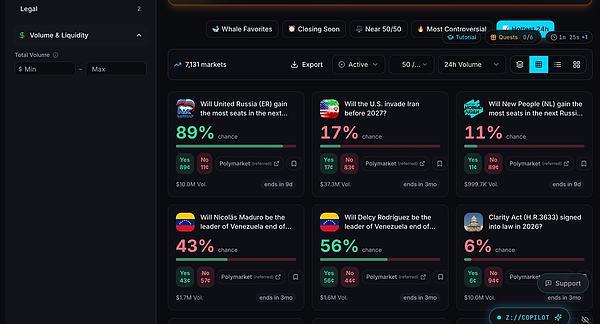
The piece frames prediction markets as, in some ways, meme coins with probabilities attached. A contract priced at $0.55, it notes, implies the market assigns a 55% chance to that outcome. In both markets, prices can move with narratives, attention, speculation, whale activity, and retail fear. The asset changes. Trader psychology often does not.
Start by narrowing the field
The article says the first step is to filter out noise. Just as meme coin traders may use tools such as fomo or Axiom to scan thousands of tokens, prediction market traders also need a way to reduce the number of contracts they are watching.
According to the piece, PolymarketScan (@PolyWhaleAlerts) lets users explore and filter markets through several data points:
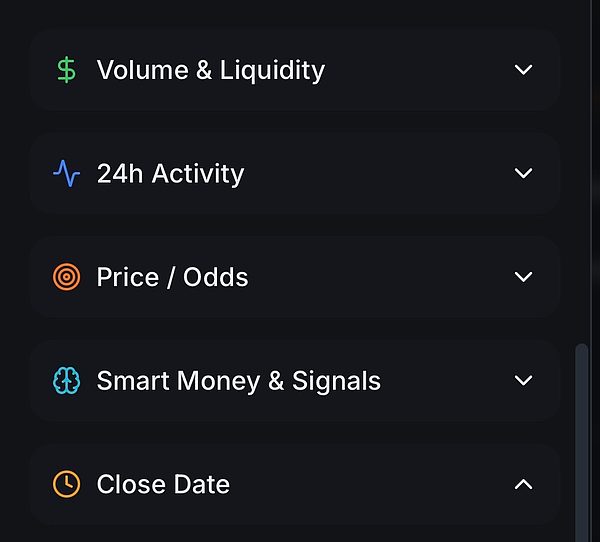
- Volume
- Liquidity
- Smart money
- Probability change
- Deadline
- Time remaining until settlement
- Recent activity
Those filters are meant to answer a simple question: which markets are showing meaningful activity, have enough liquidity, and deserve closer work right now?
The article says users can quickly isolate markets where probabilities have shifted sharply, volume looks unusual, or resolution is near. They can also narrow results by event type through manual search or an AI mode.
After a price move, examine whales and trader profiles
Once a market is selected, the article says the next task is to understand the move rather than chase it. Because market prices reflect the implied probability of an outcome, a price increase shows that traders are assigning more weight to a different result.
It highlights two lines of inquiry.

Whale activity
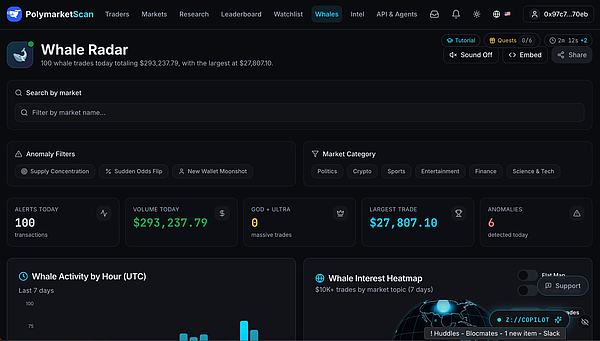
The first is whale activity. Traders can check whether a move is backed by large orders, whether sizable positions are entering or leaving, and whether shallow market depth may have made a contract easier to push with a single trade or a whale-sized order.
The article adds a clear warning: a large trade can be a starting point for research, but trade size alone does not prove that the trader has better information.
Trader profiles
The second is trader profiling. Instead of stopping at the whale alert, the article recommends investigating the wallet itself, including its history, the markets it has traded, and any performance data that can be observed.
If a wallet has built a large position, the piece suggests asking:
- What markets does it trade?
- Has it participated in similar events before?
- How has it performed on resolved positions?
- Is the position part of a broader strategy?
The article compares this approach with the pattern-based systems used in meme coin social trading, where studying repeat behavior can offer more context than any single transaction.
Following smart money takes more than a leaderboard
The piece says anyone who has traded meme coins already knows the value of tracking smart money: early entries, repeated behavior, and fund flows. It argues that the same lens can be applied to prediction markets.
PolymarketScan's Whale Radar and leaderboard features can help surface wallets and traders worth checking, the article says. But to narrow the field in a useful way, users still need their own watchlists and alerts.
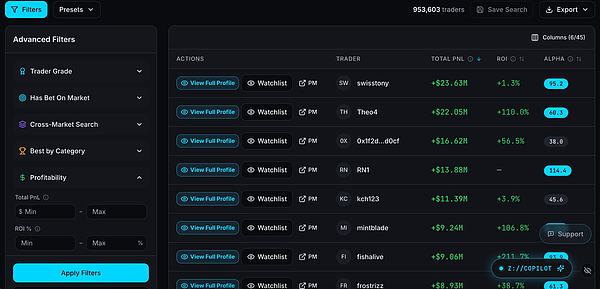
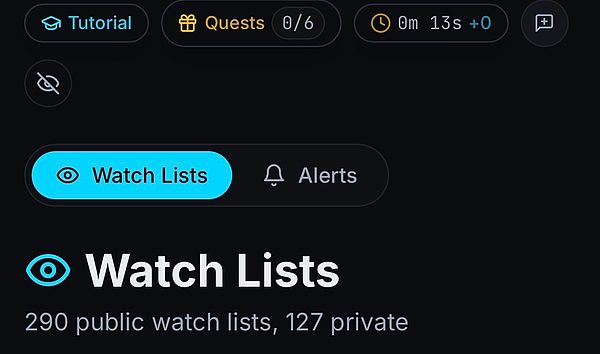
That can be done manually, or through public curated lists. The article says there are already more than 290 public watchlists available, though it still recommends building lists around specific market categories.
It lays out a simple workflow for creating a watchlist:
- Find an active wallet or trader.
- Open the profile and review its history.
- Check which markets it has traded.
- Compare that activity with your own market research.
- Decide whether it adds meaningful information to your analysis.
- Add it to the list.
Resolved markets are part of the research set too
The article says strong traders do not learn only from open markets. They also review closed ones.
It draws a parallel with meme coin analysis, where traders often point to a token's previous market-cap peak when discussing what a similar asset might do next. In prediction markets, historical records can serve a similar purpose if the platform preserves them. Past markets can be used to review price action, trading activity, and trader performance.
The piece suggests watching for several patterns:
- How probabilities change as an event approaches
- When major price moves happen
- Volume ahead of resolution
- How wallets behave across market categories
- The gap between early pricing and the final outcome
It says PolymarketScan's research tools are built for that kind of work. Users can search by keyword or pull phrase data from resolved markets to study how those markets behaved.
What the platform says about its AI tool
The article also includes a statement from the PolymarketScan team for users who do not want to handle the data themselves: 「We built an AI that can read Polymarket data so you do not have to. Ask any question in natural language, and it will answer using real-time data while showing the source for every number. You can ask 30 questions for free without registering. PolymarketScan is an independent analytics platform supported by Polymarket. When users trade through its links, the platform may receive referral fees from Polymarket's developer program. Market data comes from Polymarket. This content is not investment advice. Trading carries risk and users may lose all of their funds. Service is limited to users age 18 and above.」
Tools can structure the process, not remove uncertainty
The article closes by arguing that prediction markets and meme coin trading call for similar discipline: filter noise, identify meaningful activity, understand the narrative, build a reason for a position, and then execute.
Tools such as PolymarketScan can make research more organized, it says, but they do not eliminate uncertainty. Whether capital is deployed automatically or trades are placed manually, execution still rests with the trader.
The final point is straightforward. No one can realistically trade every market. The practical goal is to build a repeatable process and work within a success rate the trader can accept.