
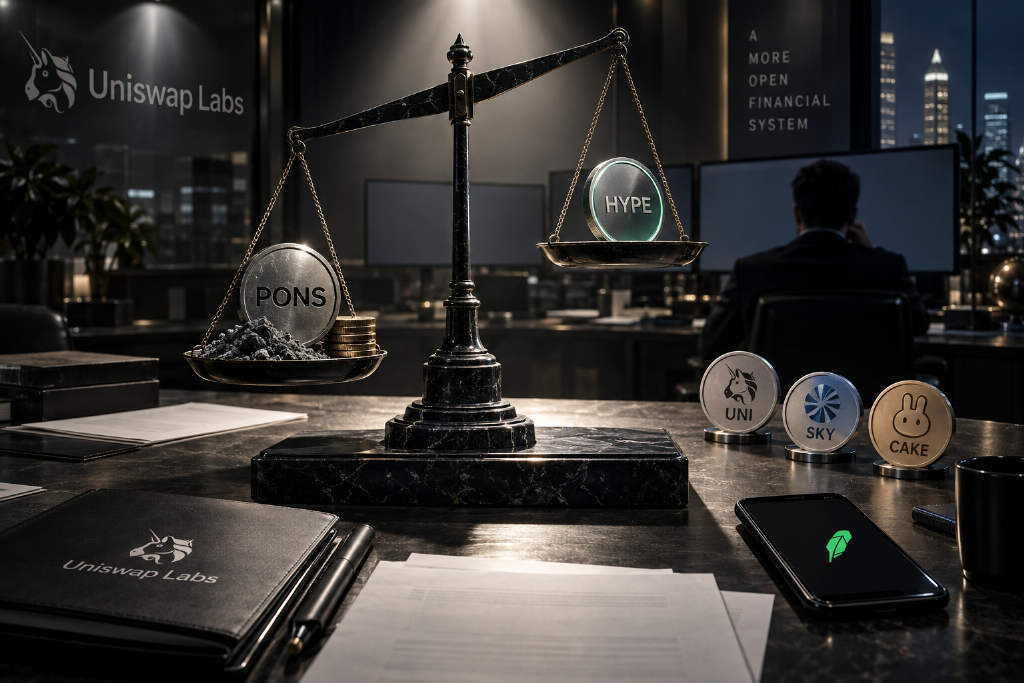
DeFi tokens that use buyback-and-burn mechanisms are no longer being priced in anything close to the same way.
Using circulating market capitalization divided by annualized revenue from the past seven days, PONS, the token of Robinhood’s on-chain token issuance platform Pons, is valued at 0.9x. On the same basis, HYPE, the token tied to decentralized exchange Hyperliquid, stands at 29.2x. Both ecosystems are using buybacks and burns. The valuation gap is still more than thirtyfold.
The point is not simply that one token looks cheaper than the other. The comparison puts DeFi tokens into a framework that looks much closer to equity-style pricing: how much a protocol earns, how much of that revenue stays at the protocol layer, how much actually reaches the token, and how much the market is willing to pay for that stream of income.
Buybacks are no longer enough on their own
The article makes clear that the "P/E" used here is not the same as the traditional price-to-earnings ratio in corporate finance. It is a rough metric based on circulating market cap divided by annualized protocol revenue. It does not factor in profit, tax, or shareholder equity. Even so, it offers a direct way to compare how the market is valuing income-bearing DeFi tokens.
Across five major buyback tokens, the spread is wide:
- UNI has a 7-day P/E of 15.2x and a yield of 4.44%.
- SKY holds at 9.0x on both a 7-day and 30-day basis, with little change.
- CAKE trades at 4.8x on a 7-day basis, with an 8.5% yield.
- PONS has the highest yield in the group at 24.7%, but also the lowest multiple.
The difference between the 7-day and 30-day readings comes from annualizing revenue from the last seven days versus the last 30 days. A wider gap points to greater recent volatility in revenue. For PONS and UNI, the 7-day P/E is lower than the 30-day figure, which suggests revenue growth in the past week ran ahead of the pace seen over the past month. HYPE shows the opposite pattern. Its 7-day P/E is higher than its 30-day figure, indicating that revenue growth in the most recent week slowed slightly relative to the broader monthly trend.
The piece also notes that buybacks and burns used to function as a scarce signal in crypto. BNB turned quarterly burns into a benchmark for exchange tokens, and FTT was once heavily promoted through a buyback narrative as well. Data from DeFiLlama shows that 55 of the 106 protocols it tracks are now marked as having "active buybacks." As that feature becomes more common, the market is asking a harder question: what is the buyback actually worth?
UNI: from buying status to buying revenue
For a long time, Uniswap’s main narrative centered on trading volume and market share. But volume by itself is not UNI revenue. Fees have to be split among liquidity providers, the protocol, and other participants first. Only the portion retained at the protocol layer can be used to pass value through to UNI.
According to the article, that changed after the protocol fee mechanism and the burn contract were put in place. The chain now looks like this: trading activity rises, protocol fees increase, UNI is bought and burned, and total supply falls.
That transmission became more powerful after Robinhood Chain, the public chain backed by Robinhood, went live. On Sept. 1, daily trading volume on Robinhood Chain briefly reached $1.43 billion, a record high. The surge in trading has become an important incremental source of both Uniswap protocol revenue and UNI burns. That is part of the logic behind UNI’s 15.2x multiple. In the article’s framing, the market recognizes the revenue pass-through, but it is still applying a discount to durability.
PONS: cheap because the revenue is not proven yet
PONS at 0.9x can easily trigger an immediate "undervalued" reaction. The article argues that the more important question is why its revenue is so high in the first place.
Pons has captured what is currently one of the hottest entry points on Robinhood Chain: new token issuance and trading. Under the mechanism described, each trade carries a 1% fee, 30% of that goes to the protocol, and about 80% of the protocol share is used to automatically buy back and burn PONS. By early September, about 29% of the total supply had already been burned. At one point in early September, daily fee revenue reached about $5.95 million, topping Pump.fun.
The problem, as framed in the article, is that this income has not been tested through a cycle.
The buyback data shows why. PONS bought and burned about $7.93 million over the most recent seven days, which accounted for 88% of the roughly $8.98 million over the past 30 days. In other words, most of the month’s buyback activity was concentrated in the latest week. That looks less like a stable revenue base and more like a sudden burst of trading activity.
There is also a clear near-term variable. Robinhood Chain is offering a 90-day gas subsidy to eligible Robinhood Wallet users, and that program is set to expire on Sept. 29. The article argues that this deadline will offer the first real test of how much current high-frequency trading has been supported by low-cost or zero-gas conditions.
On that reading, PONS is not necessarily being ignored by the market. Its low multiple reflects a discount on the sustainability of unusually high revenue. The 0.9x valuation is less a statement about what today’s revenue is worth and more a bet on how long the token issuance frenzy can last.
Uniswap Labs has already bought PONS
The article adds another layer to the comparison: Uniswap Labs has already bought PONS.
At the same time, Uniswap has launched Pools on Robinhood Chain, a launchpad that competes with Pons for token issuance and trading users. That means Uniswap Labs is not just competing with Pons. It is also a holder of PONS. In the article’s framing, this turns the PONS valuation question from a simple question of cheap or expensive into a potential risk variable for UNI if the issuance boom fades.
HYPE: expensive because the market is paying for confidence
HYPE at 29.2x points in the opposite direction. The market is not using a simple rule where more buybacks automatically mean a lower valuation.
Hyperliquid’s revenue comes from core businesses such as perpetual futures and spot trading. The chain described in the article is straightforward: trading scale expands, fee revenue rises, the Assistance Fund grows, and HYPE buybacks increase. The higher multiple reflects a market that is willing to pay up for the continuity of that income stream, essentially betting that Hyperliquid can keep trading activity at elevated levels.
That premium still has conditions attached. The article notes that HYPE’s 7-day P/E of 29.2x is above its 30-day P/E of 24.5x. That suggests revenue growth over the latest week has slowed slightly compared with the pace over the prior month. The market may be willing to pay for certainty, but only if revenue does not continue to decelerate.
Seen this way, PONS and HYPE are pricing two different things. PONS offers a high yield tied to what the article describes as hot money that has not been cycle-tested. HYPE offers a lower yield, but one that the market appears to view as more durable. Looking only at the amount spent on buybacks can lead to the wrong conclusion.
SKY and CAKE: two other models
SKY follows a different route. It does not rely on high-frequency trading for revenue. Instead, the article says its income comes more from stablecoin operations and real-world asset, or RWA, allocation returns. Part of that income is then used for buybacks and staking incentives. Its valuation has remained around 9x for a long period, with limited volatility.
CAKE represents another structure. Its revenue is spread across several business lines, including AMM, stablecoin swaps, and prediction markets. In August alone, 2.746 million CAKE were burned, with a net supply reduction of about 2.072 million. Total supply has now declined for 36 consecutive months. Even so, the article argues that CAKE at 4.8x should not automatically be read as undervalued. Instead, the market appears to be assigning it a lower premium than HYPE while recognizing that it has already spent three years proving it can keep shrinking supply.
Low P/E does not automatically mean cheap
The article closes by borrowing a familiar idea from traditional markets. Investor Peter Lynch once argued that cyclical stocks are often bought when their P/E is high and considered for sale when their P/E is low, because earnings are strongest at the top of the cycle. That pushes up the denominator and makes the multiple look cheap just when the market is warning that the earnings level may not last.
In the article’s view, DeFi tokens are now showing something similar. PONS at 0.9x may not mean the market has mispriced it. It may mean the market has already priced in the possibility that the token issuance boom on Robinhood Chain will not hold for long. By the same logic, HYPE at roughly 29x may not be expensive if Hyperliquid can keep revenue growing. In that case, the multiple is simply the market’s price for future cash flow.
The article also says that PONS’ high yield is, in essence, a market vote on how long the Robinhood Chain issuance battle can continue. Uniswap Labs has already put part of its own position on that outcome. That creates a crossover in UNI’s valuation logic: a token once priced mainly through protocol fees is now indirectly linked to an asset that has not yet been validated across a full cycle.
By this measure, the key question is not which token looks cheaper on a headline multiple. It is which protocol revenue stream can stand the test of time. PONS at 0.9x is a bet on how long the Robinhood Chain issuance boom lasts. HYPE at 29x is a bet on how long perpetuals-driven revenue can stay strong. The first has to prove it is more than a short-lived rush. The second has to prove it deserves a certainty premium.
This content is for reference only and does not constitute investment advice. Markets carry risk. Investors should exercise caution.