U.S. Treasury
Nov 5, 2026

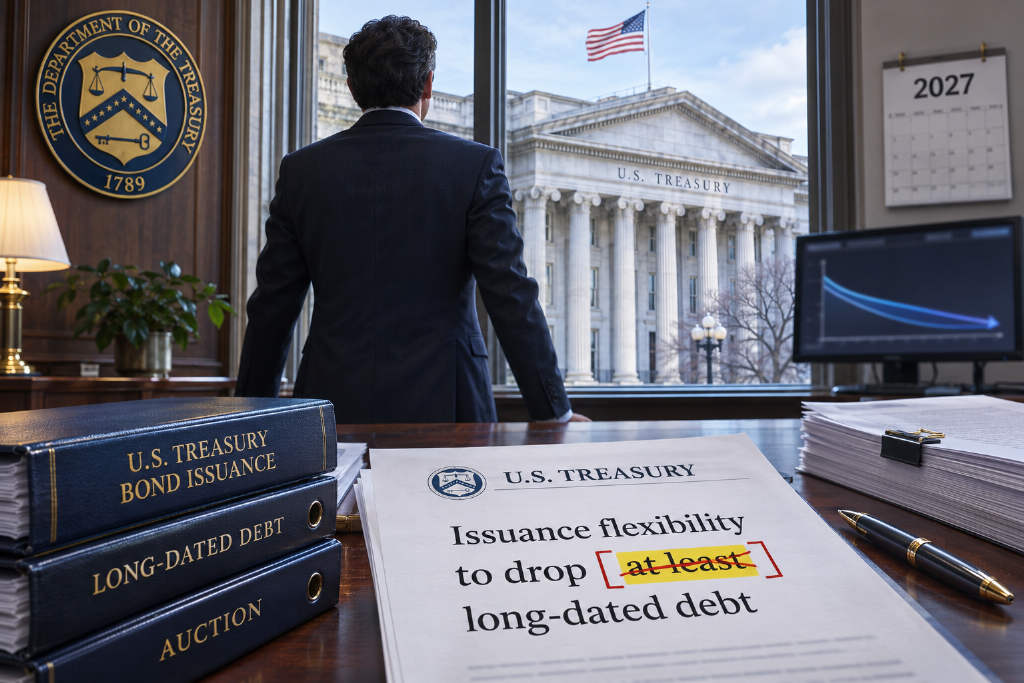
U.S. Treasury drops "at least" from debt guidance, opening room for long-bond cuts from 2027

The U.S. Treasury has revised its forward guidance on debt issuance, removing the phrase "at least" from language that had said nominal coupon and floating-rate note auction sizes would remain unchanged for the next several quarters. The wording change, made in Wednesday’s quarterly refunding statement, is being read as a move that preserves flexibility to reduce long-term Treasury issuance as early as 2027. The adjustment is the latest step tied to Treasury Secretary Scott Bessent’s efforts to contain long-end yields. Treasury said auction sizes for nominal coupon securities and floating-rate notes will stay unchanged over the coming quarters, while keeping the maximum size of upcoming long-bond buybacks at $6 billion per operation. That cap remains in line with recent practice and is three times the previous ceiling cited in the report. The Treasury Borrowing Advisory Committee, or TBAC, had already urged the department in February 2025 to revise or remove the guidance language, and repeated in August that the Treasury should consider updating it to preserve flexibility ahead of fiscal 2027. On Wednesday, the 10-year Treasury yield fell 3 basis points to 4.922%, while the 30-year yield had climbed to its highest level since 2002 last month despite expanded buyback operations.
420
U.S. Treasury drops "at least" from debt guidance, opening room for long-bond cuts from 2027
Strategy
Nov 4, 2026

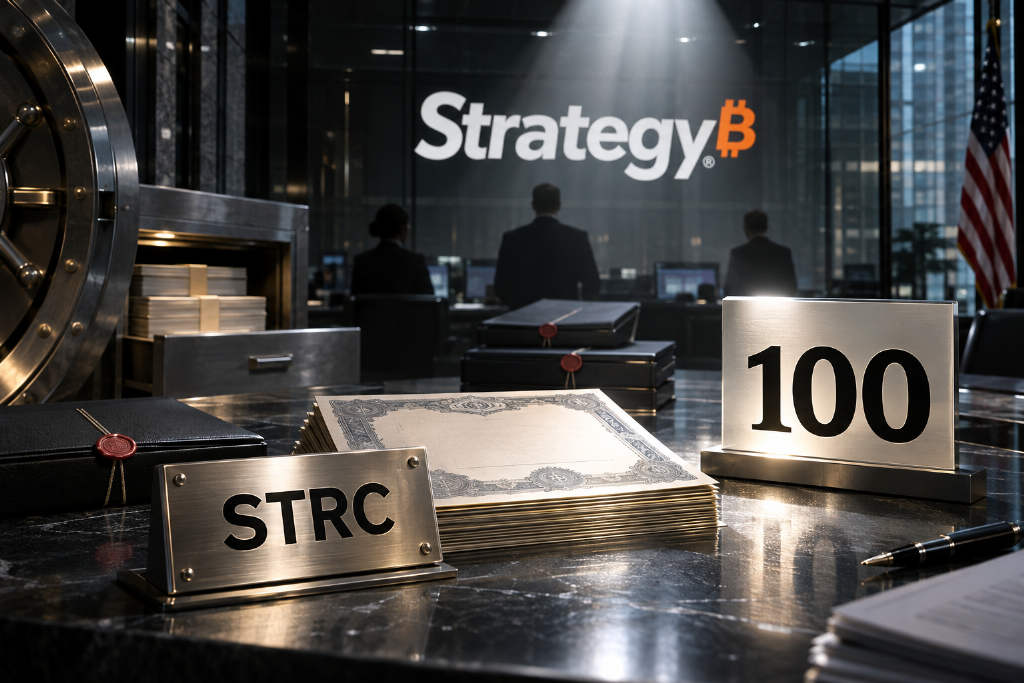
Strategy’s STRC Returns to $100, Reaching Its Stated Floor for New Issuance

Strategy’s preferred stock STRC has climbed back to $100 for the first time since May, according to The Defiant. The move followed about $2.25 billion in buybacks and brought the security back to the company’s stated minimum price for new issuance. The source material does not provide additional detail on the timing or structure of those repurchases beyond the headline figure, nor does it outline any new issuance plan beyond noting the stated floor. The report also does not add broader market context, trading data, or commentary from company executives. Based on the available information, the key development is straightforward: STRC has recovered to $100 after substantial buybacks, restoring the preferred stock to the level Strategy has identified as the minimum price for issuing new shares.

610
Strategy’s STRC Returns to $100, Reaching Its Stated Floor for New Issuance
Strategy
Nov 2, 2026

Strategy Buys 811 BTC With MSTR Share Sales as STRC Buybacks Pass $400 Million in Two Weeks

Strategy said it bought 811 bitcoin for $65.5 million in the week ended Nov. 1, according to a Form 8-K filed Monday. The company paid an average of $80,846 per coin, including fees, bringing its total holdings to 849,327 BTC acquired for $64.08 billion at an average cost of $75,451 each. Executive Chairman Michael Saylor also confirmed on X that the company had acquired 811 BTC and repurchased $208 million of STRC. The latest bitcoin purchase was funded entirely through sales of Strategy’s Class A common stock. Under its at-the-market program, the company sold 1,178,552 MSTR shares for $164.0 million after commissions. Of that amount, $65.5 million went to bitcoin and $98.5 million was added to USD Cash. Strategy said it did not issue any of its four preferred stocks — STRF, STRC, STRK, and STRD — during the week. At the same time, the company spent $208.2 million in USD Cash to repurchase 2,092,035 STRC shares. Unchained calculated that Strategy has spent $413.1 million on STRC buybacks since Oct. 19 across the last two weekly filings, more than six times the $65.5 million it spent on bitcoin over the same period.

770
Strategy Buys 811 BTC With MSTR Share Sales as STRC Buybacks Pass $400 Million in Two Weeks
DeFi
Nov 1, 2026

DeFi Fees, Revenue, and Holder Payouts: A Look at How the Money Moves

The Defiant published a piece examining how money flows through DeFi protocols, focusing on the distinction between fees, revenue, and payouts to token holders. The article says buybacks and token burns can be counted as holder revenue even when no cash is sent directly to a holder’s wallet. It also uses a worked example to separate those flows from treasury income and staking payouts. The piece centers on classification: several streams may come from protocol activity, but they do not represent the same kind of economic transfer. By drawing a line between buyback-and-burn mechanics, treasury income, and staking distributions, the article highlights how reported DeFi revenue figures can describe different things depending on methodology.

780
DeFi Fees, Revenue, and Holder Payouts: A Look at How the Money Moves
JPMorgan
Oct 30, 2026

JPMorgan says retail leverage, short covering and buybacks are still backing tech stocks into year-end

JPMorgan’s Oct. 28 flow report argues that the force behind the latest tech rally is no longer centered only on earnings. Positioning and liquidity now matter just as much. Over the past two weeks, retail investors poured a record amount of money into leveraged equity ETFs, a move the bank linked to the recent stabilization in AI-related stocks. The report says this buying came after a period of deleveraging, with assets in single-stock leveraged ETFs falling to their lowest level relative to underlying market value since late May and roughly two-thirds of the April-May rise already erased from the peak. JPMorgan also points to other sources of potential demand. Small-lot call option buying had not yet returned to earlier strong levels as of the week ended Oct. 23, leaving room for retail participation to rebuild through options. On the institutional side, speculative investors including hedge funds were running lower equity exposure than they held in mid-September, while the short interest ratio in QQQ had climbed to its highest level since 2023 as of Oct. 27, creating scope for covering flows. Corporate buybacks remain another pillar. JPMorgan estimates global announced buybacks reached about $1.55 trillion by Oct. 26, with a full-year annualized pace of roughly $1.7 trillion, above last year, even as tech capital spending rose sharply. The bank says the durability of funding channels for highly rated technology companies remains the key condition for this support to continue.

480
JPMorgan says retail leverage, short covering and buybacks are still backing tech stocks into year-end
Bitcoin
Oct 26, 2026

Perpetual preferred shares funded 136,000 BTC purchases, but Strategy now faces dividend and buyback strain

Perpetual preferred stock has become a major funding tool for bitcoin treasury companies such as Strategy and Strive, opening the door to income-focused investors who may not want direct exposure to BTC. According to Fidelity Digital Assets analyst Zack Wainwright, these securities have financed the purchase of about 136,000 BTC over the past 20 months, or more than 0.5% of bitcoin’s maximum supply. Fidelity estimates the bitcoin-focused preferred market at roughly $12 billion, still tiny next to the $150 trillion global fixed-income market. Analysts interviewed by CoinDesk said the structure now faces a tougher test. As more preferred shares are issued, dividend obligations keep rising. If the securities trade below par, new issuance becomes less attractive and companies may need to spend cash on buybacks instead. CoinShares’ James Butterfill said Strategy’s latest weekly report showed $193 million spent repurchasing STRC while only 267 BTC were bought over the same period, and that the company raised its preferred buyback authorization to $3 billion. He also said Strategy had previously sold some bitcoin to meet preferred dividend payments. Analysts added that U.S. spot bitcoin ETFs remain the larger demand channel, with about $57 billion in cumulative net inflows and roughly $106 billion in assets under management.

590
Perpetual preferred shares funded 136,000 BTC purchases, but Strategy now faces dividend and buyback strain
Aave
Oct 22, 2026

Stani says Aavenomics 3.0 will include AAVE buybacks, staking and burns

According to Odaily, citing market chatter, Aave founder Stani said during a livestream that Aavenomics 3.0 will include an AAVE buyback program, staking and a burn mechanism. The update points to three core components tied to the token model, but no launch date, operating parameters or implementation details were disclosed in the brief. The report did not specify the format of the buybacks, how staking would be structured, or under what conditions token burns would take place. For now, the only confirmed information in the item is Stani’s livestream remark that these elements are set to be part of Aavenomics 3.0.

850
Stani says Aavenomics 3.0 will include AAVE buybacks, staking and burns
Pendle
Oct 20, 2026

Pendle cut incentives by 58%, yet TVL rebounded 43% as RWA dollar assets took over

Pendle posted an unusual quarter in Q3 2026: after cutting PENDLE mining incentives by an estimated 58%, the protocol’s V2 TVL did not collapse. Instead, it rebounded 43% from its June 30 low to finish the quarter at $1.16 billion, according to a report by Alea Research translated by TechFlow. The shift was driven by a sharp change in asset mix and funding sources. In Pendle’s top 50 pools, tokenized dollar assets backed by real-world assets rose from 70% at the end of June to 85% by the end of September, while Ethena’s once-dominant yield dollar share fell from 77% in August 2025 to less than 10%. The report also points to a growing lending loop around Pendle principal tokens, or PT. PT accepted as collateral across major lending protocols doubled in Q3 to more than $496 million, and Pendle’s PT Looping tool went fully live on Sept. 23. At the same time, the protocol used 80% of retained fees for buybacks, with profit-funded repurchases reaching 3.2 PENDLE for every 1 PENDLE emitted during the quarter. The next test comes in Q4: about 90% of current capital is set to mature, including a single re.xyz market with $236 million due on Dec. 10.

940
Pendle cut incentives by 58%, yet TVL rebounded 43% as RWA dollar assets took over
Total 59 items
Go topage