
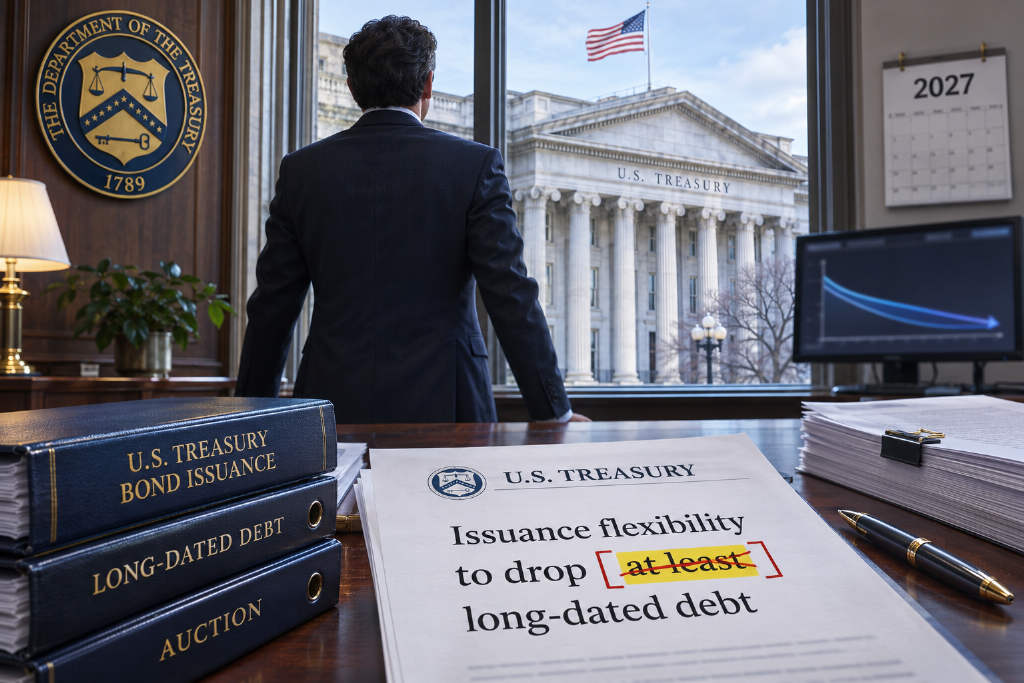
The U.S. Treasury has changed a key line in its debt issuance guidance, creating room to cut long-term bond supply as early as 2027. The move is the latest in a series of steps linked in the report to Treasury Secretary Scott Bessent’s push to restrain long-end yields.
In its quarterly refunding statement on Wednesday, the Treasury said auction sizes for nominal coupon securities and floating-rate notes will remain unchanged over the next several quarters. But it removed the phrase "at least," wording that had been used since early 2024. That small edit leaves the department with more flexibility and is being read as opening the door to lower long-dated issuance from 2027.
For markets, the change adds to a string of actions taken over recent months. Just two weeks after the August refunding statement, the Treasury unexpectedly expanded Treasury buybacks by a large margin. Even so, that step did not stop long-end yields from rising. The 30-year Treasury yield climbed last month to its highest level since 2002.
Dealers had been split ahead of Wednesday’s statement over what, if anything, would change. Some institutions had expected only limited adjustments, given that yields had already pulled back from their early-October highs. On Wednesday, the 10-year Treasury yield fell 3 basis points to 4.922%.
Why the wording change matters
The edit looks minor. It is not.
Since early 2024, the Treasury had said coupon auction sizes would remain unchanged "at least" over the next several quarters. Markets broadly took that to mean near-term supply cuts were off the table. By dropping those two words, the Treasury has preserved the option to adjust issuance later.
The Treasury Borrowing Advisory Committee, or TBAC, had already pushed for that change. In February 2025, the committee — made up of bond investors, dealers and other market participants — recommended that the Treasury remove or revise the forward-guidance language.
In August this year, TBAC again advised the Treasury to "consider updating the forward guidance language to preserve operational flexibility ahead of fiscal 2027." On Wednesday, TBAC formally recommended revising the language and said that "clear communication and a regular, predictable operating framework are critical to helping market participants adapt to future changes."
The Treasury had already laid some groundwork in its Aug. 5 refunding statement. At that time, it changed its wording on possible adjustments to coupon and floating-rate note sizes from "increases" to "changes," leaving room for reductions in supply later. Removing "at least" now makes that signal more explicit.
Buyback cap stays at $6 billion
On buybacks, the Treasury said Wednesday that the maximum purchase size for each upcoming long-term Treasury buyback operation will remain $6 billion, in line with recent practice. The report said that level is already three times the previous cap.
The Treasury also said it will "continue to evaluate potential improvements to buyback operations, including changes to maximum purchase amounts, buyback scheduling and frequency, security eligibility, and execution processes," pointing to possible further adjustments.
So far, though, larger buybacks have not delivered the intended effect on long-end yields. The 30-year Treasury yield still rose last month to its highest level since 2002, suggesting the market response to the Treasury’s recent measures has been limited.
$125 billion in refunding auctions next week
For this quarter’s refunding, total auction size next week will remain $125 billion, unchanged for an 11th straight time. The breakdown disclosed in the report includes $58 billion of 3-year notes on Nov. 9, $42 billion of 10-year notes on Nov. 10, and the Nov. 12 leg of the schedule.



