

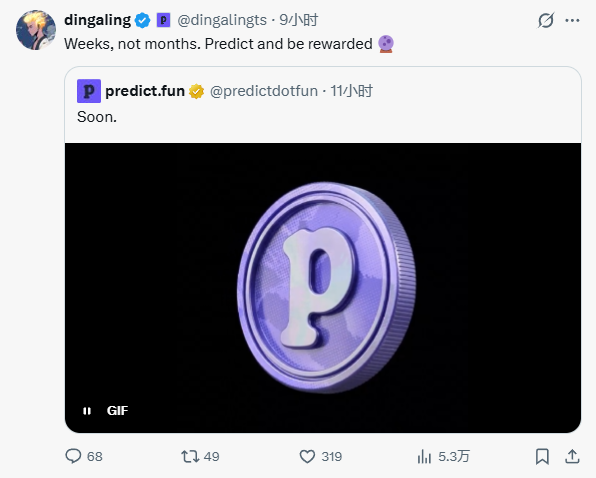
predict.fun, a prediction market project on BNB Chain, has added to token launch expectations after posting "Soon" on X at 10 a.m., paired with an image showing a token marked with the letter P. Founder dingaling later quoted the post and wrote, "Weeks, not months. Predict and earn rewards," giving the market a narrower timeline than the original teaser.

According to the source article, predict.fun is a prediction market platform on BNB Chain founded by dingaling, who was previously known in the NFT sector. Unlike traditional prediction markets such as Polymarket and Kalshi, predict.fun says user funds are not left idle during the prediction period and can continue generating additional yield.
The project has completed two funding rounds so far. In December 2025, it entered YZi Labs EASY Residency Season 2 and received its first investment and incubation support. On April 2, 2026, YZi Labs joined again in a strategic follow-on round, with Susquehanna Crypto participating at the same time. The article also cited a previous reply from dingaling in the official Discord saying new financing news may be announced soon.
On distribution, predict.fun has already been embedded into the main Binance platform and Binance Wallet, allowing users to take part in prediction trading directly through those interfaces.

A TGE window measured in weeks
Crypto projects often hint at token launches on social media, but many do not move to TGE quickly. That is why some users still questioned whether the "Soon" post might end up being another delay signal rather than a near-term launch marker.
Dingaling’s follow-up comment changed that reading. By saying the timeline was in weeks rather than months, he pointed to a countdown that the market now reads on a weekly basis. After speaking with several early predict.fun participants, the source article said community expectations broadly center on a TGE date roughly three to four weeks away, which would place it around the end of this month or the beginning of next month.
That shift showed up in prediction market pricing. Polymarket data cited in the article showed the probability of predict.fun launching a token before December 31 this year rose nearly 40% over 24 hours to 83%.
How the total points supply is being estimated
To estimate what one point may be worth, the article breaks the calculation into three parts: total points outstanding, pre-market valuation, and the airdrop ratio.
It says predict.fun points come from four main buckets:
- regular weekly point distributions, which make up the largest share;
- genesis points from Season 0;
- points brought over through the acquisition of Probable, mainly converted at a 1:10 ratio;
- ambassador points, issued at 100,000 points per week.
For estimation purposes, the article treats genesis points and Probable conversion points together as roughly equal to one standard week of issuance, or about 10 million PP. Ambassador points are described as relatively small in share and are left out of the calculation.
predict.fun settles points weekly, every Tuesday at 10 p.m. The token launch signal was released on a Tuesday, and the article says the settlement later that night would complete the Week 42 distribution.
Based on compiled data from Week 1 through Week 41, Weeks 1 to 19 each distributed a fixed 10 million points, for a total of 190 million. Starting in Week 20, the weekly amount was no longer fixed. Across Weeks 20 to 41, a span of 22 weeks, total issuance reached 216,997,841 points, or about 217 million PP.
That puts total issuance for the first 41 weeks at about 407 million points. If Week 42 is estimated at another 10 million points, official issuance to date would be about 420 million points. Adding genesis points and points from the acquisition and merger process brings the total to roughly 430 million points.
If TGE arrives around late October to early November, using the article’s assumptions, the total points supply would be around 460 million to 470 million. If the airdrop snapshot date ends up being December 1, the total would rise to 500 million.
Pre-market valuation and opening expectations
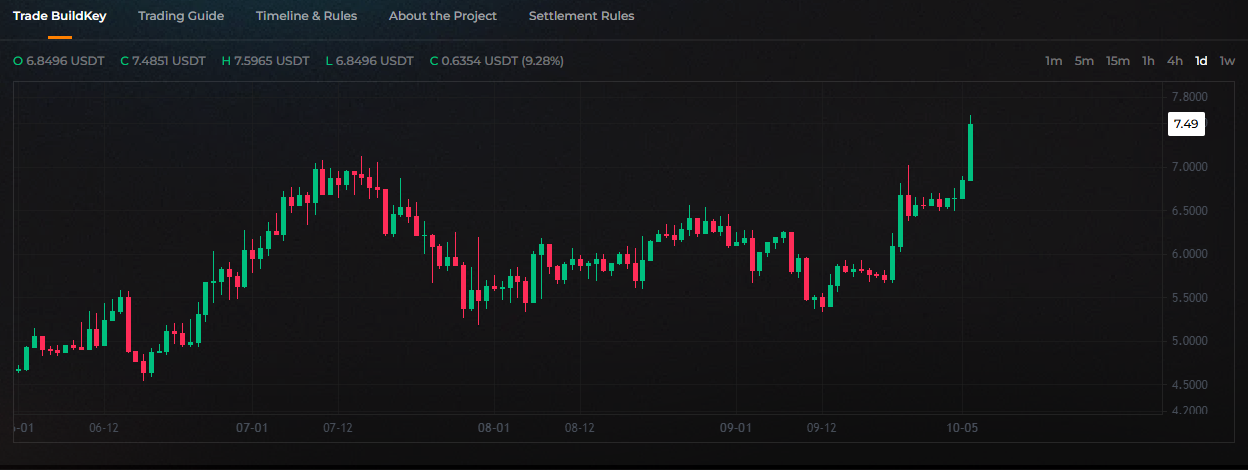
Aspecta data cited in the article puts predict.fun’s pre-market valuation at about $750 million, with total trading volume at $2.44 million.
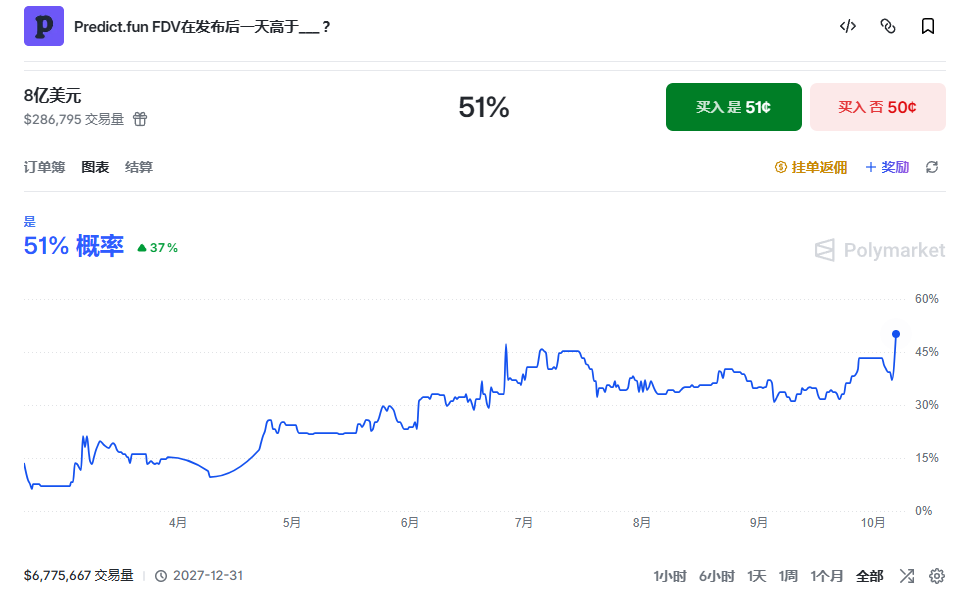
Separately, Polymarket data showed a 51% probability that predict.fun’s fully diluted valuation would exceed $800 million one day after trading opens.
Using those figures, the article says a $700 million to $800 million opening valuation looks like a reasonable base case under current market conditions. It also notes that a more optimistic outcome, near $1 billion, cannot be ruled out if sentiment is lifted by factors such as another financing round or renewed public support from CZ.
The airdrop ratio is still unknown
There is still no confirmed figure for the Season 1 airdrop ratio.
The article points instead to two earlier comments from dingaling in the official Discord as reference points. In one, he said OPN’s 3% airdrop ratio was too low. In another, during a community discussion about Variational’s airdrop ratio, he said 32% was not achievable.
Those remarks do not determine predict.fun’s final allocation, but they do help frame a range. Because the team may continue with later seasons such as S2 and S3 after TGE and would need to reserve tokens for future incentives, the article uses a 5% to 20% range as a working estimate for the first-season airdrop.
What one point could be worth
For the valuation exercise, the article uses a relatively conservative assumption on total points and a relatively optimistic assumption on FDV: 500 million total points, corresponding to a December 1 snapshot date, and a $1 billion opening FDV.
Under that framework, the estimated value per point is:
- Bear case: a 5% to 10% airdrop ratio, implying $0.1 to $0.2 per point;
- Base case: a 10% to 15% airdrop ratio, implying $0.2 to $0.3 per point;
- Bull case: a 15% to 20% airdrop ratio, implying $0.3 to $0.4 per point.
That leads to an estimated potential range of $0.1 to $0.4 for each predict.fun point.
The article makes clear that this range depends on three assumptions at once: the final points supply, the opening FDV, and the eventual token allocation plan. The actual outcome will depend on the project’s TGE timing, snapshot date, and final distribution structure.
