World Cup Ignites Prediction Market, Ordinary Users Fall into the 'Smart Money Trap'
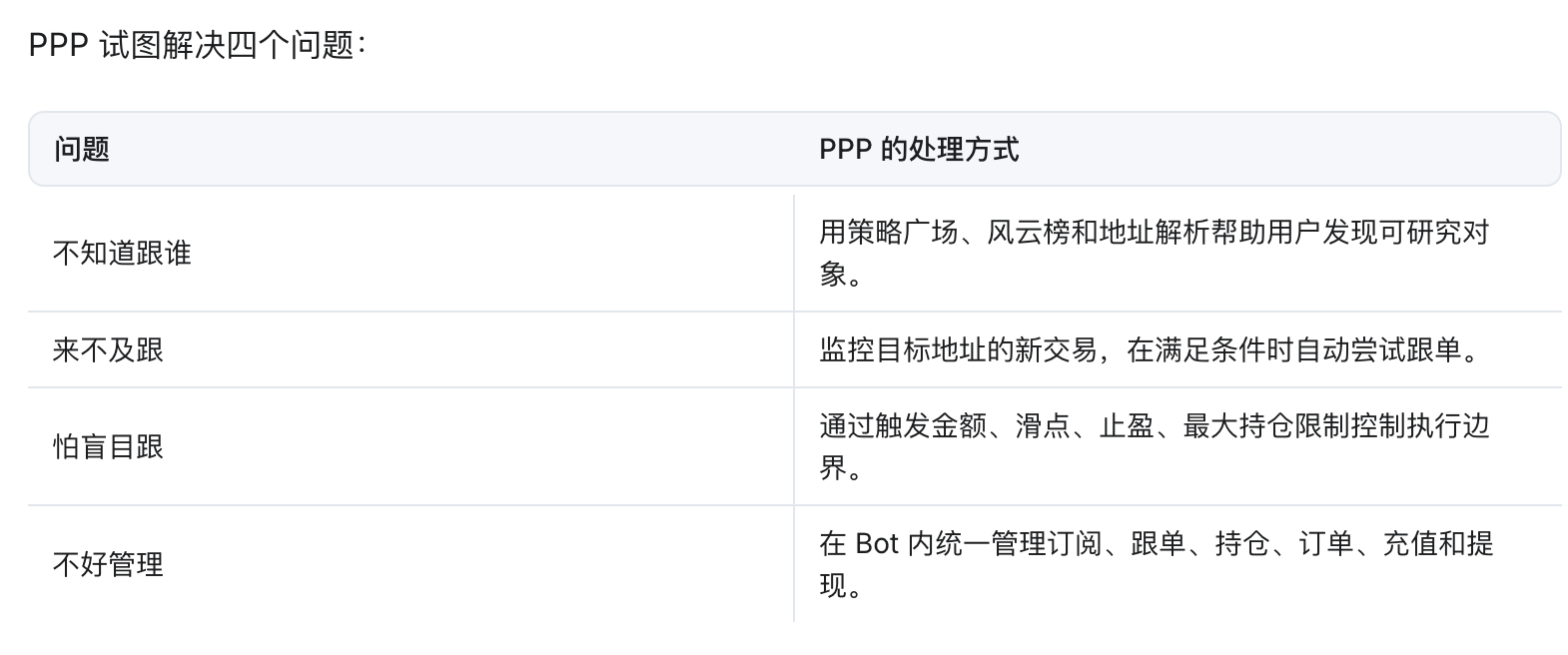
With the 2026 World Cup underway, prediction markets are experiencing a historic surge. Huge amounts of capital are flowing into match outcome, group advancement, champion, and Golden Boot betting, pushing trading volume and user participation to all-time highs. Yet most ordinary users struggle to achieve consistent profits amid rapidly changing probabilities. Many try to follow 'smart money' addresses on social media or news platforms, but manual copy-trading often fails as opportunity costs shift momentarily. Existing copy-trading tools typically rank addresses by total profit or recent win rate, leading users to ignore crucial factors such as drawdown, liquidity, position style, and track record. As a result, users who blindly follow these so-called 'experts' often end up with losses. The PPP team points out: 'Not all profitable addresses are suitable for copy-trading.' Some addresses may have profited from special information, extreme positions, one-time market moves, or capital size advantages—their profitability is not reproducible.
PPP Combines AI Modeling and Manual Review to Filter Reproducible Smart Money
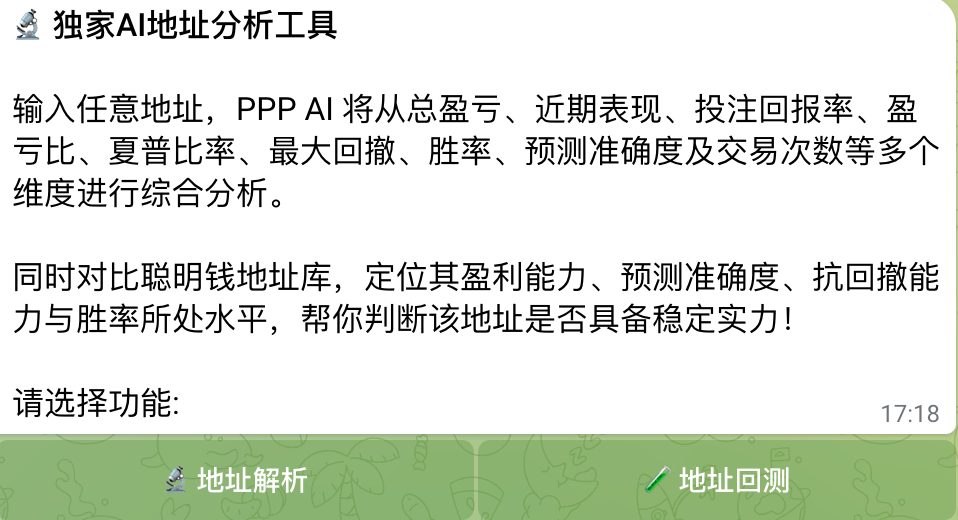
To identify truly 'reproducible, verifiable, and sustainable' smart money from the vast pool of on-chain addresses, PPP has developed a dual-filter system combining AI modeling and manual verification. The system analyzes addresses across multiple dimensions: win rate, maximum drawdown, strategy stability, position allocation, capital behavior, and more. It first eliminates 'accidental profits' and abnormal trading samples, then undergoes multiple rounds of manual review to select statistically more stable trading addresses. While the AI model itself is not disclosed, PPP offers an 'AI Address Analysis Tool' that allows users to paste any address and compare it against the smart money database. Users can evaluate an address's profitability, information advantage, drawdown resistance, and win rate percentile to judge its fundamental strength. Lorne, a member of the PPP team, states: 'The market doesn't lack monitoring tools or copy-trading bots. What's missing is a mechanism that structures, cleans, and transforms complex trading behavior into strategies that ordinary users can understand, trust, and easily execute.'
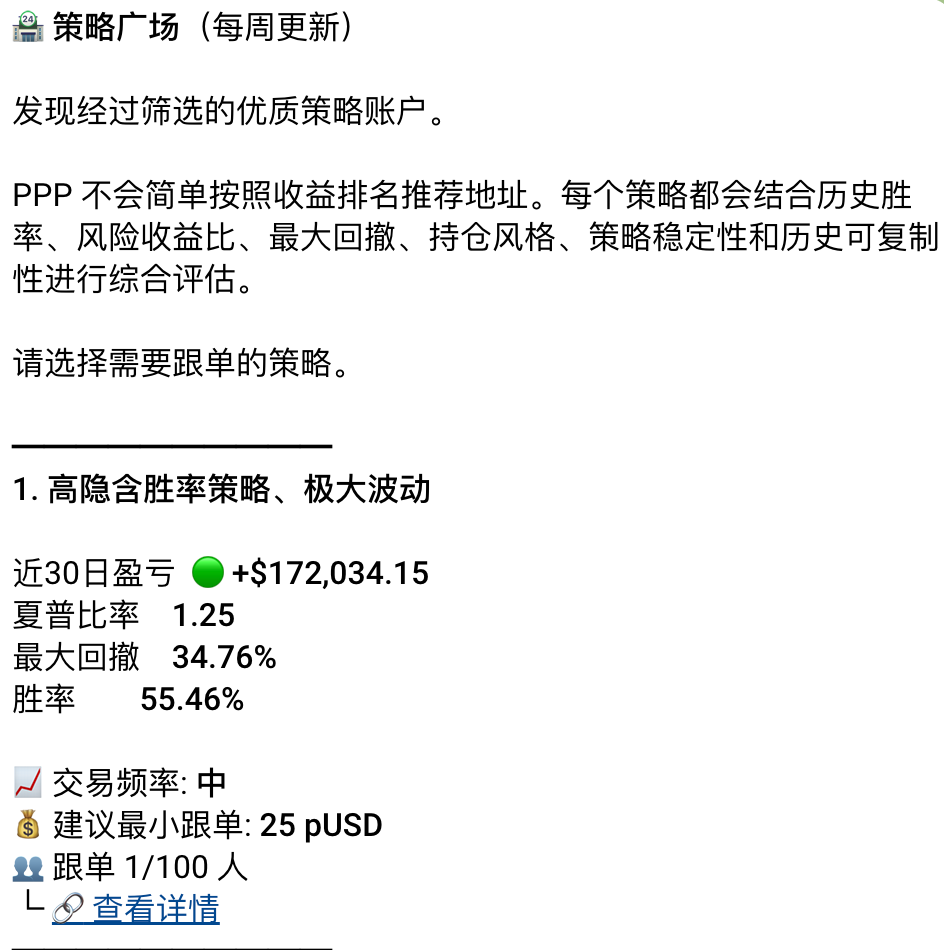
Strategy Plaza vs. Trading Storm List: Tiered Products for Different Risk Appetites
After the initial screening, PPP classifies reproducible smart money addresses into two core tiers. Strategy Plaza aggregates long-term stable strategies that have passed extended verification periods. To enter this list, addresses must meet stricter criteria: historical win rate >52%, maximum drawdown <5%, strategy running consistently for over 60 days, and positive net profit in the last 30 days. PPP conducts weekly reviews to ensure these strategies remain effective. The Trading Storm List, on the other hand, showcases high-yield, high-volatility addresses that are suitable for users seeking short-term opportunities (e.g., during World Cup events). PPP explicitly warns that this list is not for long-term stable copy-trading. For each strategy or address, the platform provides a simple style description (e.g., 'high implied win rate strategy, extreme volatility') to help users quickly understand differences and make informed choices.
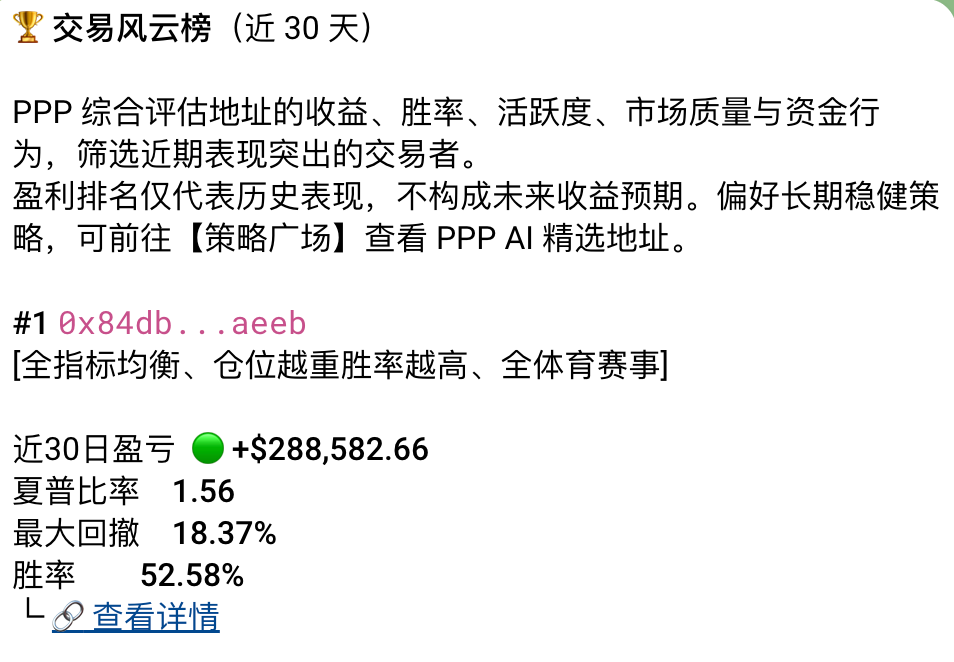
Test Run and Risk Reminder: 60% Daily Return Later Reversed; Self-Control Is Key
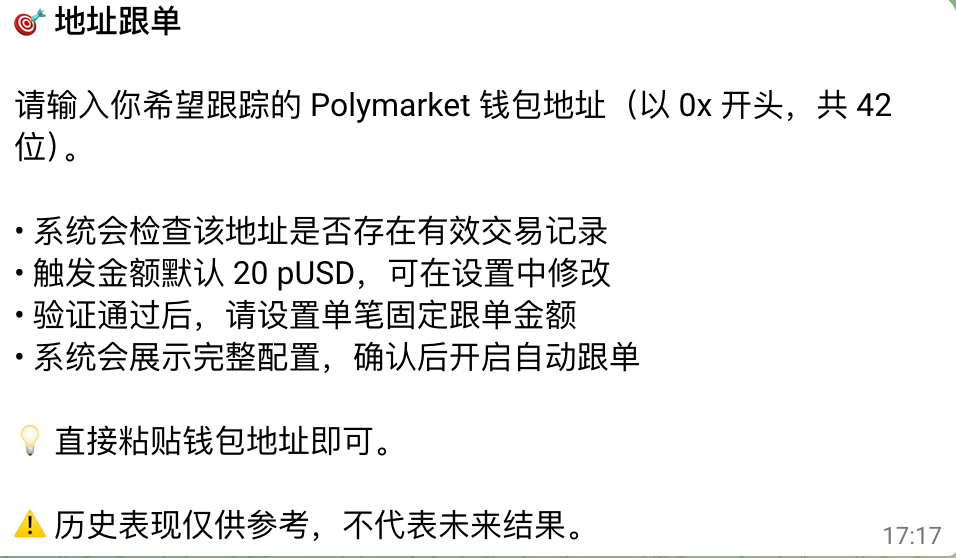
PPP recently launched its Telegram Bot product as the primary user interface, with a website and other products under development. The wallet system is non-custodial—users always control their private keys (exportable), and any potential future airdrops (e.g., from Polymarket) belong entirely to the user. In a test, a user followed two strategies from Strategy Plaza and Trading Storm List, depositing $100. The account net value peaked at $164 the next day (over 60% daily return), but later suffered a drawdown because the user set the same copy-trading amount for both strategies, allowing a low-probability event to consume too much capital. Lorne admits: 'While PPP has rigorously reviewed and verified the historical performance of selected strategies, we cannot guarantee future profitability. Users should only trade within their acceptable risk tolerance and never overcommit.' PPP's mission is to eliminate information asymmetry in prediction markets—it is not just a copy-trading tool but a structured 'compilation path' from trading signals to executable strategies. However, long-term success ultimately depends on each user's own capital management skills and risk appetite.