

Prediction markets are showing a notable shift. From Binance and Coinbase to Interactive Brokers and Robinhood, major players are moving up the stack and spending less energy on building another Polymarket. The new push is to make platforms such as Polymarket and Kalshi fade into the background and serve as infrastructure that other financial products can call on directly.
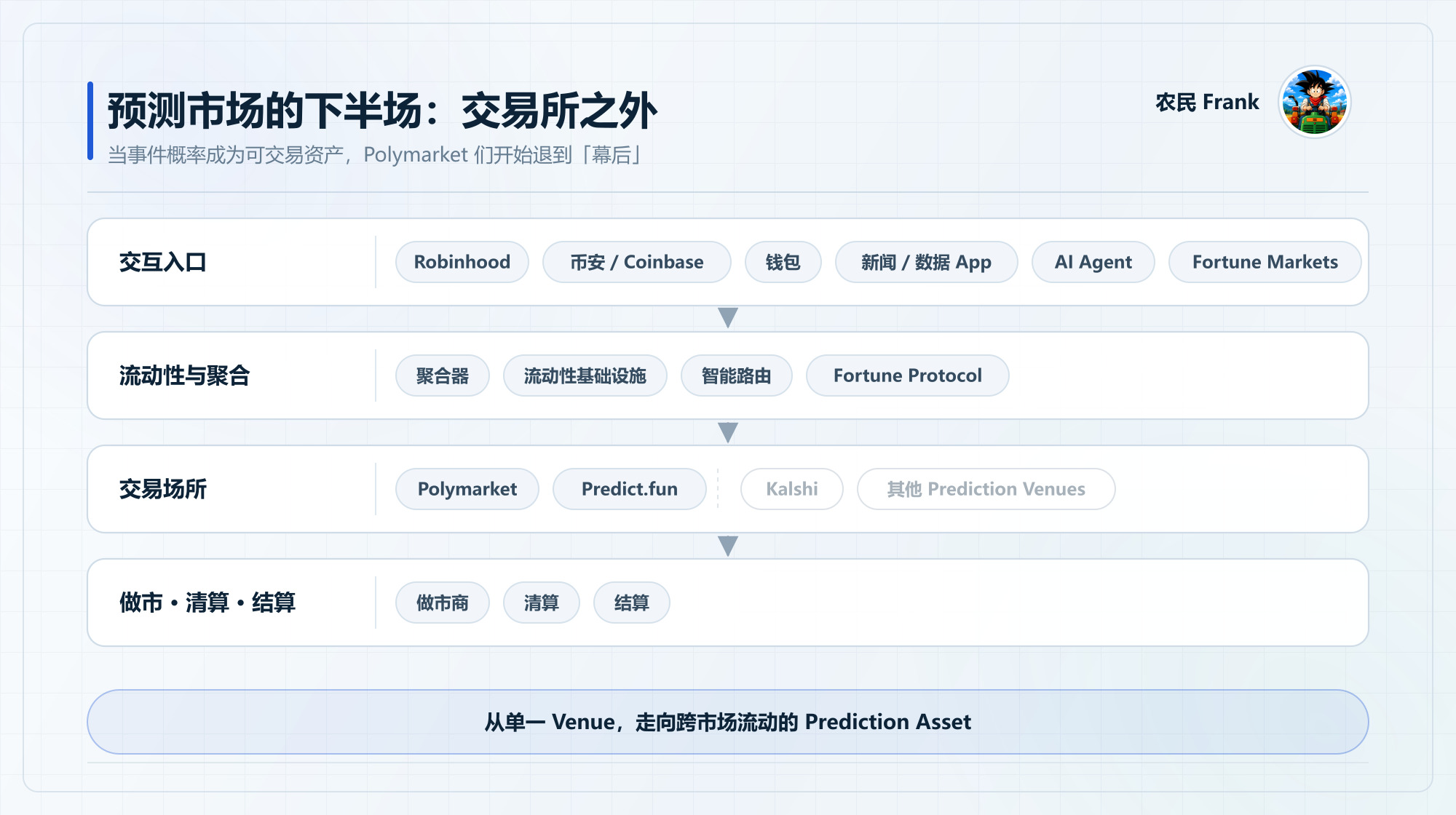
The model looks a lot like stock trading today. When users buy TSLA through Futu, Tiger or Robinhood, most do not care which market maker handles the order or which clearing system sits underneath. Prediction markets could evolve in the same way. The user-facing layer may be a brokerage app, a wallet, a news product or even an AI agent; the middle layer may be aggregators and routers; and the actual venues supplying markets, liquidity and settlement may become hidden infrastructure.
DeFi has already gone through a similar phase. After AMMs proved that tokens could trade on-chain, the market did not stop at cloning more AMMs. It expanded into aggregators, derivatives infrastructure, professional market making and smart execution. Prediction markets may now be entering a comparable second stage.
Major platforms are embedding prediction markets into broader distribution systems
Over the past few years, prediction markets have shown that uncertainty in the real world can become a tradable asset with price and liquidity. From the U.S. presidential election to the World Cup, and from crypto and macro to entertainment and culture, questions that once lived mainly in discussion have been compressed by platforms such as Polymarket and Kalshi into event contracts that can be bought and sold for profit and loss.
Once that demand was validated, the strategy of leading platforms began to change.
In April this year, Binance integrated Predict.fun. Third-party prediction market infrastructure supplied the market layer, while Binance kept the front-end entry point and allowed users to trade probability-based events directly inside the app. Two months later, Binance opened a Prediction Markets API so that quantitative strategies, trading bots and third-party products could access market data and trading functions directly.
Coinbase is taking a similar path. It added Prediction Markets to its “Everything Exchange,” while initial liquidity came entirely from Kalshi. Coinbase also said it plans to support more prediction market venues over time.
On the traditional finance side, Interactive Brokers, or IBKR, has gone a step farther. In May this year, IBKR placed Kalshi, CME Group and ForecastEx inside a single interface. Users do not need separate accounts for each venue. They can search events, compare prices and liquidity across exchanges, and trade from one account.
Robinhood has moved deeper into the trading and clearing layer. It is operating Rothera with Susquehanna. Rothera took over the CFTC-registered exchange and clearing infrastructure that had belonged to MIAXdx/LedgerX, and by June had begun routing some World Cup and professional baseball event contracts to that affiliated exchange.
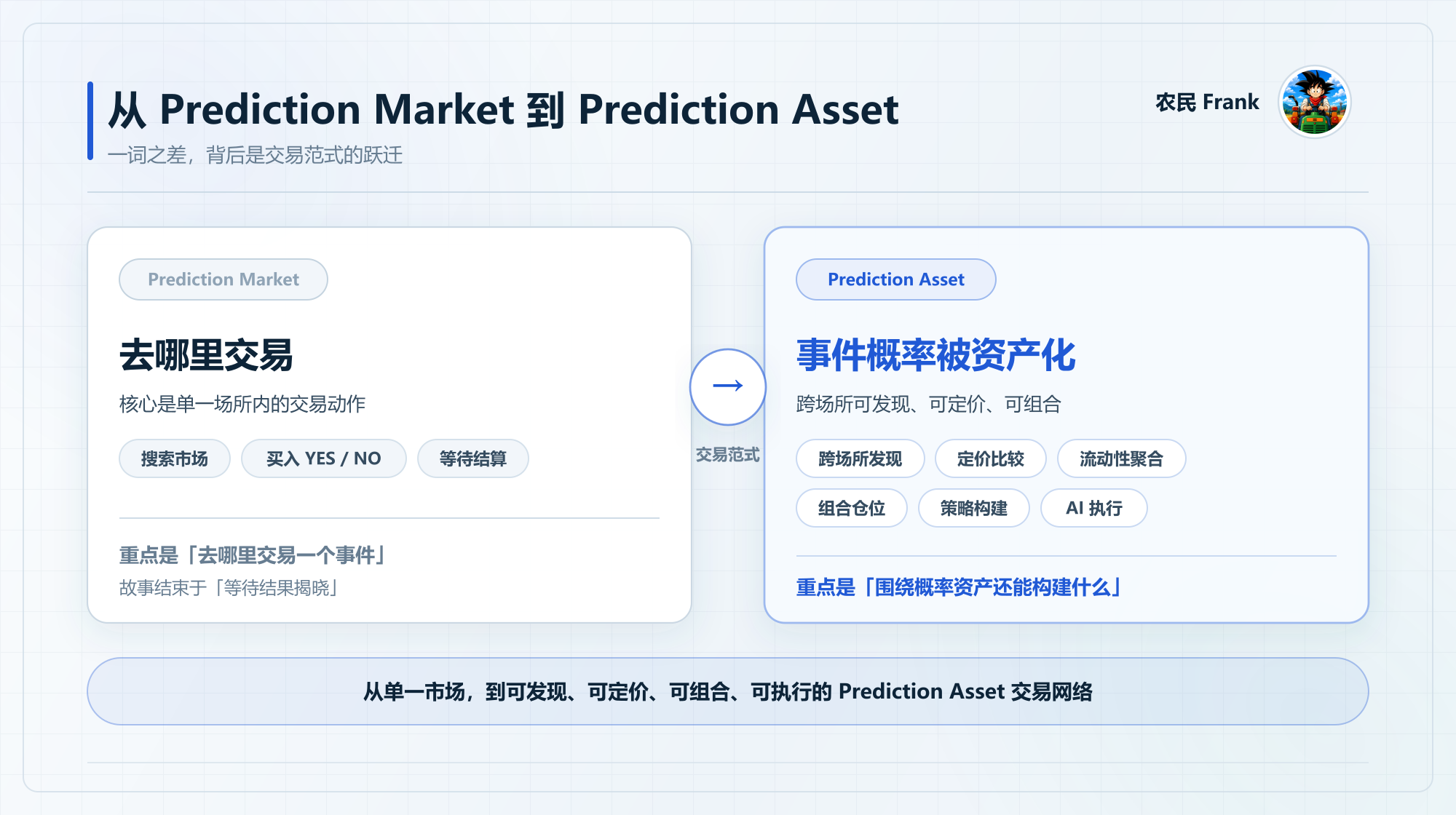
All of these moves point to the same shift: prediction markets are turning from destinations that users must visit into financial capabilities that other products can invoke. In the past, someone who wanted to trade the next U.S. midterm election might have opened Polymarket first and then searched for the relevant contract. In the future, the same trade could appear as an event card on Binance’s home page or as a live probability beside a financial news item on Robinhood.
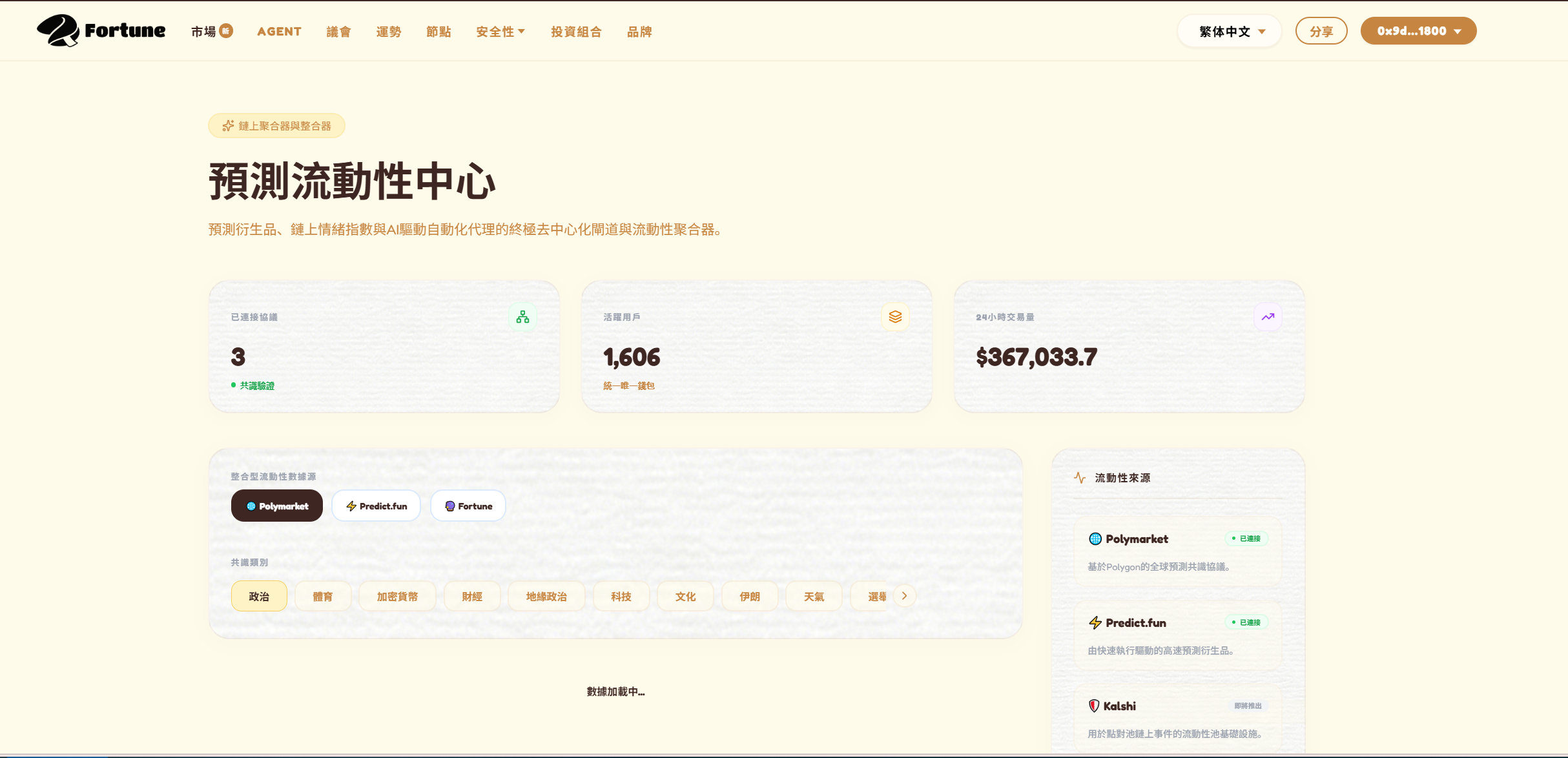
At that stage, users may not even realize they are using a prediction market at all. It will matter less whether the order ultimately comes from Predict.fun, Kalshi or CME, or whether a router splits it across several venues.
That change makes prediction markets less visible while making prediction assets more important. Once the market reaches that point, the central question changes as well. How should liquidity scattered across Polymarket, Kalshi, Predict.fun and other venues be organized? Which market offers the best price for a U.S. midterm contract? Which venue has the deepest liquidity? Are there probability gaps between two superficially similar markets?
Those questions echo early DeFi. After Uniswap showed that tokens could trade on-chain, the next meaningful layer was not “ten more Uniswaps.” It was liquidity aggregation such as 1inch, smart execution networks such as CoW Swap, derivatives infrastructure such as Hyperliquid, and the market makers and quant systems built around them.
Fortune is trying to build a unified liquidity layer for prediction markets
Fortune is presented as an early example. As of August this year, it had completed multiple funding rounds including seed and pre-A rounds, with cumulative financing of more than $4 million. The article says the capital is being used to upgrade Fortune Agent, connect more prediction markets, and expand liquidity and related infrastructure.
Its target is what it calls “The Liquidity Infrastructure for Prediction Markets.” Not long ago, Fortune added Polymarket liquidity and placed it inside Fortune Markets alongside the Predict.fun liquidity it already supported. Users can now see markets, trading volume, liquidity and implied probabilities from different sources through one entry point instead of moving back and forth between separate prediction market platforms.
This is still an early form, but the direction is clear. Fortune is trying to abstract fragmented prediction markets into a single liquidity layer.
More than a prediction-market version of 1inch
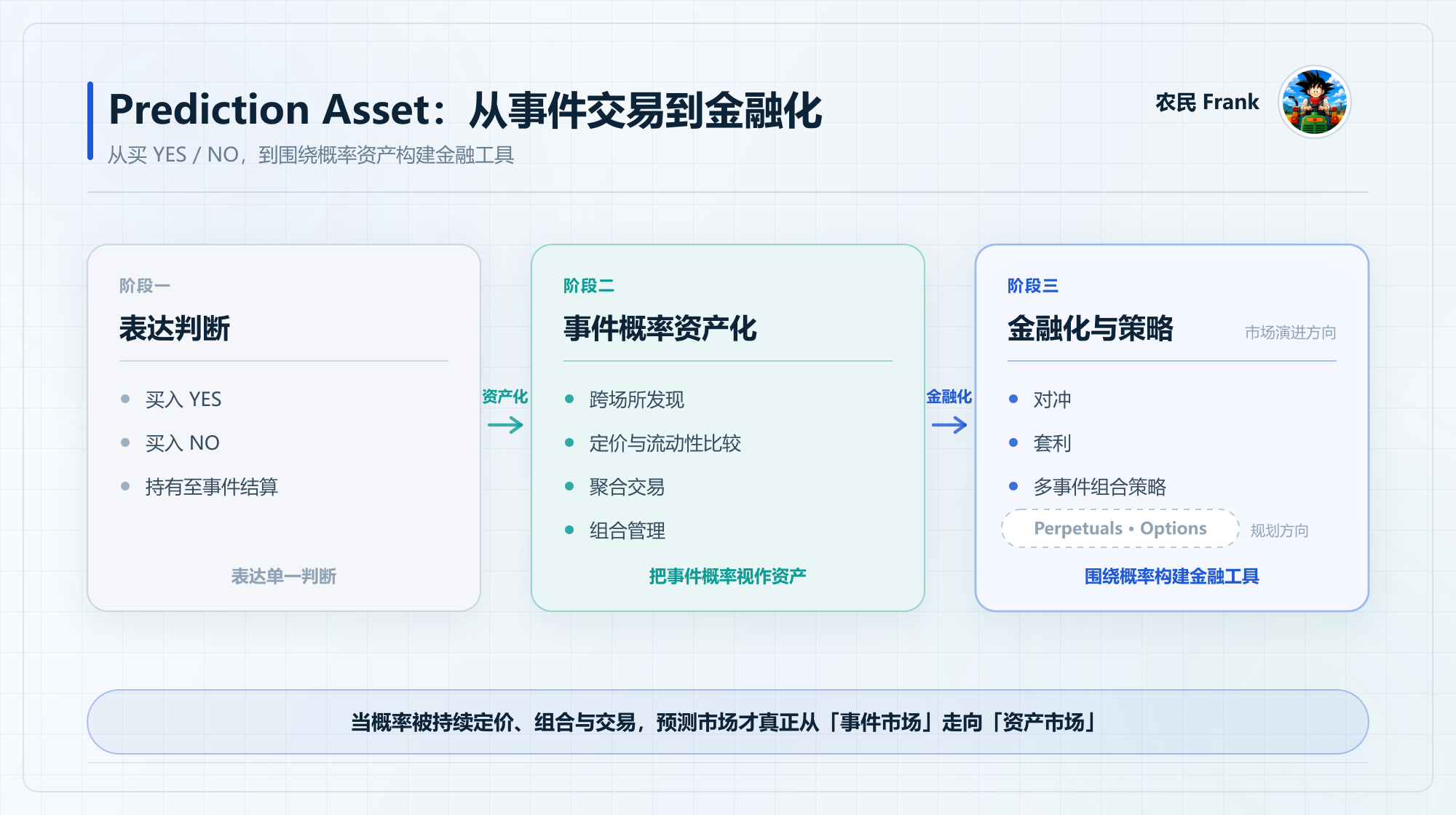
Even so, reducing Fortune to a “1inch for prediction markets” misses part of the point. Prediction markets may not repeat DeFi’s path in full. What matters more for players like Fortune is a shift in perspective from prediction markets to prediction assets.
That sounds like a small difference, but the logic changes sharply. A market asks where trading happens. An asset asks what is being traded and what can be built around it. BTC does not belong to Binance, and Tesla shares are not exclusive to Robinhood. U.S. equities are not limited to spot trading, and crypto is not limited to spot either. Once prediction assets can be discovered, priced, combined and traded across multiple markets, infrastructure above the venue layer has room to emerge.
1. Put fragmented prediction assets in one place
Prediction markets remain highly fragmented. The same category of event can exist on Polymarket, Predict.fun and other venues at the same time, while each platform has its own market structure, liquidity profile and pricing.
Fortune launched its native prediction market in April this year. In August, it added Polymarket CLOB v2 and placed it in the same Fortune Markets entry point alongside Predict.fun. Users can browse event markets from different liquidity sources and compare liquidity, volume and implied probabilities before opening positions.
The updated trading flow also added Outcome Selection, Position Preview and Portfolio features, linking market discovery, position creation and later management more closely together. Instead of searching multiple platforms manually for political, sports or crypto events and then comparing prices and depth on their own, users are being offered a compressed flow: discover the event, compare platforms, choose the price and liquidity, open the position and manage it in one place.
In practice, aggregation in prediction markets is more complicated than in a standard DEX aggregator. One ETH on Uniswap and one ETH on Curve are still the same ETH. But two prediction markets that look nearly identical may become entirely different assets because of small differences in cutoff time, event wording, resolution criteria or settlement rules.
From that angle, Fortune’s first task is not to create more markets. It is to turn prediction assets scattered across different venues into a pool that is easier to search, compare and trade.
2. Move beyond yes-or-no contracts toward fuller financial products
Once assets are connected, the next question changes. Today, the most common trade in prediction markets is still simple: buy YES if you think an outcome will happen; buy NO if you think it will not; then wait for resolution. That resembles early crypto, when spot trading dominated.
If prediction assets grow into a large enough asset class, demand is unlikely to stay limited to binary exposure. Once the underlying asset base becomes large enough, markets often begin to develop leverage, options, portfolios, hedging structures and structured products.
That is why Fortune includes prediction derivatives in its broader product direction. The goal is to turn an event contract from a binary instrument that waits for a final answer into a prediction asset that can be combined, managed and used in strategy.
This matters because asset-class maturity is rarely defined only by activity in the spot market. BTC did not become part of a complete trading system until perpetuals, options and structured products developed around it. Equities also trade with futures, options, ETFs and portfolio tools. Fortune is betting that prediction assets will go through a similar process of financialization.
That leads to another question. If users eventually face not just a handful of markets but hundreds or thousands of prediction assets, plus combinations and strategies, can people still handle all of the research and execution on their own? That is where Fortune’s AI agent enters the picture.
3. Bring AI directly into the trading chain
Prediction markets may be one of the clearest financial settings for AI agents because the transmission path is so direct: something changes in the real world, new information appears, event probabilities move, the market reprices, and a trading opportunity may emerge.
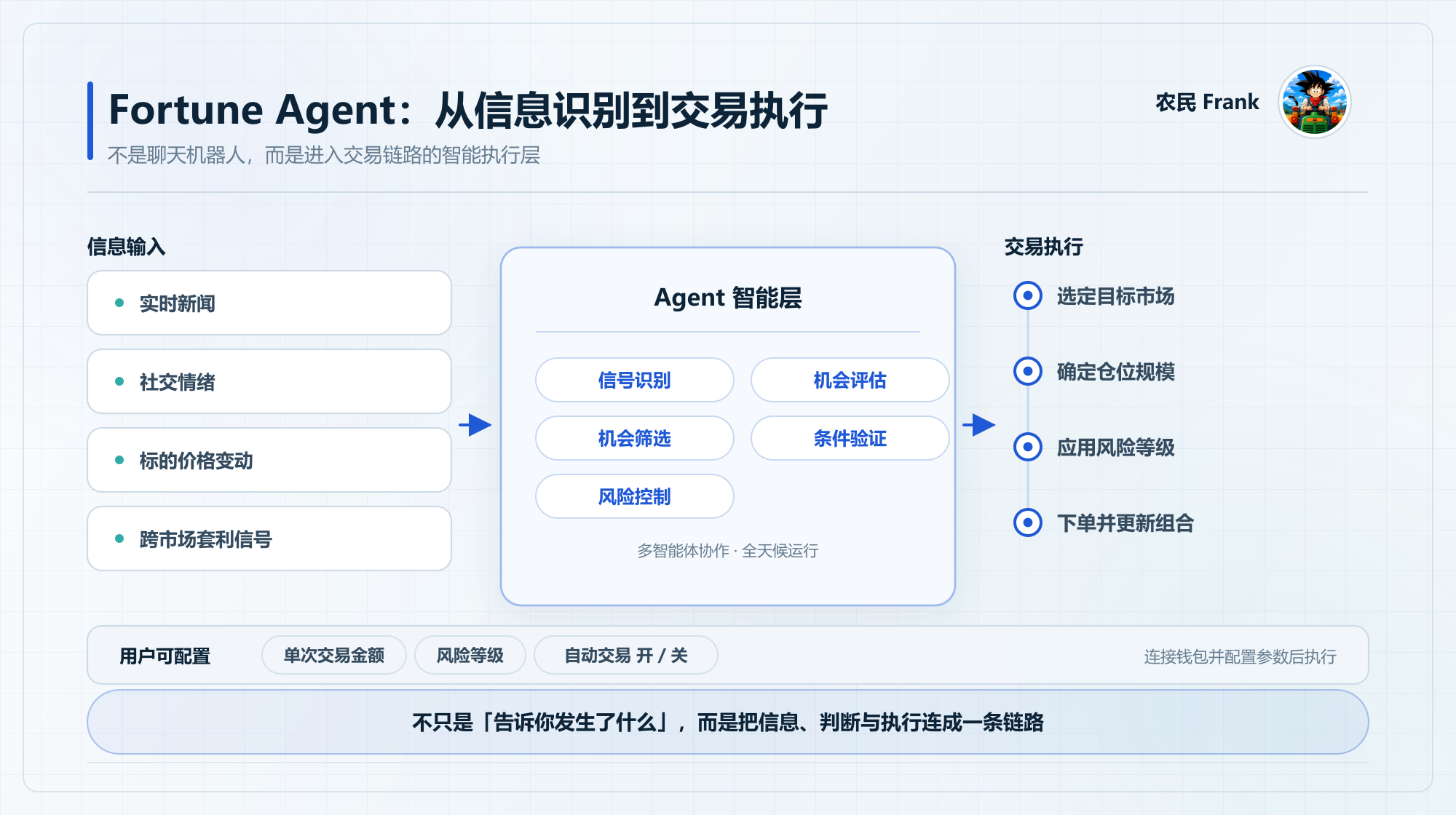
Traditional trading requires people to do the entire sequence manually. They read news, scan social media, gauge sentiment, decide whether a development changes the odds of an event, find the contract, compare prices, size the trade and execute it. Fortune Agent is trying to compress that chain.
The trading agent already live is described as a multi-agent system. It continuously looks for opportunities from three categories of signals — news, sentiment and arbitrage — and then validates the setup. After connecting a wallet, users can set order size, risk level and whether automated trading is enabled.
When that is combined with the project’s later descriptions of 24/7 market intelligence, structured decision-making, risk management and execution, the broader logic of the product becomes easier to see.
Take a macro event where a fresh policy signal suddenly appears. The agent first captures the information and judges whether it changes the true probability of a given event. Fortune Markets then provides the related prediction assets, prices and liquidity across multiple venues. If quoted prices have not fully reflected the new information, the agent can seek a better trade and a better execution route.
At that point, the product is not just an “AI predictor.” It starts to look more like a system connecting the information layer, the asset layer, the liquidity layer and the execution layer.
4. Use incentives to bootstrap the network
Outside that stack sits an incentive layer. Fortune has built a rewards system centered on F Points, including daily check-ins and invitations. Users who invite other participants can receive 10% of their invitees’ F earnings.
On the surface, this resembles the familiar points, NFT and referral mechanics seen across Web3. Inside the broader architecture, though, it addresses a practical issue: where do the first liquidity providers, traders and ecosystem participants in a new prediction asset network come from?
More users bring more trading and more liquidity. Deeper liquidity improves execution quality and then attracts more users and more strategies. As agents and additional financial products are layered in, trading frequency and strategy complexity may rise as well.
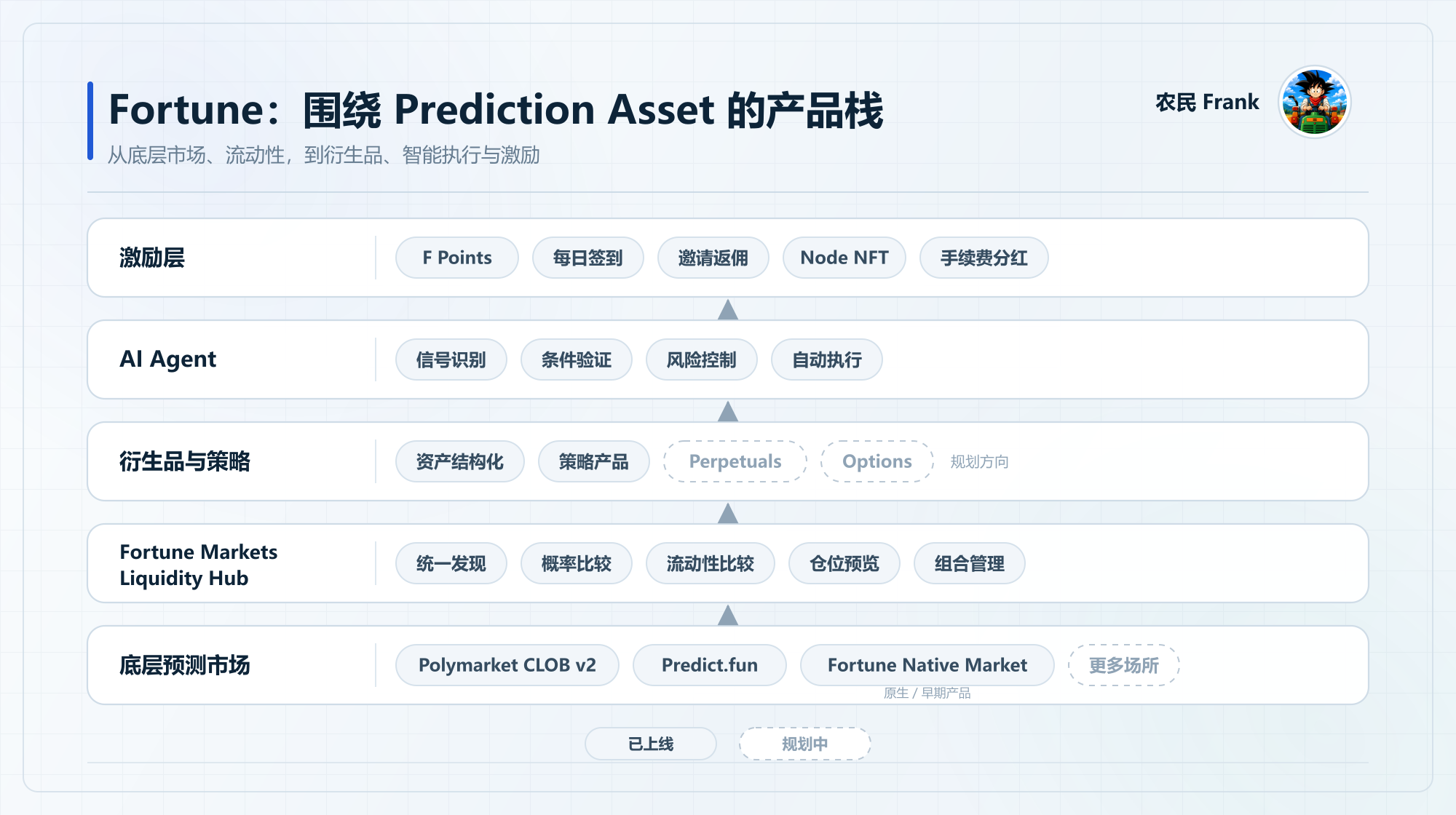
Taken together, the stack Fortune is attempting to build is not a single feature. It is a connected chain:
- Prediction Markets supply the underlying event assets.
- Fortune Markets connects assets and liquidity.
- Prediction Derivatives expands the financial expression of those assets.
- Fortune Agent handles information processing and trade execution.
- The Incentive Layer provides early growth for the network.
That is why the project does not fit neatly into a single label. It is not only a prediction market, and not only a 1inch-style aggregator for prediction markets. The more precise framing is infrastructure for trading and execution built around prediction assets.
When probability itself starts to behave like an asset
It is still difficult to say whether Fortune can fully deliver on that roadmap. The project remains early. Polymarket liquidity access and the agent are already visible in product form, but unified order routing, mature prediction derivatives and a deep cross-market liquidity network are still far from their end state.
Yet the direction is not isolated. Apex has already begun connecting Kalshi event contracts to brokerage infrastructure through APIs. Paradigm is also developing a prediction market terminal for professional traders and researching internal market making and a prediction market index.
If prediction markets are becoming more like a real financial market, then a mature market will not end with the exchange layer alone. The article highlights three shifts worth watching.
From bets to portfolios
Many first-time users still understand prediction markets as a place to bet on whether something will happen. For more advanced traders, they can become a set of assets used to express a broader view.
For example, if a trader believes U.S. inflation is reaccelerating and the Federal Reserve is turning hawkish, that trader may not limit the trade to whether the next FOMC meeting will produce a rate hike. The same view could be expressed through several event contracts at once, including whether the Fed keeps rates higher for longer, whether BTC breaks a certain price level by year-end, and whether the U.S. avoids recession.
Individually these are event contracts. Together they can express a broader higher-for-longer macro thesis. If the market reaches that stage, portfolio management, correlation analysis, hedging and risk management may follow naturally. In that setting, projects like Fortune would matter not because they reduce the number of browser tabs a user needs, but because they could fill in the derivatives and portfolio layers.
From single-market trading to cross-market aggregated execution
This shift is easier to understand. As the market gets larger, any single platform may become less central. Crypto never ended up with one exchange carrying all liquidity, and prediction markets are unlikely to do so either. Different regulatory systems, user groups, market makers, event categories and regions will keep creating fragmentation. That fragmentation itself is an opportunity for infrastructure.
Arbitrageurs need prices. Market makers need order flow. Institutions need depth. Retail users want the best execution available. Agents need enough venues to scan and trade across.
So as prediction markets mature, the trading entry point may become less visible, not more. A user may simply see a line in a brokerage app saying that the probability of a Fed rate move next month is 72%, with a buy button beside it. Whether the order is filled by Polymarket, Kalshi or a router splitting across three venues may be invisible to the user. That is the kind of change APIs could bring.
From human traders to AI traders
The article argues that prediction markets may become one of the most natural financial applications for AI agents. The reason is the structure of the market itself: information leads to probability, probability leads to price, and price leads to trade.
If crypto gave AI agents a financial system where they can control assets around the clock without a bank account, prediction markets give them a market where “cognition” can be traded directly. One of AI’s core strengths is processing information. The core asset in prediction markets is probability, which is information compressed into price. The fit is direct.
One can imagine an agent that listens to news, social media, macro data, on-chain data, company filings, sports events and policy documents at the same time, continuously recalculating its probability models. Once market prices diverge enough from those models, the system places orders directly. If that happens, the speed of the market changes as well.
In the past, alpha may have come from seeing a headline earlier than someone else. Later, it may come from whose agent can interpret that headline faster. After that, the edge may belong to whoever can translate that informational advantage into execution across more venues, more quickly. Information edge, model edge and execution edge may start to converge.
Even so, several practical constraints remain.
- Liquidity comes first. Without deep enough order books, sophisticated routers and derivatives do not matter much.
- Resolution standards remain critical. Prediction markets still need event settlement mechanisms that are credible, clear and as dispute-free as possible.
- Regulation is unresolved. Different jurisdictions still answer very differently when asked whether an event contract is a derivative, gambling, or a new financial instrument.
- The capability gap inside AI itself is still wide. Being able to summarize news is not the same as producing stable alpha.
Those problems will not disappear simply because the market is growing. Only as that infrastructure is filled in can prediction assets move from a novel trading category toward a mature asset class.
The next phase may sit outside the exchange itself
From the 2024 U.S. presidential election to the 2026 World Cup, Polymarket and Kalshi have already completed one of the hardest parts of the story: they showed users that real-world uncertainty can indeed be traded.
But that may only have been the first half. In the history of financial markets, proving that an asset can be traded is rarely the end of the story. As the number of participants, assets and venues grows, market maturity is often defined by things outside the exchange that are much less glamorous: liquidity, market making, routing, derivatives, risk management, portfolio construction and more automated execution.
DeFi has already gone through that progression. Prediction markets may be heading the same way.
That is why projects like Fortune are worth watching. The core issue is not whether they are building yet another platform. It is how the market will trade probability more efficiently once probability itself begins to act like an asset. That would require deeper liquidity, richer financial instruments, better execution, and AI agents that can interpret the real world around the clock and keep recalculating probabilities. That may be where the next stage of prediction markets really begins.