
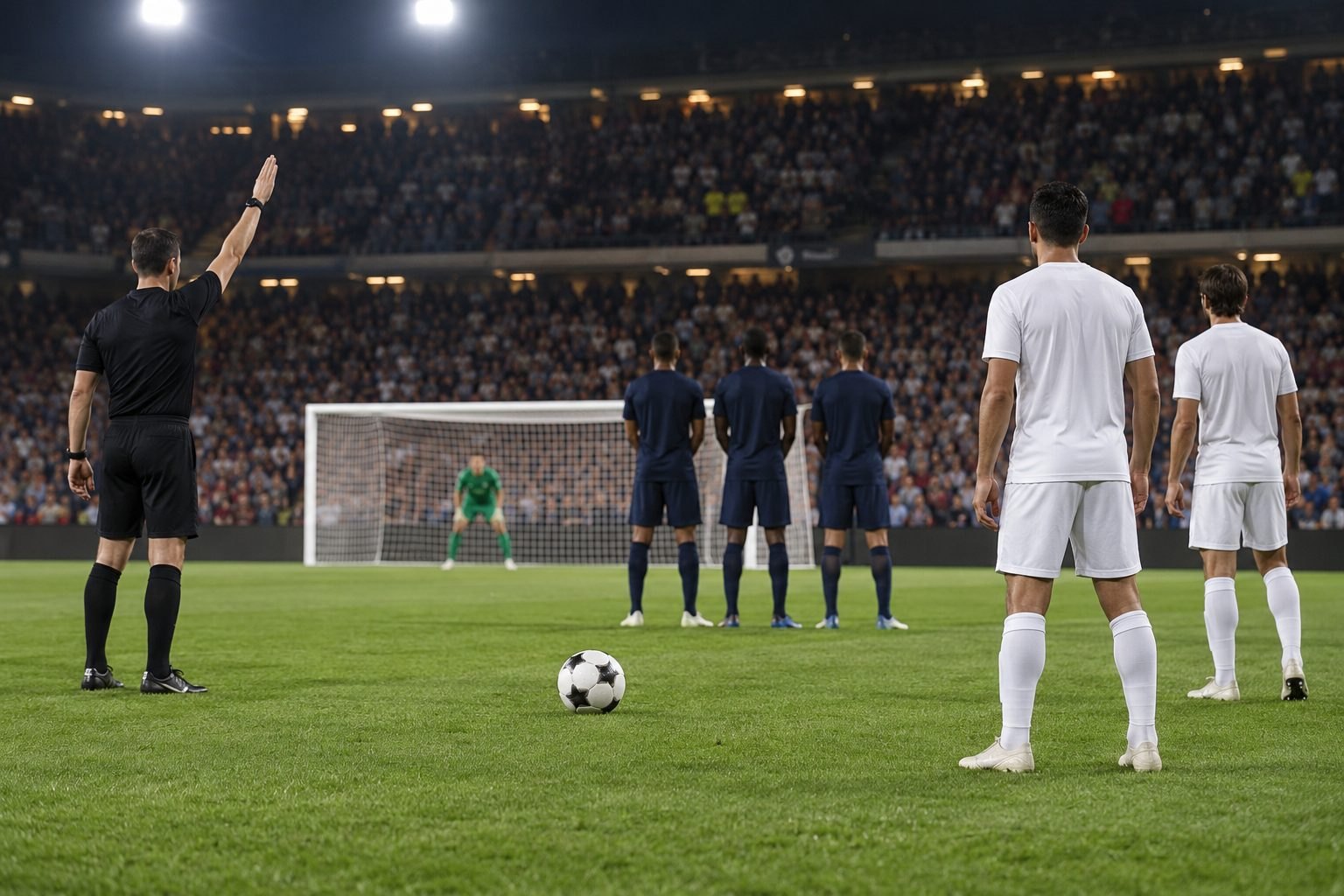
A free kick is usually taken from where the offence happened, with the ball stationary and opponents at least 9.15 m away. For an indirect free kick, the referee raises an arm; if three or more defenders form a wall, attackers must stay at least 1 m from it.
Where the kick is taken and the exceptions
A free kick is taken from the place where the offence happened. Direct and indirect free kicks both exist, but which offences belong in each category is a separate subject.
Several exceptions move the kick elsewhere. Two of them come up most often. An indirect free kick to the attacking team for an offence inside the opponents' goal area is taken from the nearest point on the goal area line parallel to the goal line. A free kick to the defending team inside its own goal area may be taken from anywhere in that area.
Indirect free kick signal and what happens if the ball goes straight in
The referee signals an indirect free kick by raising an arm above the head, and holds that signal until the kick has been taken and the ball touches another player, goes out of play, or it is clear a goal cannot be scored directly. If the referee fails to give that signal and the ball is kicked straight into the goal, the kick must be retaken.
Where the ball ends up then decides the outcome. A direct free kick kicked straight into the opponents' goal is a goal. An indirect free kick kicked straight into the opponents' goal brings a goal kick instead. A free kick of either kind kicked straight into the kicker's own goal brings a corner kick.
When the ball is in play and the no-second-touch rule
The ball must be stationary before the kick is taken. It is in play once it is kicked and clearly moves.
The kicker cannot touch the ball again until another player has touched it. If the kicker does so, the restart is an indirect free kick; if that second touch is a handball offence, the restart is a direct free kick, or a penalty kick if it happened in the kicker's own penalty area, unless the kicker was the goalkeeper, in which case it is still an indirect free kick.
Distance rules and the quick free kick
These are the distance requirements around a free kick.
| Who | How far | Until when |
|---|---|---|
| Opponents, in general | At least 9.15 m (10 yds) from the ball | The ball is in play |
| Opponents on their own goal line between the posts | No distance applies | - |
| Attackers, when three or more defenders form a wall | At least 1 m (1 yd) from the wall | The ball is in play |
There is also a separate position rule for a free kick inside the defending team's own penalty area: until the ball is in play, all opponents must be outside the penalty area.
The 1 m wall rule applies to the attacking team, not the defending team, and only when three or more defenders form the wall. If an attacker is closer than that when the kick is taken, the defending side gets an indirect free kick.
Feinting to take a free kick in order to confuse opponents is permitted. If the kick is taken quickly and an opponent who is inside 9.15 m intercepts the ball, play continues. If an opponent deliberately prevents the quick kick, that player must be cautioned for delaying the restart of play.
In the ordinary case, an opponent who is too close brings a retake unless advantage can be applied. The quick free kick has its own treatment when the ball is played before the defence has moved back.
FAQ
How far does the wall have to be from a free kick?
For defenders, the general requirement is the same as for other opponents: at least 9.15 m from the ball until it is in play. Defenders standing on their own goal line between the posts are the exception.
Can attackers stand in the wall at a free kick?
A defender lying or kneeling behind the wall can count towards the three. Once three or more defenders form a wall, every attacker must stay at least 1 m away from it.
What happens if someone blocks a quick free kick?
If an opponent simply intercepts a quickly taken kick while already inside the required distance, play continues. If the opponent deliberately stops the kick from being taken quickly, the referee cautions that player for delaying the restart.
Can you score directly from an indirect free kick?
No, not into the opponents' goal. If an indirect free kick goes straight in there, the restart is a goal kick, which is why the referee keeps the arm raised until the signal can end under the rule.