
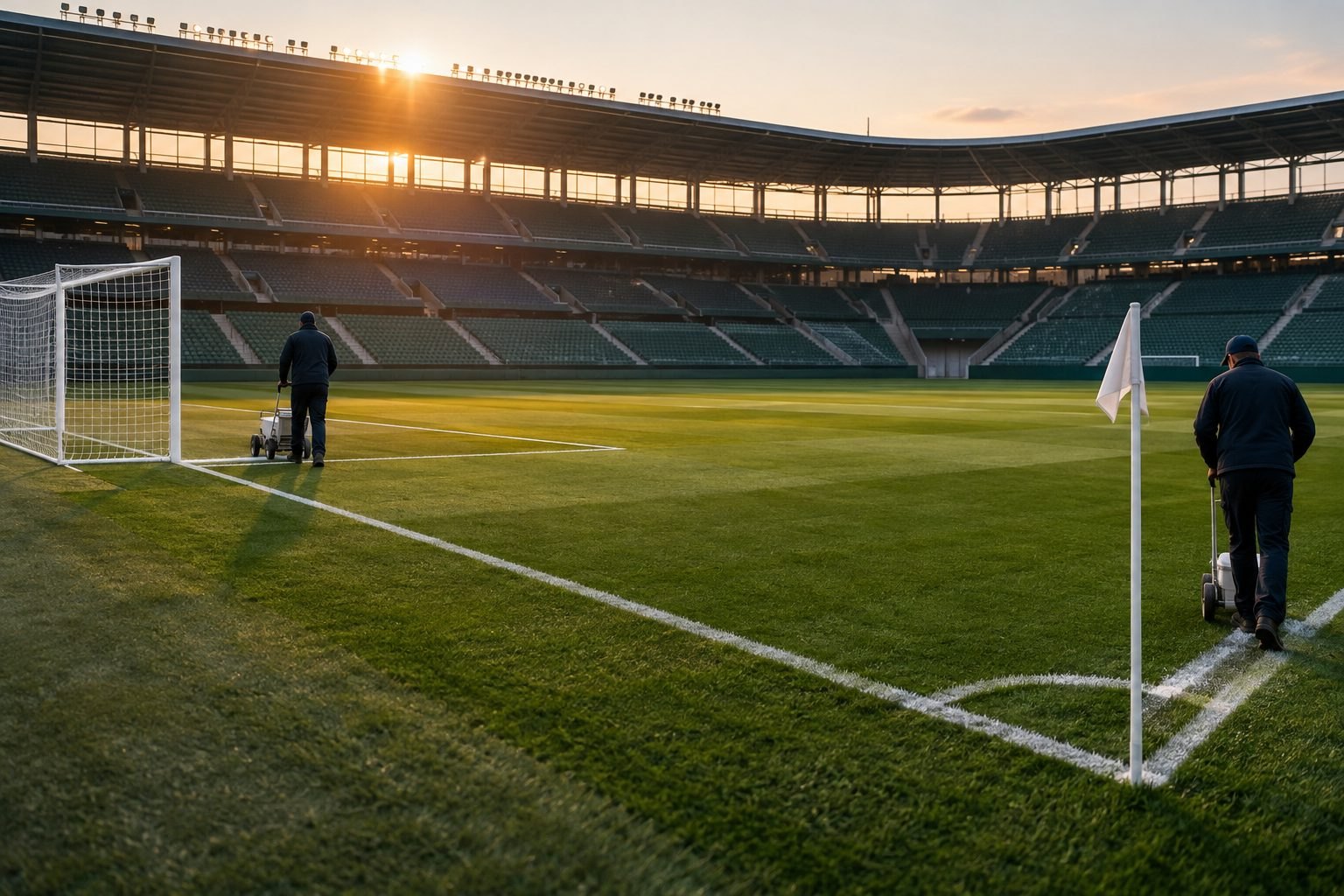
Both restarts happen after the ball crosses the goal line without a goal. The decision turns on the last touch: if an attacker touched it last, the defending team takes a goal kick; if a defender touched it last, the attacking team takes a corner kick.
The deciding point
The starting situation is the same in both cases: the ball has wholly crossed the goal line and no goal has been scored. What separates them is the last player to touch the ball.
It decides who takes the restart, where it is taken from, and where opponents must stand. In both cases, the ball must be stationary before the kick is taken.
The two restarts compared
Here is the basic comparison.
| Item | Goal kick | Corner kick |
|---|---|---|
| Taken by | The defending team | The attacking team |
| From where | Any point within the goal area | The corner area nearest where the ball crossed the line |
| Opponents must be | Outside the penalty area | At least 9.15 m (10 yds) from the corner arc |
| In play when | It is kicked and clearly moves | It is kicked and clearly moves, without having to leave the corner area |
How a goal kick works
A goal kick is taken by the defending team. The ball must be stationary, and it is kicked from any point within the goal area. The two areas in this rule are different: the kick is taken from the goal area, while opponents must stay outside the larger penalty area until the ball is in play.
The ball is in play once it is kicked and clearly moves. If opponents are still inside the penalty area because they did not have time to leave, the referee allows play to continue.
An opponent who genuinely had no time to leave may play the ball once it is in play. The kick is retaken if an opponent who is inside the penalty area when the kick is taken, or who enters it before the ball is in play, touches the ball or challenges for it before the ball is in play, and also where an opponent who deliberately remained inside gains an unfair advantage from doing so. There is also a separate sanction for delaying the restart unfairly: the referee uses a five-second countdown, and if the kick is still not taken in time, a corner kick is awarded to the other team.
How a corner kick works
A corner kick is taken by the attacking team. The ball is placed in the corner area nearest to the point where it crossed the goal line, and it must be stationary before the kick.
The ball is in play once it is kicked and clearly moves. It does not have to leave the corner area. Until the ball is in play, opponents must remain at least 9.15 m (10 yds) from the corner arc.
The corner flagpost must not be moved.
FAQ
When is a goal kick given instead of a corner?
A goal kick is given when the ball crosses the goal line without a goal and an attacker touched it last. A corner is given when the last touch came from a defender.
Do opponents have to leave the penalty area for a goal kick?
Yes. They must be outside the penalty area until the ball is kicked and clearly moves. If they are still inside only because they did not have time to leave, play continues, and such a player may play the ball once it is in play. The kick is retaken if an opponent touches the ball or challenges for it before the ball is in play, or if an opponent who deliberately stayed inside gains an unfair advantage.
Does a corner have to leave the corner area?
No. A corner is in play once it is kicked and clearly moves. Leaving the corner area is not required.
Can the corner flag be moved for a corner kick?
No. The corner flagpost must stay in place. The kick is taken with the flagpost unmoved.
What if the taker touches the ball again before anyone else?
For either restart, that brings an indirect free kick if the ball has not touched another player first. If the second touch is a handball offence, the restart is a direct free kick, or a penalty kick if it happened in the taker's own penalty area, unless the taker was the goalkeeper, in which case it is still an indirect free kick.