
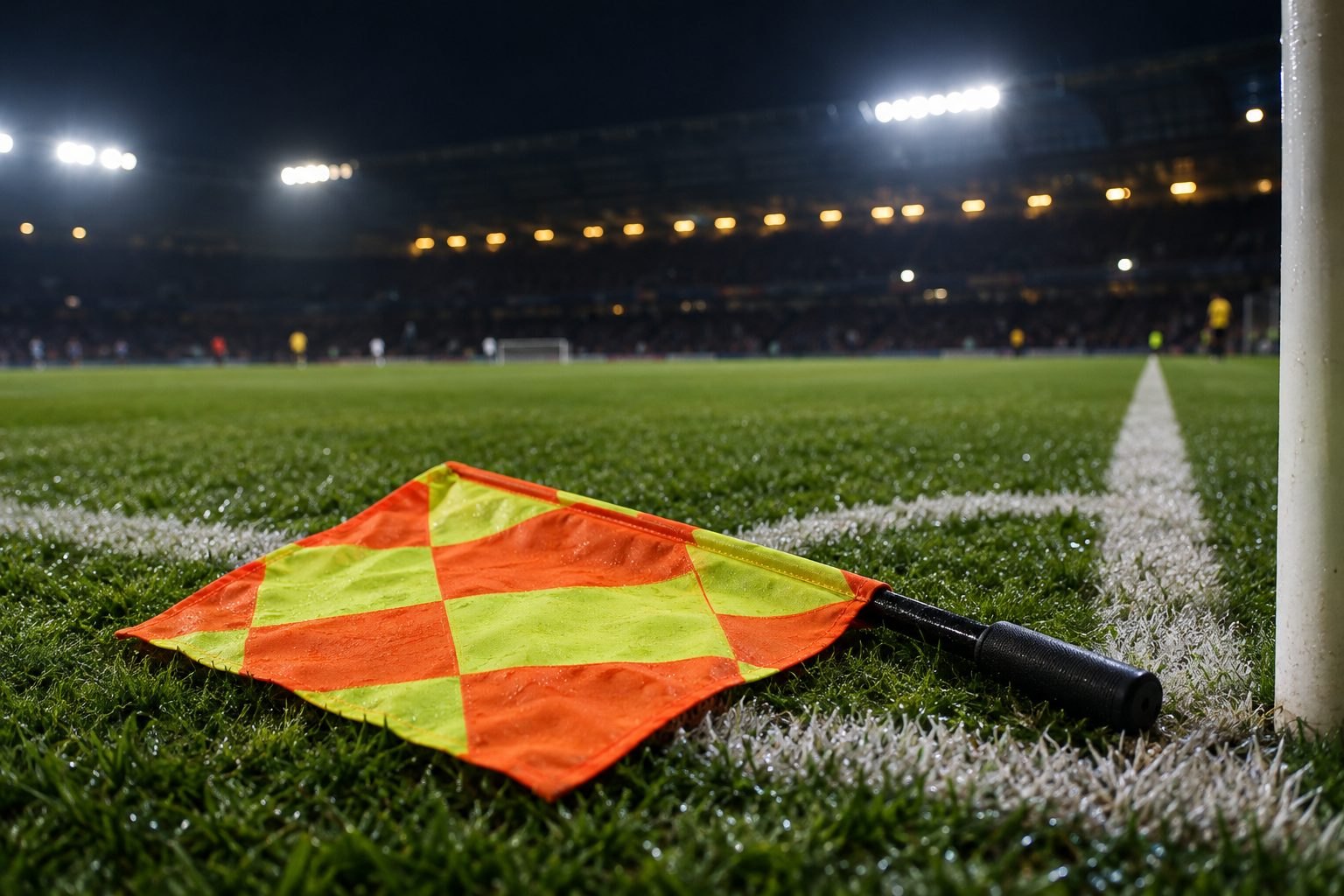
An assistant referee, often called a linesman, uses the flag to tell the referee what has happened. The flag must always be unfurled and visible; for offside the first move is a right-hand flag, a foul signal includes a slight wave, and near the assistant referee the flag indicates a goal kick or corner kick.
How the flag is used
To make a signal, the assistant referee stops running, faces the field of play, makes eye contact with the referee and raises the flag with a deliberate, not hasty or exaggerated, motion. The flag should be like an extension of the arm.
The flag must be raised with the hand that will be used for the next signal. If that changes, the assistant referee should switch the flag to the other hand below the waist. When the signal shows that the ball is out of play, it must be kept up until the referee acknowledges it.
The beep signal is an additional signal used only to gain the referee’s attention.
Common flag signals
Here are some common flag signals.
| Situation | What the assistant referee does |
|---|---|
| Offside | Raises the flag with the right hand; if the referee stops play, uses the flag to indicate the area where the offence occurred |
| Ball wholly over the goal line, near the assistant referee | Raises the flag with the right hand, then indicates goal kick or corner kick |
| Throw-in, near the assistant referee | A direct signal should be made for the direction of the throw-in |
| Foul that needs a signal from the assistant referee | Must raise the flag with the hand used for the rest of the signal, make eye contact and give the flag a slight wave |
| Foul by a defender inside the penalty area, out of the referee's vision, with no action from the referee | Must signal with the flag, use the beep signal, then visibly move down the touchline towards the corner flag |
| Foul by a defender outside the penalty area, near its boundary | Should make a clear movement along the touchline towards the halfway line |
| Substitution requested | Must signal this to the referee at the next stoppage |
Offside signals and delayed flags
If the referee does not see the offside flag at once, the flag must stay up until it is acknowledged or until the ball is clearly under the control of the defending team.
In matches using VAR, a delayed flag for an offence is permitted only in a very clear attacking situation, when a player is about to score or has a clear run into or towards the opponents’ penalty area. After a delay, the flag must go up if the attacking team scores, is awarded a penalty kick, free kick, corner kick or throw-in, or keeps possession after the initial attack has ended. In all other situations, the assistant referee should decide whether to raise the flag according to the requirements of the game.
Fouls, restarts and goal decisions
The flag must go up for a foul or misconduct in the immediate vicinity of the assistant referee or when it happens out of the referee’s vision. In other situations, the assistant referee must wait and give an opinion if asked.
Before signalling a foul, the assistant referee must determine both that the offence was out of the referee’s view, or the view was obstructed, and that the referee would not have applied advantage. If the fouled team will benefit from advantage, the assistant referee must use the wait and see technique and keep the flag down.
For a defender’s foul inside the penalty area out of the referee’s vision, the assistant referee must first make eye contact to check the referee’s position and action; if the referee has taken none, the assistant referee must signal with the flag, use the beep signal and then visibly move down the touchline towards the corner flag. For a defender’s foul outside the penalty area near its boundary, the assistant referee should make eye contact and, if needed, signal with the flag.
When the ball wholly passes over the goal line, the flag goes up with the right hand to show that the ball is out of play; the assistant referee then indicates goal kick or corner kick if near, or makes eye contact and follows the referee’s decision if far. If the ball clearly passes over the goal line, there is no need to raise the flag, and if the goal kick or corner kick decision is obvious, no signal is necessary, especially when the referee gives one. For a throw-in far from the assistant referee, a direct signal must be made if the decision is obvious; in doubt, the assistant referee must raise the flag, make eye contact and follow the referee’s signal.
If it is clear that the ball has wholly crossed the goal line into the goal, the assistant referee must make eye contact without any extra signal; if a goal has been scored but it is unclear whether the ball crossed the line, the assistant referee must first raise the flag to attract attention and then confirm the goal.
FAQ
Why does the assistant referee sometimes not raise the flag for offside straight away?
That is a delayed flag, which in matches using VAR is permitted only in a very clear attacking situation.
Which hand should the flag be held in?
Usually, it is carried in the hand closest to the referee so it stays visible. When a signal is made, though, the flag must be raised with the hand that will be used for the next signal.
When does the assistant referee signal for a substitution?
After being told by the fourth official or a team official that a substitution is requested, the assistant referee must signal this to the referee at the next stoppage.