
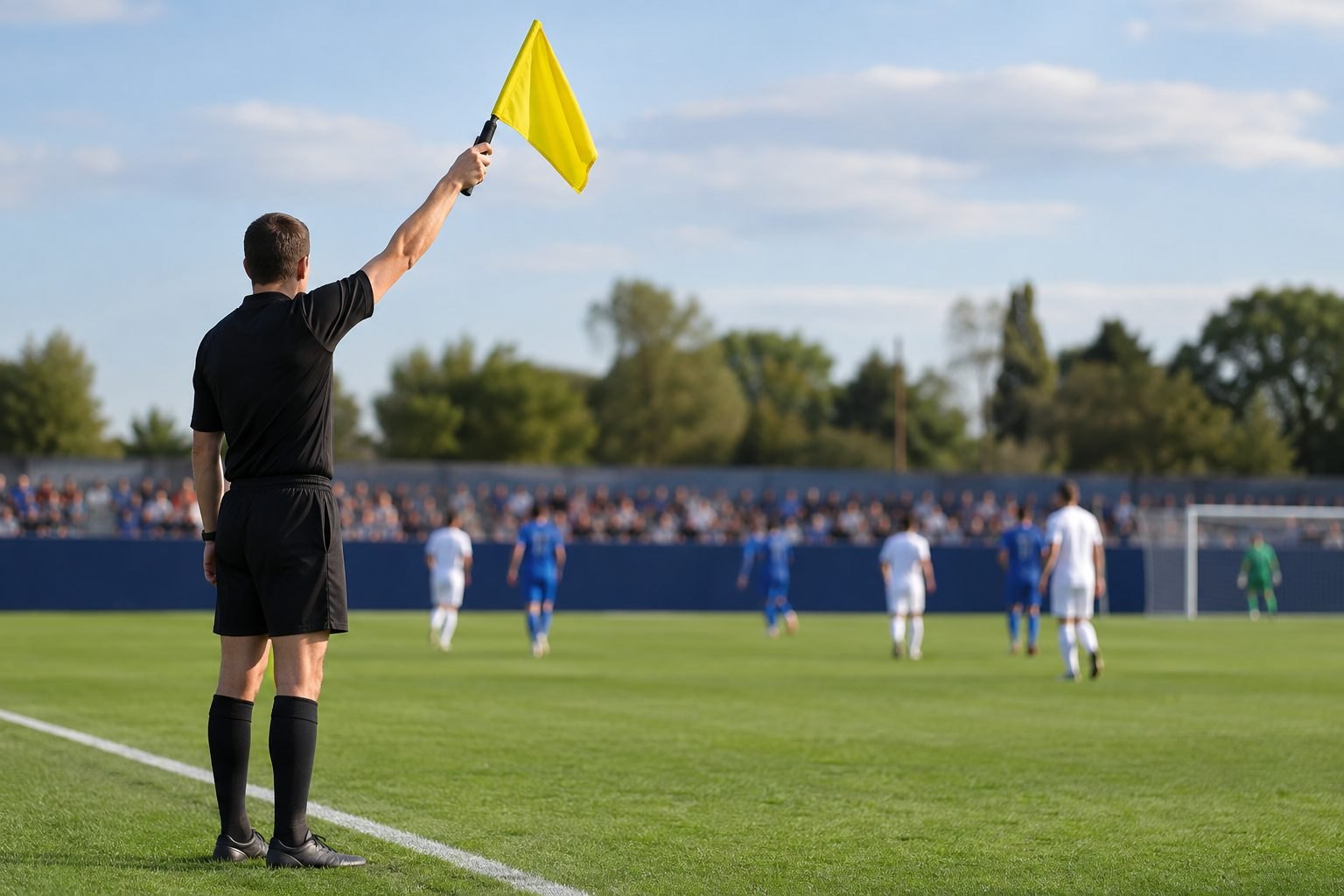
In the Premier League, being in an offside position is not an offence by itself. A player is penalised only if, at the moment a team-mate plays the ball, that player is in an offside position and then becomes involved in active play; the restart is an indirect free kick.
What counts as an offside position
A player is in an offside position when any part of the head, body or feet is in the opponents' half, not including the halfway line, and any part of the head, body or feet is nearer to the opponents' goal line than both the ball and the second-last opponent.
Hands and arms do not count for offside, including for goalkeepers. The upper limit of the arm is taken from the bottom of the armpit, so only body parts that can legally play the ball are used in the judgment.
Being level matters. A player is not in an offside position if level with the second-last opponent or level with the last two opponents.
When an offside position becomes an offence
These are the main situations that turn an offside position into an offside offence.
| Situation | Offside offence | Reason |
|---|---|---|
| In an offside position when a team-mate plays the ball, then plays or touches it | Yes | Becomes involved in active play by playing or touching the ball |
| In an offside position when a team-mate plays the ball, then affects an opponent competing for it | Yes | Interferes with an opponent |
| In an offside position when a team-mate plays the ball, then receives it after a rebound or deflection | Yes | Gains an advantage from a rebound or deflection |
| Simply stands in an offside position without becoming involved | No | Offside position alone is not an offence |
Interfering with an opponent has a specific meaning. It includes clearly blocking an opponent's line of vision, challenging an opponent for the ball, or making an obvious action that clearly affects an opponent's ability to play the ball.
When a player is not penalised
These restarts allow a player to receive the ball directly without an offside offence.
| The player receives the ball directly from |
|---|
| A goal kick |
| A throw-in |
| A corner kick |
Another key distinction is the defender's touch. If a defender deliberately plays the ball, an attacker who had been in an offside position is not penalised. Deliberate play means the defender had control with the possibility of passing, gaining possession or clearing, even if the attempt was inaccurate.
A deflection or an uncontrolled touch does not count as deliberate play. In that case, an attacker can still be penalised for gaining an advantage from the ball coming back.
Restart and assistant referee guidance
An offside offence is punished with an indirect free kick from where the offence happened. That location can even be in the offending player's own half.
The assistant referee can delay the flag when there is a clear chance to score and the decision is tight. That lets the attack finish before play is stopped. There is no delay when the attack is not clear or immediate and there is no risk of error.
FAQ
How does offside work in the Premier League in simple terms?
The judgment starts at the instant a team-mate plays the ball. First, whether the player is in an offside position when a team-mate plays the ball; second, whether that player then becomes involved in active play.
When is a player not offside even if standing very high up the pitch?
A player is not in an offside position when level with the second-last opponent or level with the last two opponents. Position on its own also does not bring a punishment unless the player becomes involved.
Is a player offside if level with the defender?
No, being level with the second-last opponent means the player is onside. The same applies if level with the last two opponents.
Does a defender's touch cancel offside?
Only a deliberate play by the defender does that. A rebound, deflection or uncontrolled touch does not reset the situation for the attacker.