
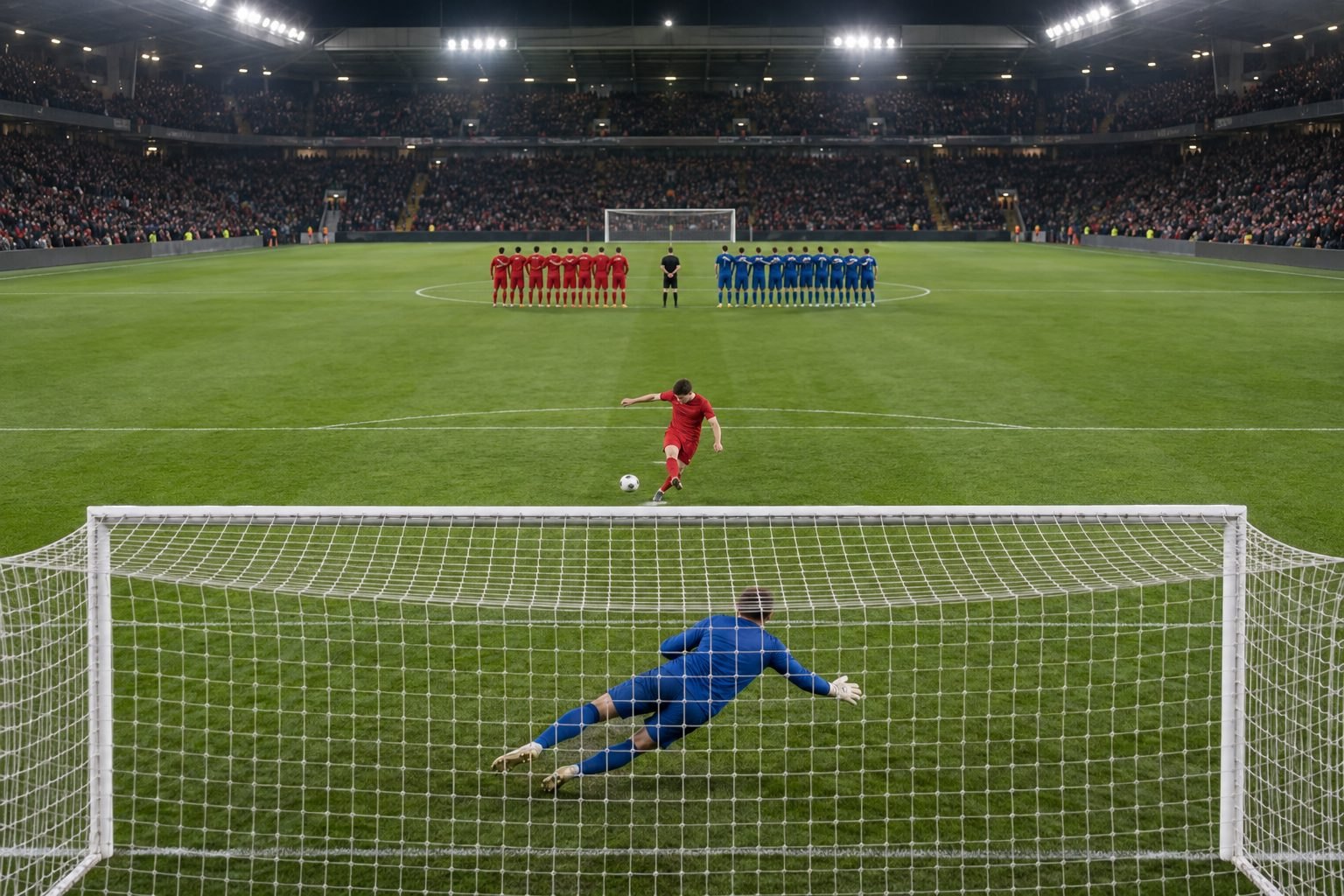
A penalty shoot-out starts after a match ends level. The referee tosses a coin twice, for the goal and for who kicks first. Only players on the field at the end are eligible, anyone sent off cannot take part, and the teams kick alternately until one has scored more than the other can still match.
What is settled before the kicks begin
A shoot-out is taken after the match has ended, not during it, and the ordinary Laws of the Game still apply to it unless a shoot-out rule says otherwise. Before any kick is taken, the referee uses two coin tosses: one to choose the goal, and one to decide which team chooses to kick first or second.
Safety or ground conditions can also settle the goal without a toss. Once chosen, that goal stays in place unless there is a safety reason to change it, or the goal or the playing surface becomes unusable. The second toss does not set the order of individual kickers; each team controls that itself.
The two coin tosses
These are the two tosses and the separate decision made by each one.
| The toss | What it settles |
|---|---|
| The first | Which goal the kicks are taken at |
| The second | Which team chooses whether to kick first or second |
Who is eligible to take a kick
Eligibility is limited to players who are on the field of play at the end of the match, plus players who are only temporarily off the field because of an injury or to adjust equipment. A player sent off during the match cannot take any part in the shoot-out. The one addition is a substitute who comes on for a goalkeeper unable to continue.
Each team chooses its own order of kickers from the eligible players, and the referee is not told that order. Each kick must be taken by a different player, and every eligible player must take a kick before any player takes a second. Warnings and cautions given during the match to players and team officials do not carry into the shoot-out.
If one team has more players than the other at the end of the match, or later during the kicks, it must reduce its number to match the opponents. It must also give the referee the name and number of every excluded player, and a player excluded in that way cannot take a kick, unless the team's goalkeeper cannot continue and that player comes on in goal.
How the shoot-out runs and how a goalkeeper can be replaced
The teams kick alternately, and both teams take five kicks. Each kick is taken by a different player, and every eligible player must take a kick before anyone takes a second. Before both teams have taken five, the kicks stop as soon as one team has scored more goals than the other could reach even by completing its five. If the scores are level after five each, the kicks continue until one team has scored a goal more than the other from the same number of kicks.
If a goalkeeper cannot continue before or during the shoot-out, that goalkeeper may be replaced. The replacement may be a player who had been excluded to equalise numbers, or a named substitute if the team has not used its maximum. The goalkeeper who is replaced takes no further part and may not take a kick.
There is one extra limit if that goalkeeper had already taken a kick. In that case, the replacement is not allowed to take a kick until the next round of kicks.
FAQ
Who can take a penalty in a shoot-out?
Only eligible players can do so. That means players who were on the field at the end of the match, plus players who were only temporarily off because of injury or equipment adjustment.
Anyone sent off during the match is out, and a player excluded later to equalise numbers cannot kick either, unless they come on for a goalkeeper who cannot continue. The order is the team's own choice, but each kick must be taken by a different player, and every eligible player must take a kick before anyone takes a second.
Do yellow cards carry into a penalty shoot-out?
No. Warnings and cautions given during the match to players and team officials do not carry forward into the shoot-out.
That does not restore eligibility to a player who was sent off during the match. A sent-off player still cannot take part.
Why do teams have to have the same number of players in a shoot-out?
The procedure requires the team with more players to reduce to the same number as its opponents, whether that difference exists at the end of the match or arises during the kicks. The referee must be told the name and number of each excluded player.
Those excluded players are then outside the shoot-out as kickers. It is a required adjustment, not a choice.
What happens if the goalkeeper gets injured in a shoot-out?
A goalkeeper who cannot continue may be replaced before or during the kicks. The replacement may be a player previously excluded to equalise numbers, or a named substitute if the team has not used its maximum.
The replaced goalkeeper takes no further part and cannot take a kick. If that goalkeeper had already taken one, the replacement must wait until the next round before taking a kick.