
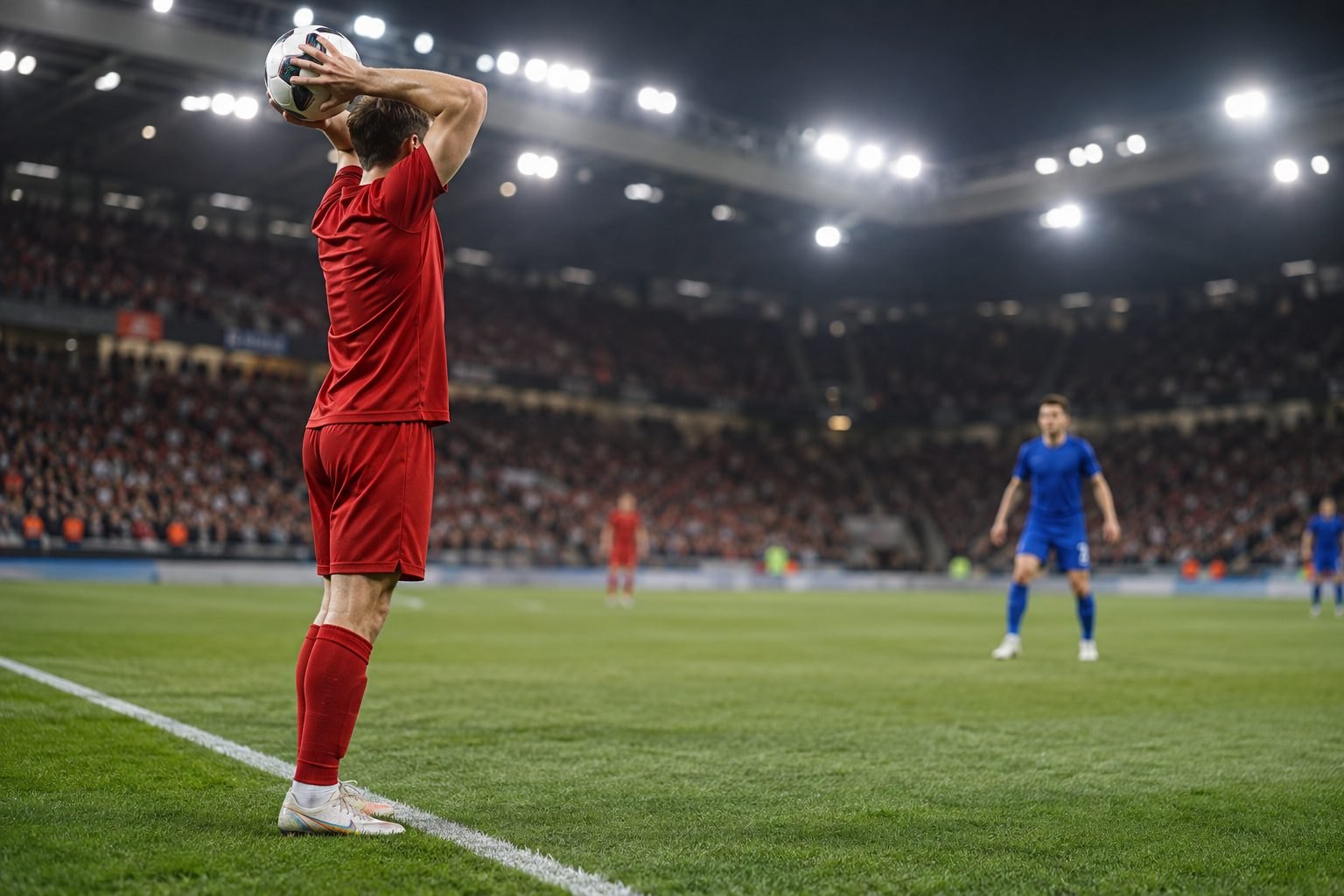
A throw-in is valid only if, at the moment of release, the thrower faces the field, keeps part of each foot on or outside the touchline, uses both hands from behind and over the head, and takes it from where the ball went out. Opponents must stay at least 2 m (2 yds) away.
The four requirements at release
Under the IFAB Laws of the Game, all four parts apply together at the instant the ball is delivered. Missing any one of them means the throw-in has not been taken correctly.
- Face the field of play: the thrower must be facing the field when the ball is released.
- Foot position: part of each foot must be on the touchline or on the ground outside it.
- Both hands from behind and over the head: the throw must use both hands, and the motion must come from behind and over the head.
- From the point where the ball left the field: the restart must be taken from that place on the touchline.
The ball is in play as soon as it enters the field of play.
When it is retaken, and by whom
Here are the two retake outcomes that need to be kept separate.
| What happened | Who retakes it |
|---|---|
| The ball touched the ground before entering the field | The same team, from the same place |
| The throw-in was not taken correctly | The opposing team |
These are different rulings. If the ball hits the ground before it comes into the field, the same side takes the throw-in again from the same position. If the throw itself was not taken correctly, the restart goes to the other team.
Opponent distance and unfair interference
All opponents must stand at least 2 m (2 yds) from the point on the touchline where the throw-in is taken. The distance applies to every opponent, not just the nearest one.
An opponent who unfairly distracts or impedes the thrower is cautioned for unsporting behaviour. That includes moving inside the 2 m (2 yds) distance. If the throw-in has already been taken, the restart is an indirect free kick.
The no-second-touch rule
The thrower must not touch the ball again until it has touched another player. If the thrower does so, an indirect free kick is awarded.
If that second touch is a handball offence, the restart changes. It is a direct free kick, or a penalty kick if the handball happened in the thrower's own penalty area. There is one exception: if the ball was handled by the defending team's goalkeeper, the restart is an indirect free kick.
There is also a permitted play-on situation. If a player takes the throw-in correctly and deliberately throws the ball at an opponent in order to play it again, without being careless, reckless or using excessive force, the referee allows play to continue.
FAQ
What counts as a foul throw?
A foul throw is a throw-in that was not taken correctly. That covers any failure in the required release conditions, including failing to face the field of play, foot placement, hand use, throwing action, or taking it from the wrong place.
How far away do opponents have to be?
They must be at least 2 m (2 yds) from the place where the throw-in is taken. An opponent who comes closer and unfairly distracts or impedes the thrower is cautioned for unsporting behaviour.
What if the ball bounces before it comes into the field?
The same team retakes the throw-in from the same place. The ball is in play only once it enters the field of play.
Can you score directly from a throw-in?
No. If the ball passes directly into the opponents' goal, a goal kick is awarded; if it passes directly into the thrower's own goal, a corner kick is awarded to the opponents.
Is it a foul throw if only the heels are on the line?
No. As long as part of each foot is touching the touchline or the ground behind it, the throw-in is taken correctly, wherever the rest of each foot is. A thrower standing with both feet inside the field and the heels on the line has thrown correctly.