
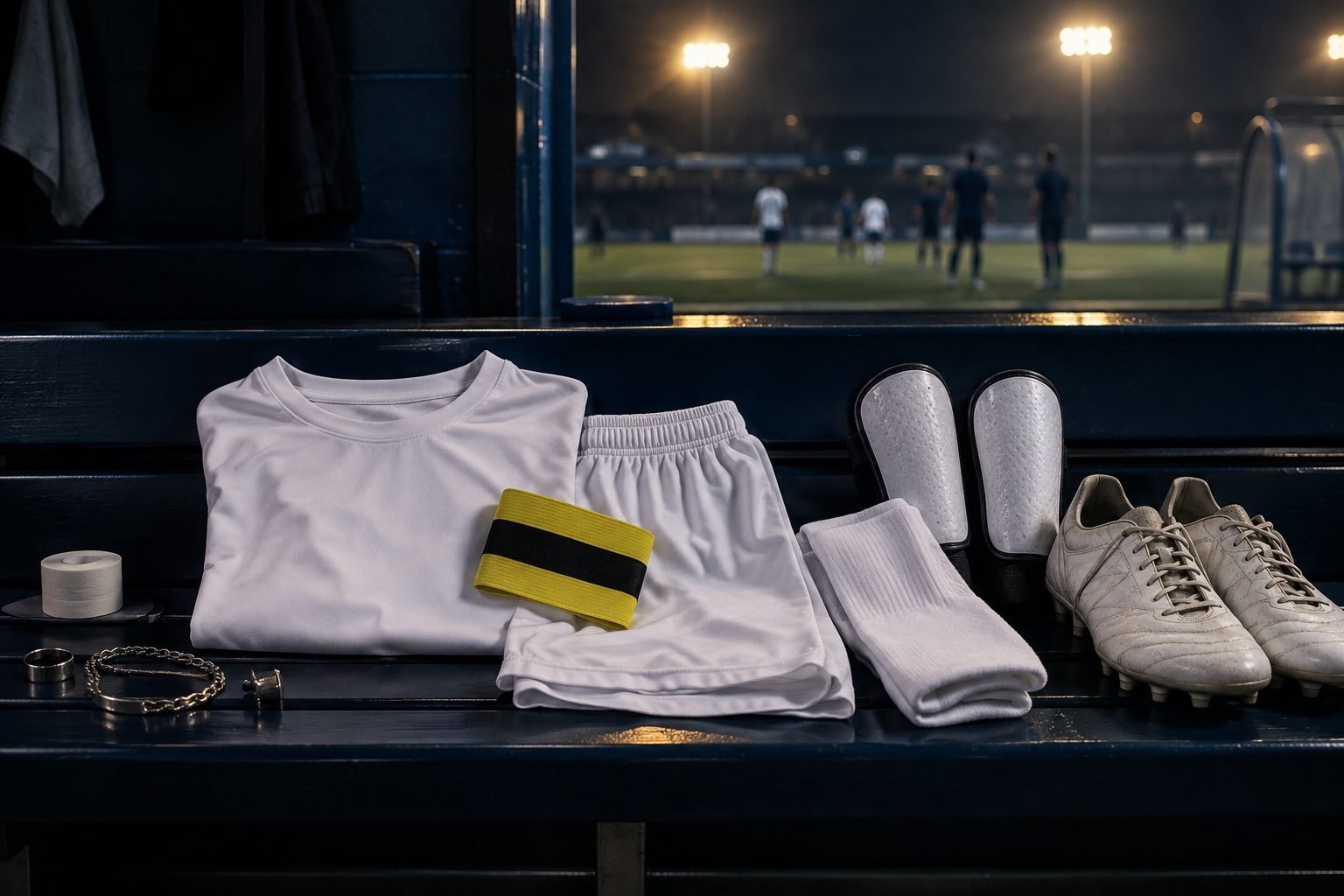
Players must wear five compulsory items: a shirt with sleeves, shorts, socks, shinguards and footwear. The captain must also wear a captain's armband. Nothing dangerous is allowed, and all jewellery must be removed; taping over it is not allowed.
What must be worn
Here are the required items and the matching kit conditions that go with them.
| Item | The requirement |
|---|---|
| Shirt | With sleeves |
| Shorts | Undershorts or tights must match the main colour of the shorts or their lowest part |
| Socks | Tape or material worn over them must match the colour of the part it covers |
| Shinguards | Suitable material, appropriate size for reasonable protection, covered by the socks |
| Footwear | Compulsory |
Shinguards have their own full requirement. They must be made of a suitable material, be of an appropriate size to give reasonable protection, and be covered by the socks. The player is responsible for the size and suitability.
The captain's armband also has a set form. It must be the armband issued or authorised by the competition organiser, or a single-coloured armband that may carry the word captain or the letter C.
What is forbidden and how checks work
A player must not use equipment or wear anything that is dangerous. Accessories are permitted as long as they are not dangerous and are safely and securely covered.
Necklaces, rings, bracelets, earrings, leather bands, rubber bands and similar items are forbidden and must be removed. Tape does not solve it: covering jewellery with tape is not permitted, and dangerous items must be removed rather than taped or covered.
Players must be inspected before the start of the match, and substitutes before they enter the field. A player wearing unauthorised or dangerous equipment is ordered to remove it, or to leave the field at the next stoppage if unable or unwilling to do so. A player who refuses to comply, or who puts the item back on, is cautioned.
Colour rules and other permitted items
The two teams must wear colours that distinguish them from each other and from the match officials. Each goalkeeper must wear colours distinguishable from the other players and the match officials. If both goalkeepers' shirts are the same colour and neither has another shirt, the referee allows the match to be played.
Undershirts must be a single colour matching the main colour of the shirt sleeve, or a pattern that exactly replicates the sleeve. Undershorts and tights must match the main colour of the shorts or their lowest part, and players of the same team must wear the same colour.
Non-dangerous protective equipment is permitted, for example gloves, headgear, facemasks and knee and arm protectors made of soft, lightweight padded material. Goalkeepers' caps and sports spectacles are also allowed, and goalkeepers may wear tracksuit bottoms.
Head covers other than goalkeepers' caps must meet every listed condition. They must be black or the main colour of the shirt, with players of the same team in the same colour; they must fit the professional appearance of the equipment; they must not be attached to the shirt; they must not be dangerous to the wearer or anyone else; and they must have no parts extending out from the surface.
What happens if a player loses a boot or shinguard
If a player accidentally loses a boot or a shinguard, it must be replaced as soon as possible and no later than the next time the ball goes out of play. This applies to accidental loss.
The second part matters just as much. If the player plays the ball or scores before replacing the boot or shinguard, the goal still stands.
FAQ
Can footballers wear jewellery?
No. All jewellery is forbidden and must be removed.
It has to be removed. Taping over a ring, earring or any similar item does not make it legal.
Are shin pads compulsory in football?
Yes. Shinguards are one of the five compulsory items.
They also have to meet the full standard: suitable material, appropriate size for reasonable protection, and covered by the socks. The player carries responsibility for size and suitability.
What happens if a player loses a boot during play?
If it happens accidentally, the player must replace it as soon as possible and no later than the next time the ball goes out of play.
If the player plays the ball or scores before replacing the boot, the goal is still awarded. After that, the missing item still has to be put back on within the required limit.
Can a player wear a headscarf or other head cover?
Yes, if it meets the listed conditions. Other than a goalkeeper's cap, it must be black or the main colour of the shirt, and players on the same team must wear the same colour.
It must also be in keeping with the professional appearance of the player's equipment, must not be attached to the shirt, must not be dangerous to the wearer or anyone else, and must have no parts extending out from the surface. A head cover that fails any of those conditions is not permitted.