
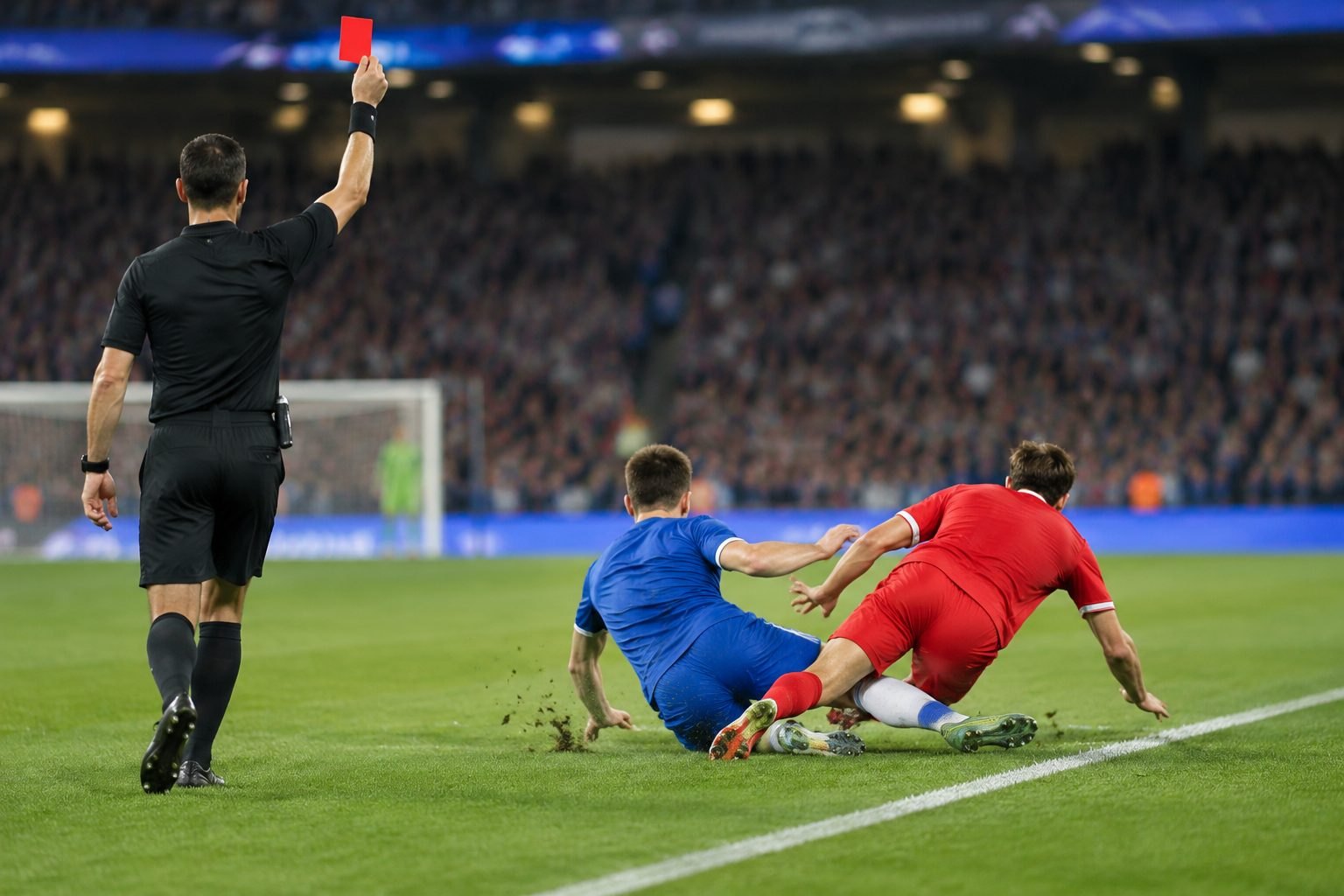
If more than one offence occurs at the same time, the referee punishes the more serious offence, judged by sanction, restart, physical severity and tactical impact. If players from both teams offend at the same time, each receives the appropriate disciplinary sanction, and play restarts against the team that committed the more serious offence.
The core rule
The more serious offence is judged in terms of four measures: sanction, restart, physical severity and tactical impact.
When one player commits two offences at the same time, the referee punishes the more serious one, with the disciplinary action and the restart that go with that offence.
Examples of offences at the same time
Here are examples of offences that occur at the same time and the decision in each.
| Offences | Decision |
|---|---|
| A reckless challenge that stops a promising attack | One caution, for the reckless challenge |
| A reckless tackle outside the penalty area that denies an obvious goal-scoring opportunity, with no advantage played | Direct free kick and a sending-off for denying the opportunity |
| A reckless challenge for the ball in the penalty area that denies an obvious goal-scoring opportunity, with a penalty kick awarded | Caution, for the reckless challenge |
| A challenge in the penalty area that denies an obvious goal-scoring opportunity and endangers the opponent's safety | Penalty kick and a sending-off for serious foul play |
| A reckless challenge by one team and violent conduct by the other, at the same time | Both sanctioned; direct free kick against the team that committed violent conduct |
| A foul and an offside offence at the same time | The foul is penalised |
A reckless challenge that also stops a promising attack brings one caution for the reckless challenge, because the physical offence is more serious than the tactical one.
The same approach applies when the disciplinary outcome is higher. A reckless tackle outside the penalty area that denies an obvious goal-scoring opportunity, with no advantage, leads to a direct free kick and a red card for denying the opportunity, rather than a yellow card for the reckless foul.
Inside the penalty area, the distinction also matters. If a player commits a reckless offence while challenging for the ball, denies an obvious goal-scoring opportunity, and a penalty kick is awarded, both offences are cautionable, so the yellow card is shown for the reckless challenge because its physical severity is greater. A foul challenge in the penalty area that denies an obvious goal-scoring opportunity and endangers the opponent's safety is different: the decision is a penalty kick and a red card for serious foul play, not a yellow card for denying the opportunity.
When both teams offend at the same time
Simultaneous offences by opponents do not cancel each other out. Each player receives the disciplinary sanction that fits their own act, and the restart follows the more serious offence.
One example has a reckless challenge by one player and striking an opponent with excessive force by the other at the same time. The reckless challenge brings a caution, the violent conduct brings a sending-off, and play restarts with a direct free kick against the team that committed the violent conduct.
Fighting in the penalty area has a separate pattern because the order matters. When two players from different teams fight in one team's penalty area while the ball is in play, both are sent off for violent conduct, but the restart changes with who offended first.
- If the defending player offended first, the restart is a penalty kick.
- If the attacking player offended first, the restart is a direct free kick to the defending team.
- If they offended at the same time, the restart is a penalty kick, because the defending player committed the more serious offence in terms of the restart.
A foul and an offside offence follow another clear line. Whichever offence happens first is penalised, and if they happen at the same time the foul is penalised because a direct free kick is more serious than an indirect free kick.
Separate cautionable offences are treated differently
Two offences that are close together are not always simultaneous. When there are two separate cautionable offences, even in close proximity, they should result in two cautions.
For example, a defender makes a reckless tackle, the referee plays advantage, and the defender then pulls the attacker's shirt and stops a promising attack. The defender must receive two cautions, so is shown two yellow cards followed by a red card and is sent off.
The key distinction is whether the acts are one simultaneous incident or two separate offences. If they are separate, the referee should not fold them into a single caution just because they happened close together.
FAQ
Which offence does the referee punish if two happen at once?
The referee punishes the more serious offence, judged in terms of sanction, restart, physical severity and tactical impact.
What happens if players from both teams foul each other?
Each player still gets the disciplinary sanction for their own offence. The restart is then given against the team whose offence is judged more serious.
Can a player get two yellow cards for one challenge?
Not for one simultaneous incident just because it contains two cautionable elements. A reckless challenge that also stops a promising attack brings one caution for the reckless challenge.
What happens if two players fight in the penalty area?
Both players are sent off for violent conduct. If they are from different teams and the ball is in play, the restart depends on who offended first, and if they offended at the same time it is a penalty kick.