
Twenty-five-year-old Qin Shentao remembers that it took just one day to get a letter of investment intent from BlueRun Ventures.
He spoke with the project lead in the morning, met partners around noon, and had a term sheet by the afternoon. Zhu Tianyu, managing partner at BlueRun Ventures, later said the firm needed only 30 minutes to make up its mind.
Across the Pacific, 23-year-old Noah Shinn has stepped into the spotlight as well. His company Instinct has only 14 employees, yet it has just completed a $1 billion financing round at a $10 billion post-money valuation.
Together, those cases capture a mood in the primary market this year. As one investor put it, "This group of young people cannot be missed." In some deals, while one investor is still trying to decide whether a founder is a genius, another is already worried about getting shut out.
The label "young genius" carries admiration, but it also keeps a note of youthfulness. In sectors where the road ahead is still unsettled, imagination becomes a scarce asset. Investors competing for founders born after 2000 are effectively betting that the next company to reshape the industry may come from this generation.
Young founders line up to announce funding rounds
Back in March, Lin Junyang left Qwen with the line, "bye my beloved qwen." For months afterward, venture investors kept asking where he had gone. Five months later, Pragmatik Labs was formally unveiled, along with its first-round backers: Gaorong Ventures and HongShan China as co-lead investors, with support from Tencent and the Shanghai Future Industry Fund.
That sense of urgency is especially sharp around founders born after 2000.
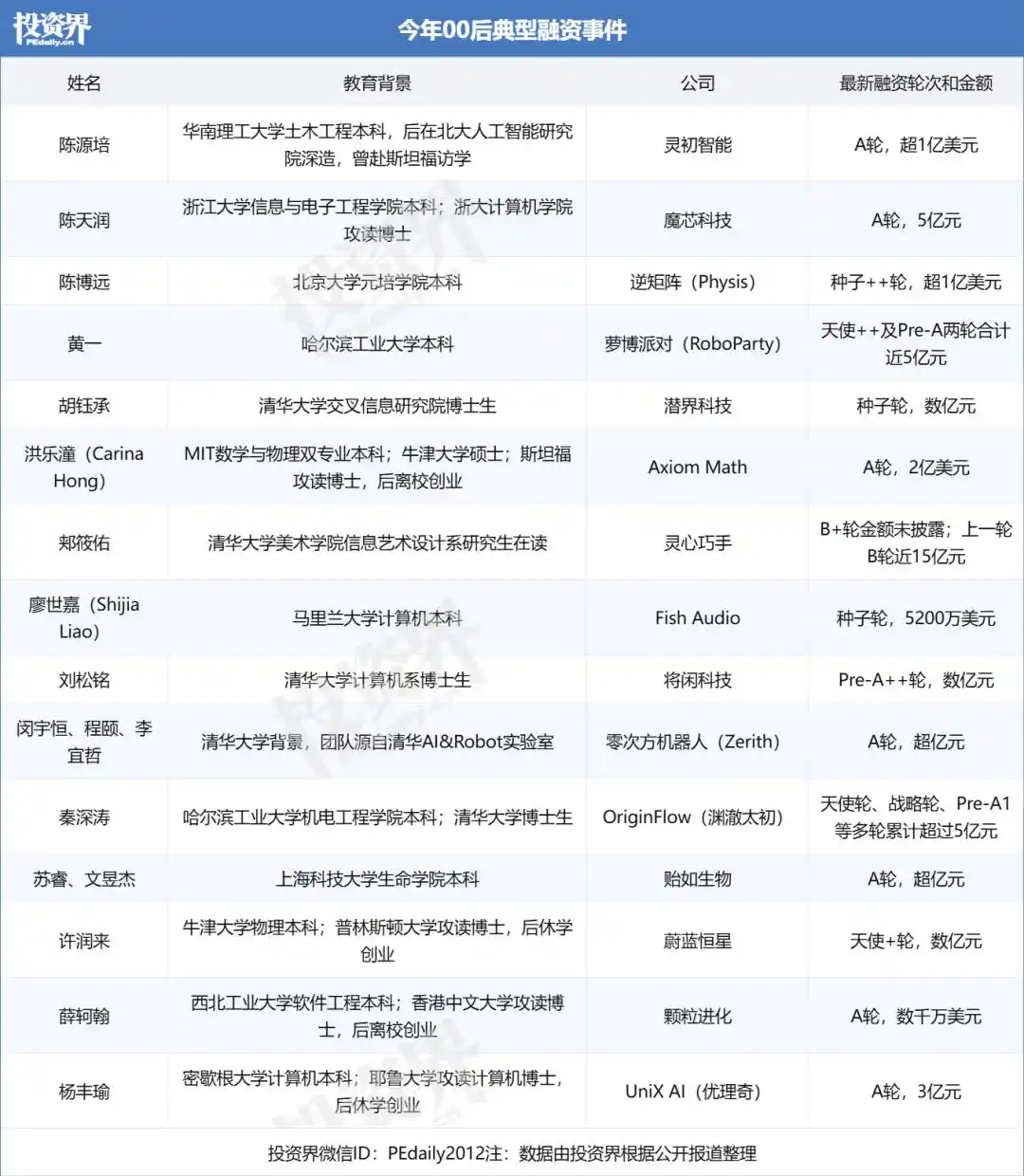
Huang Yi, born in 2004, founded RoboParty and completed six funding rounds in eight months, with valuation rising more than 20 times. Liu Songming founded LiberAI, and HongShan China has added capital in four consecutive rounds starting from the angel round.
For some institutions, even a short delay means missing the next valuation step. One state-backed investment institution said that when it first approached Magic Core Technology earlier this year, the company was valued at about RMB 800 million. By the time site visits, deeper talks and internal approval were completed less than two months later, that valuation had nearly doubled.
Months later, Magic Core Technology closed a new RMB 1 billion financing round at a valuation close to RMB 10 billion. Its founder, Chen Tianrun, was still a PhD student at Zhejiang University and, in the words of colleagues, still looked like "a college student on campus." The distance between university life and startup building has narrowed quickly for this generation.
Qin, who also has not yet finished his PhD, described fundraising in much looser terms. Speaking about OriginFlow raising three rounds in five months for a cumulative amount of more than RMB 500 million, he used a simple comparison: it felt "as natural as breathing."
Born in 2001, Qin graduated from the School of Mechatronics Engineering at Harbin Institute of Technology, then went on to pursue a PhD at Tsinghua University and founded OriginFlow. This spring, investor interest became noticeably more active. BlueRun Ventures, Oasis Capital, 58 Strategic Investment and Monolith Capital Partners were among the firms that moved in.
Another example is Hong Letong from Guangzhou, also born in 2001. She dropped out of Stanford to found AI company Axiom. In March this year, the company completed a $200 million Series A round at a $1.6 billion valuation, or about RMB 11 billion.
One founder after another in their early 20s has taken a seat across the table from investors. "Young genius" has become one of the primary market’s unavoidable phrases this year.
One investor described the profile in broad terms: founders in their 20s, usually from elite schools, still in school or only recently out of it, and concentrated in frontier fields such as AI and robotics. Competition results, open-source projects, or a preexisting "genius teenager" image often help them enter investors’ field of vision quickly.
Some investors are even waiting outside the gates of major tech companies. Yao Shunyu is still at Google DeepMind and said earlier this year that he "wouldn’t stay at Google for very long." He recently joined a domestic event remotely to discuss RSI, and speculation about his next move resurfaced. People familiar with the matter said top-tier venture firms have already been in touch with him.
A technology transition is loosening the old ordering by seniority. What used to be isolated stories of very young founders has started to look like a cohort.
Investors are moving their search onto campuses
"Look at the long board," one investor said, summing up how they assess founders born after 2000. With limited work experience to examine, one standout ability can be enough for a firm to place an early bet.
Huang Yi and his roommate built a biped robot by hand in a dorm at Harbin Institute of Technology. After graduating early, he moved to Shanghai with 13 classmates to start a company. Chen Tianrun began with small hardware inventions in his dorm room, including a machine that solves Rubik’s cubes and a cart that picks up takeout orders.
Investors are not only watching technical ability. They are also testing whether a founder can build and hold an organization together. Cao Xi, founding partner of Monolith Capital Partners, called Qin "a natural entrepreneur." What stood out to him were Qin’s grasp of broad direction, his thinking about organization, and his determination to win.
Sometimes, investors go further and conduct something close to a family visit.
Yan Yi, partner at Shuimu Venture Capital, told pedaily that when a founder born in 2004 decided to leave school to start a company, he made a point of meeting the founder’s parents. Those conversations revealed that the young founder had already done business with classmates in middle school and had tried to start a company in high school. What impressed him even more was the founder’s ability to attract talent, having already persuaded several PhDs and scientists to join the team.
The search begins earlier now. Several early-stage investors said firms are actively using social platforms, hackathons and universities to look for young people before they have formally incorporated a company. In some cases, investors see a prototype online and fly over directly to ask whether the builder wants to start a business.
There are now more entry points for those meetings. ZhenFund’s campus program, ZhenCampus, has already gone to Fudan University, Zhejiang University and Tsinghua University, among others, bringing alumni founders from portfolio companies together with investment teams to speak with students face to face. Platforms such as the X-Day Xilihu Roadshow Club have also hosted multiple Tsinghua-focused sessions, serving as a bridge between campus and market.
In Silicon Valley, investors are even helping launch schools. Andreessen Horowitz, or a16z, said it would invest $35 million to support the Horowitz Andreessen Academy that it incubated. The first class is scheduled to open in San Francisco in 2027, aimed first at high-school graduates, with particular emphasis on products applicants have already built. The hunt for young talent has moved even earlier.
Student entrepreneurship has also been pushed onto a bigger stage. Hunan TV’s "Win Gold 2025" put 30 university students who are already building companies in front of the camera, with projects spanning artificial intelligence, aerospace and biomedicine. One of the program’s startup mentors, Zero2IPO Group founder and chairman and Zero2IPO Ventures CEO Ni Zhengdong, said, "Looking back now, the time when I had the most energy and the biggest nerve was in my 20s."
Many of these founders have not even left campus yet, but investors are already arriving first. The next important meeting may take place in a classroom.
Applause is growing, but so are the questions
Looking at this crop of founders, there is another timeline beyond age alone. Their years of growth overlap almost exactly with a decade of rapid AI development. The technology curve ran alongside their education.
As one investor put it, "They don’t have path dependence. Their academic starting point was already Transformer." The point is simple: what many others now need to relearn is exactly where these young founders began.
With technical paths not yet settled, seniority is harder to use as a ranking system. That has allowed younger people to reach the frontier earlier. Cao Xi described the shift this way: "The generational transition in the AI industry has already been completed." In Monolith Capital Partners’ portfolio, founder age has moved quickly from the post-1995 cohort to the post-2000 cohort.
Many investors say what stands out is not only technical judgment, but also the maturity these founders show in organization and competitive awareness. Some even said that if an AI team has no members born after 2000, they would worry whether the team is sensitive enough to new technology.
But early opportunity also means early testing.
Observers may be impressed by youth, yet that same youth draws scrutiny to dazzling resumes. If large checks come in at an unusually early age, the expectations and pressure arrive just as fast. For the young people selected early by capital, the real examination has only started.
Investors are also being questioned. Some have described the moment as an "unfalsifiable carnival," while others have mocked the choice with the phrase "young geniuses or old favorites."
Chen Yu, managing partner at Yunqi Capital, has said that institutions worry about missing out and are often influenced by the judgments of peers. In hot sectors, capital can become highly imitative. Once a company reaches a sufficiently high valuation and well-known firms appear on its cap table, it becomes easier to treat it as a top project and draw in even more money.
Chen also warned that the threshold for building a demo has dropped, but turning a product into something stable, adaptable across scenarios and deliverable remains difficult. A single successful demonstration still has a long way to go before it becomes reliable performance in daily use.
The phrase "young genius" spreads easily and can make a founder visible almost overnight. It does not answer how far a company can go. Beyond the spotlight lie customers, delivery and the long routine of running a business. Qin put it plainly: "Customers and investors will not lower expectations just because we were born after 2000."
Seen in retrospect, the concentrated emergence of this post-2000 generation coincides with a moment of technical change. AI, embodied intelligence and world models have given them room to show talent earlier. Earlier figures such as Zhihuijun, often described as "genius teenagers," moved first. For the next wave, those once-distant examples became proof that the journey could begin.
Speaking about these founders, Yan Yi said many outstanding Chinese products are simply part of everyday life for people born after 2000. That has made it easier for them to believe, at an earlier age, that world-class products can come from their own hands.
The label may fade. The opportunities and the answers, however, belong to a generation of its own.
This article was originally published by the WeChat public account pedaily (ID: pedaily2012) and written by Wang Lu and Chen Jia.