
PrimePiper has introduced a prime broker service built for AI agents, pitching it as a way to close the gap between strategy generation and safe trade execution. The company says AI agents are already managing capital, producing trading signals, and operating around the clock, yet they still run into serious limits once orders need to be executed across real markets.
Execution remains the weak point for AI-driven trading systems
PrimePiper identifies four main problems. The first is fragmented access to trading venues. Exchanges use different API standards, authentication methods, and rate limits, which forces teams to build and maintain separate integrations for each venue. That raises operational overhead quickly.
The second issue is the lack of a unified control layer. According to the company, fund managers often cannot enforce strategy-level constraints on AI agent behavior. It also points to reconciliation problems when multiple agents trade on multiple venues at the same time, leaving order flows hard to aggregate and PnL reporting dependent on manual work. A separate concern is auditability, especially where compliance standards require a complete record of every action initiated by an agent.
PrimePiper combines account management with pre-trade controls
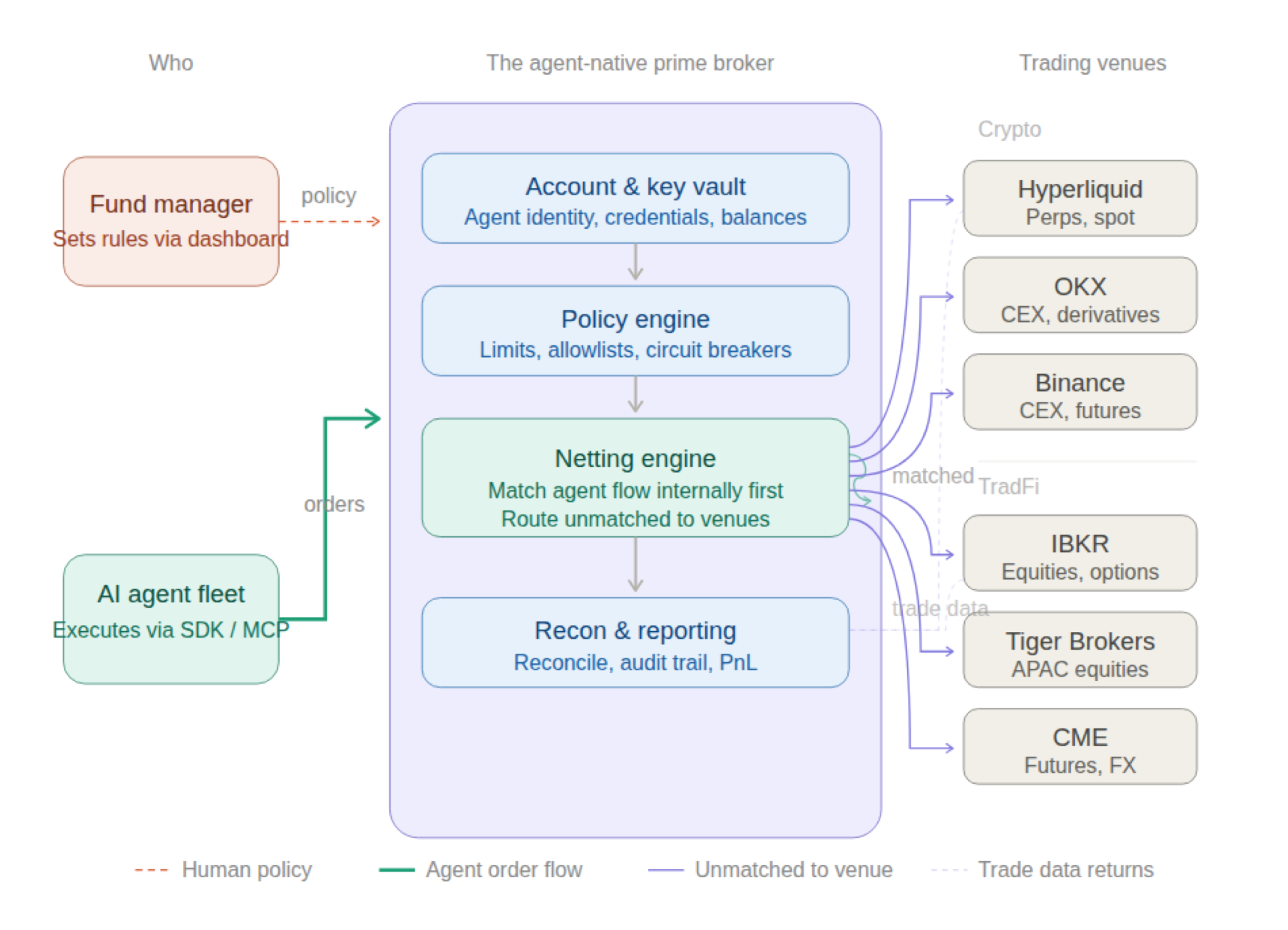
The platform describes itself as the first prime broker designed for AI agents. Its product stack includes enterprise API key management, unified access to multiple venues, spending limits, circuit breakers, and audit-grade reporting aimed at funds and traders. Managers define trading rules first, then agents execute through an SDK or the MCP protocol.
At the account layer, PrimePiper says it can manage agent identity, credentials, and balances in one place. A single setup can connect to several venues, including Hyperliquid, OKX, and Binance on the crypto side, as well as IBKR and Tiger Brokers in traditional finance.
Net settlement and reconciliation are positioned as core infrastructure
Policy controls are a central part of the product. Fund managers can set spending caps, whitelist instruments, and define circuit-breaker rules. Every order must pass through this control system before execution. The company says this keeps human oversight in place even when trading decisions are being made by autonomous agents.
PrimePiper also includes a net settlement system that is designed to identify and match offsetting fund flows between agents. The stated goal is to cut unnecessary external trading costs and improve capital efficiency. On top of that, its reconciliation and audit module is meant to generate a full transaction trail, reconcile activity across venues automatically, and produce PnL reports for fund-level compliance review.
Product is live and early institutional onboarding is underway
The onboarding flow is presented as a three-step process: install the PrimePiper SDK, configure API keys and fund the account, then define trading rules and risk limits for each agent. Once configured, agents can execute trades through API or MCP, and the company says agents built on mainstream frameworks can connect without extra adaptation.
PrimePiper says its team includes members from Galois Capital, Kraken, DRW, and AWS. The product is already live, and the company is onboarding early institutional clients. It also says its ambitions go beyond prime brokerage, with plans to expand from a SaaS tool into smart routing, internal liquidity matching, and exchange capabilities.