

Primitive Ventures founder Dovey argues that the AI boom is producing a new social divide, with extraordinary upside concentrated among a small group of workers while a much larger population is left facing what she calls a “permanent underclass.”
San Francisco’s AI wealth boom and the idea of a permanent underclass
In her essay, Dovey says the phrase “permanent underclass” has started circulating in San Francisco’s tech circles. She adds that Silicon Valley has, this year, also become “Cerebral Valley” in the vocabulary of younger people.
She points to a house at 160 Noe St in Duboce Triangle, not far from the core of what she calls Cerebral Valley. The property has just completed a two-year renovation, with a marble kitchen island wide enough for six people, nine-foot doors, and a loft staircase that folds into the ceiling automatically. Young engineers have been coming through to view the home, she writes, with some saying they wish the timing were six months later. According to the agent’s retelling of the seller’s response, that would not be a problem: the seller would accept equity in the buyer’s company, as long as it was OpenAI or Anthropic.
Dovey writes that the expected IPOs of those two companies could produce at least 3,000 newly minted fortunes worth more than $10 million, with 800 of them above $100 million. She also cites a Redfin calculation saying the employees’ after-tax equity, in theory, would be enough to buy 29% of all homes in San Francisco’s core districts.

At the same time, she says, the city has lost nearly 50,000 tech jobs during repeated waves of AI-led “cost cutting and efficiency” drives. Tech hiring still sits about 40% below its pre-pandemic level. Even workers who remain inside big tech feel exposed, in her telling. She writes that Meta employees have accepted round-the-clock keyboard and screen monitoring required by the company, under a stark choice: “distill yourself, or lose your job immediately.”
Dovey frames this as a form of open class humiliation. Companies once associated with the coolest strain of internet-era geek culture, she says, are now being called “squid factories.” Only 15 years have passed since Facebook’s blockbuster IPO, she notes.
Her reading of U.S. consumption data
Dovey says headline consumption figures still make Americans look willing to spend, but the composition tells a different story. In her account, the top 10% of households by income spend almost as much on non-essential items as the bottom 70% combined.
Wealth is just as uneven, she writes. The bottom half of households hold less than 3% of total wealth, while the top 10% hold 59%. In that sense, what gets described as the “resilient U.S. consumer” is, in her view, a single macro data line averaging two different worlds: one group keeps paying for travel, healthcare, education, and entertainment thanks to asset appreciation, while another is starting to finance even everyday necessities in installments.
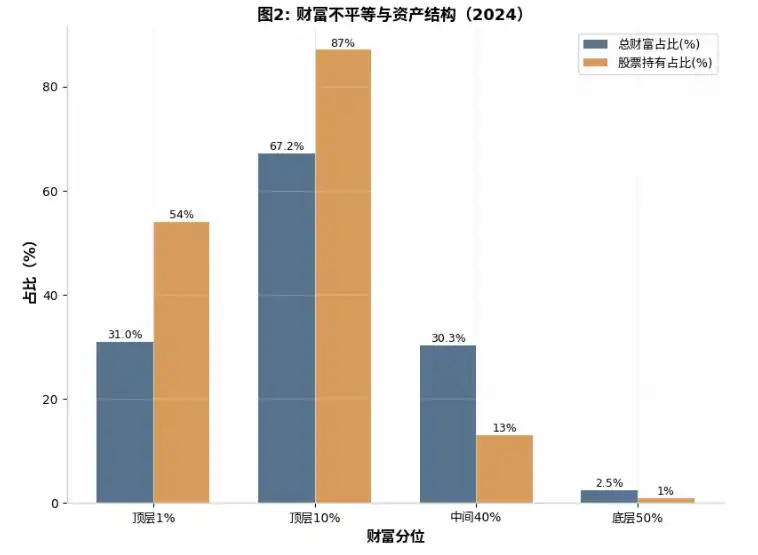
She goes on to say that consumption once supported by the government balance sheet during the pandemic is gradually being shifted onto household balance sheets. Credit card balances, she writes, climbed from about $820 billion at the end of 2020 to $1.25 trillion, with average interest rates still above 20%. Nearly one in ten working-age adults has used buy now, pay later loans to purchase daily necessities, and about one-third of them were delinquent over the past year.
Real wages for much of the middle class have lagged inflation badly, she writes. The “resilience” seen in U.S. demand, in that framing, is really the resilience of the private credit system.
Her comparison with China
Dovey describes the past five years of China’s property downturn as a kind of “shared impoverishment card” handed to every social stratum. With real estate no longer serving as the core anchor of household wealth, she says, the result has been a reversal in the wealth effect and a deterioration in private-sector balance sheets.
That, she argues, marks an important difference from the United States. In China’s household consumption function, she writes, the elasticity of the wealth effect is far greater than that of the income effect. So even if disposable income keeps rising — she gives 2025 real growth of 5.0% — consumption willingness is hard to restore as long as asset prices keep shrinking.
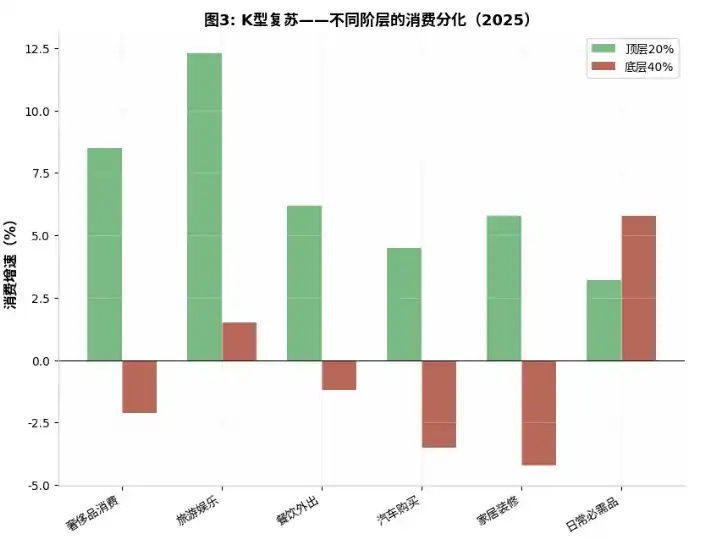
Once deflation expectations become a social consensus, she says, consumer behavior starts reinforcing that expectation: the less people spend, the more prices fall; the more prices fall, the less people spend. In her telling, the downward spiral becomes self-fulfilling. She cites a third-quarter 2025 urban depositor survey in which 63.8% of residents preferred “more savings,” while only 19.2% preferred “more consumption.” The core objective of the household sector, she writes, has shifted from profit maximization to debt minimization.
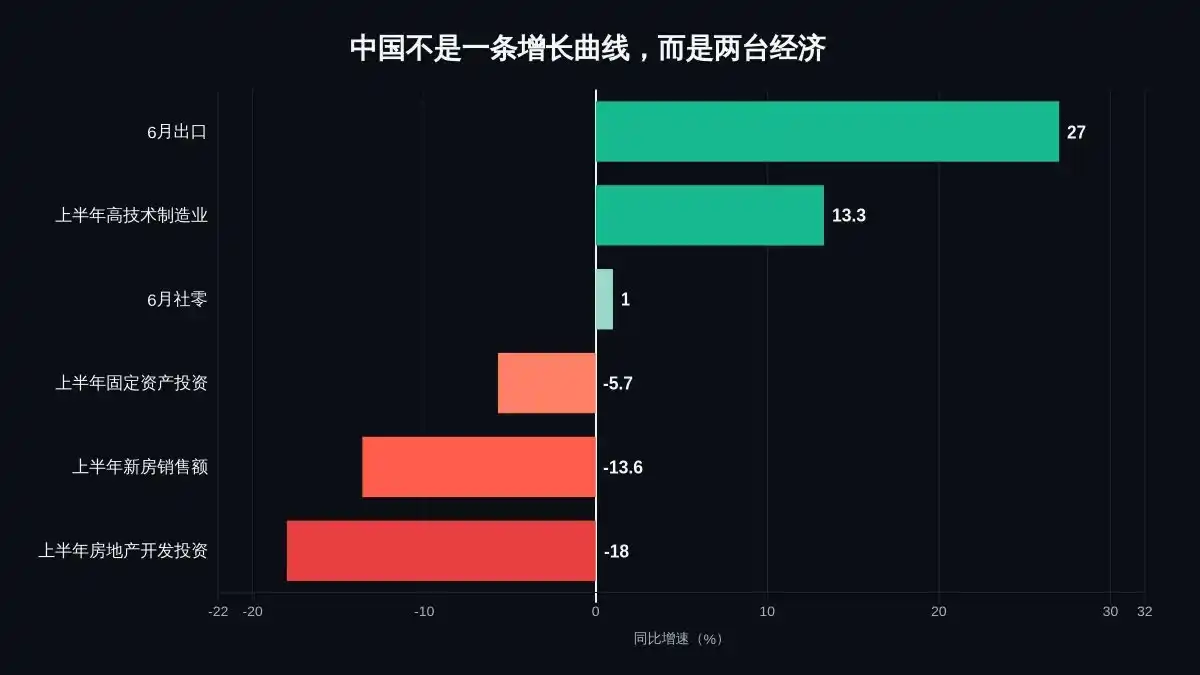
She says China’s K-shaped split is showing up mainly in domestic demand versus exports. The figures she lists are these: exports in June rose 27% year over year; high-tech manufacturing grew 13.3% in the first half; integrated circuit manufacturing rose 67.3%; fixed-asset investment fell 5.7%; real estate development investment dropped 18%; and new-home sales by value declined 13.6%.
She adds that WAIC gave tech workers a rare sense of economic momentum, but in her view the gains are limited to employees at a small number of foundation-model companies and suppliers along what she calls the “T-chain and Da-chain.”
The disappearance of the “under-person” from public attention
Dovey writes that winners are naturally favored by algorithmic distribution, while ordinary suffering attracts little attention. In an environment of ultra-short collective attention spans, everyone is busy watching the next winner. Losers have neither market value nor narrative value. The people at the bottom disappear both from public storytelling and from one another’s field of view, reduced to a statistical symbol.
Looking back over nearly 50 years, she says China’s reform and opening-up combined with globalization while the United States kept exporting capital, new assets, and inflation, and China exported manufacturing capacity, scale effects, and what she calls “China speed.” Across two generations in both countries, the common belief was the same: work hard, accumulate income, buy assets, and move up.
Her essay then turns to a different question. If careers no longer generate stable income and work no longer defines a person’s value on its own, she asks, why should people keep defending identity, dignity, and meaning built around older work ethics? The collapse of that older system of meaning, she says, may also open the door to redefining the human person.
From labor and work to action
In the final section, Dovey brings in Hannah Arendt’s division of vita activa into labor, work, and action. Arendt, she writes, did not believe human beings should prove their existence through labor alone. People also need to create a meaningful world and to be seen by others in public space.
What she calls “action” means choosing to enter the map without a script and starting something that did not exist before, with the mindset of a protagonist. No model, she writes, can decide for a person what is worth loving, what is worth carrying, or with whom they are willing to level up and fight monsters in the giant MMORPG of the world.

When established paths can no longer answer the question of who you are, she says, the result may be painful and disorienting, but it may also amount to a delayed form of freedom.
Her closing line reads: “The disappearance of the under-person means that, for the first time, everyone is being forced to truly own their own life.”
She ends the essay with a film quote: “In case I don't see ya, good afternoon, good evening, and good night!”