

PrismML has released Bonsai 27B, saying it is the first 27B-class AI model to get under the memory ceiling of a consumer smartphone. A 27-billion-parameter model, which the article describes as medium-sized by industry standards, typically needs about 54 GB of memory to run at half precision. Most laptops cannot handle that, and some desktop systems cannot either. PrismML’s new release cuts that down to 3.9 GB, small enough to fit on an iPhone.

Parameters are the internal dials a model uses to represent and process information. In general, more parameters mean a denser and more capable model. PrismML said Bonsai 27B runs at 11 tokens per second on an iPhone 17 Pro Max. Its ternary version, which is 5.9 GB, reaches around 26 tokens per second on an M5 Pro laptop. Both versions are free under the Apache 2.0 license.
How Bonsai is compressed
The compression method is based on Caltech intellectual property. PrismML reduces each model weight from 16 bits of floating-point precision to a single sign in the binary build, either +1 or -1, or to one of three values in the ternary build. Each block of 128 weights shares a 16-bit scaling factor. That leaves the binary variant at 1.125 bits per weight, making it 14 times smaller than the full-precision original. The ternary version adds a zero state for a bit more expressive power and lands at 1.71 bits per weight.
Put more simply, a ternary AI model gives each internal value only three possible settings: negative, zero, or positive. A standard AI model can choose from roughly 65,000 settings for the same kind of value. PrismML said it managed that reduction without losing much output quality.
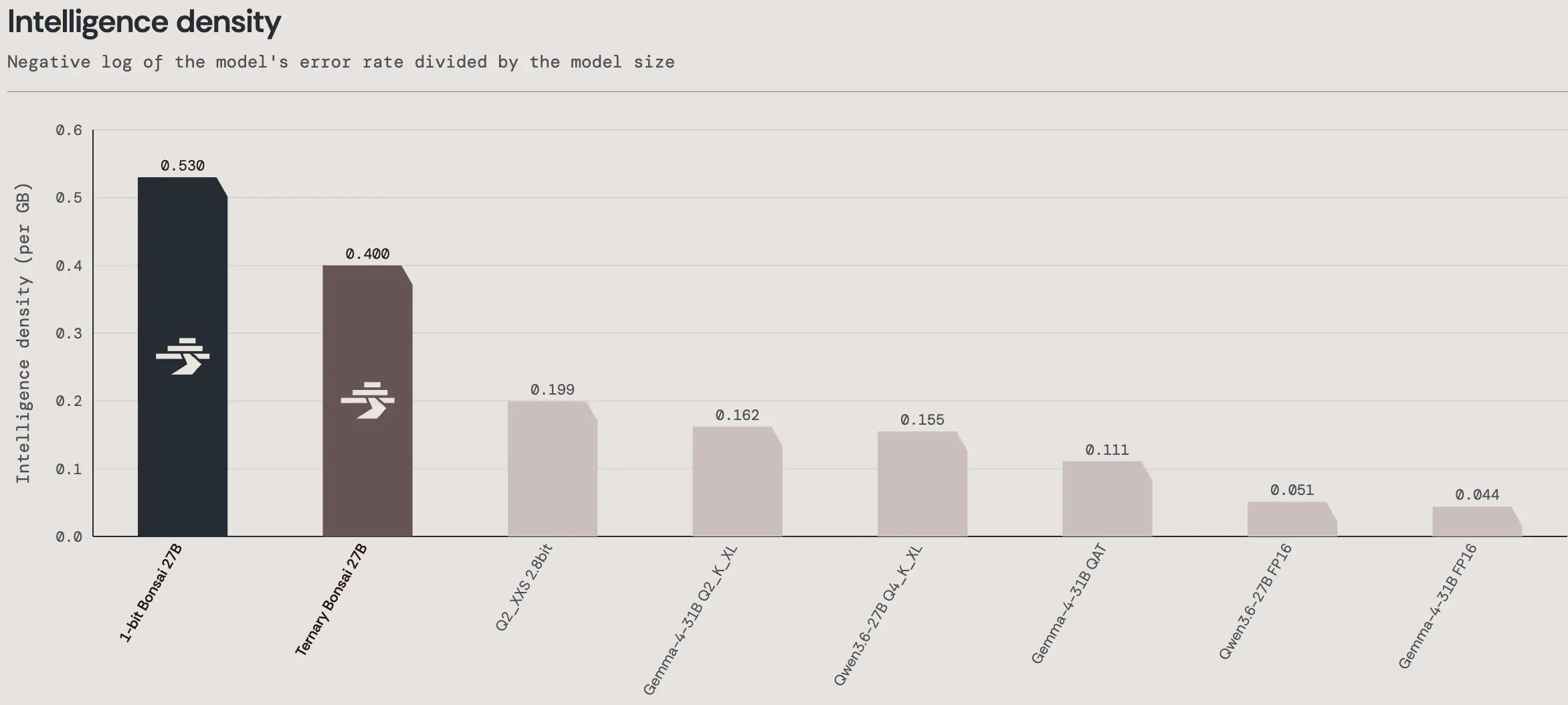
The company also draws a sharp distinction between Bonsai and conventional low-bit systems. In Bonsai, there is no higher-precision escape hatch left in place for sensitive components. Embeddings, attention, and the full language model head are all compressed end to end. Many quantized builds keep certain layers in full precision as a tradeoff to protect quality, which also pushes model size back up. Bonsai does not take that route.
From Bonsai 8B to 27B
This is the second major release in the Bonsai line. In March, PrismML shipped Bonsai 8B, a 1.15 GB model intended to show that a 1-bit architecture could survive at 8 billion parameters without reasoning falling apart. The move to 27 billion parameters is presented as the point where the stakes change. According to the article, this is the scale at which sustained chain-of-thought reasoning, reliable tool use, and multi-step agentic behavior begin to show up consistently, while smaller models still struggle with those tasks.
Benchmark results
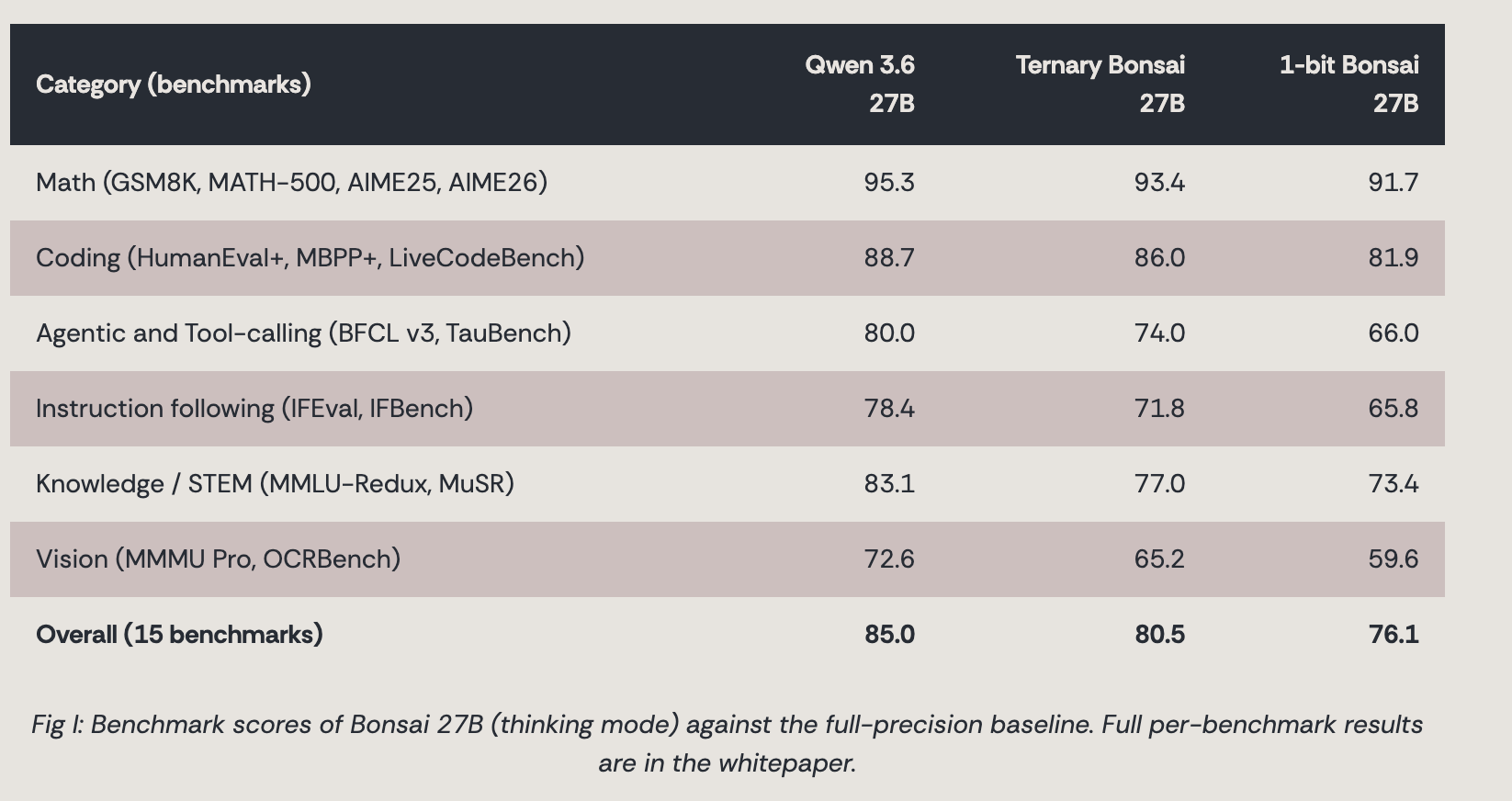
Across 15 benchmarks run in thinking mode on NVIDIA H100 GPUs, covering knowledge, mathematics, coding, and tool use, Ternary Bonsai 27B posted an average score of 80.49. That equals 94.6% of the full-precision model. The 1-bit version scored 76.11.
The article says the models compare very well against Gemma 4 and Qwen 3.6 in terms of capability relative to size. It gives several examples. On AIME25 and AIME26, which are modeled on the American Invitational Mathematics Examination, Ternary Bonsai 27B scored 93.7%, while the much bigger Qwen 3.6B scored 95.3%. In coding, Bonsai scored 86 compared with 88 for Qwen 3.6. On general knowledge, Bonsai scored 77% compared with 83 for Qwen 3.6.
Bonsai also uses a hybrid attention backbone. Roughly 75% of its layers are linear rather than full quadratic attention. The article says that is what makes a 262K-token context window practical on-device. A standard attention stack would make that prohibitively expensive on phone hardware.
Decrypt’s hands-on test
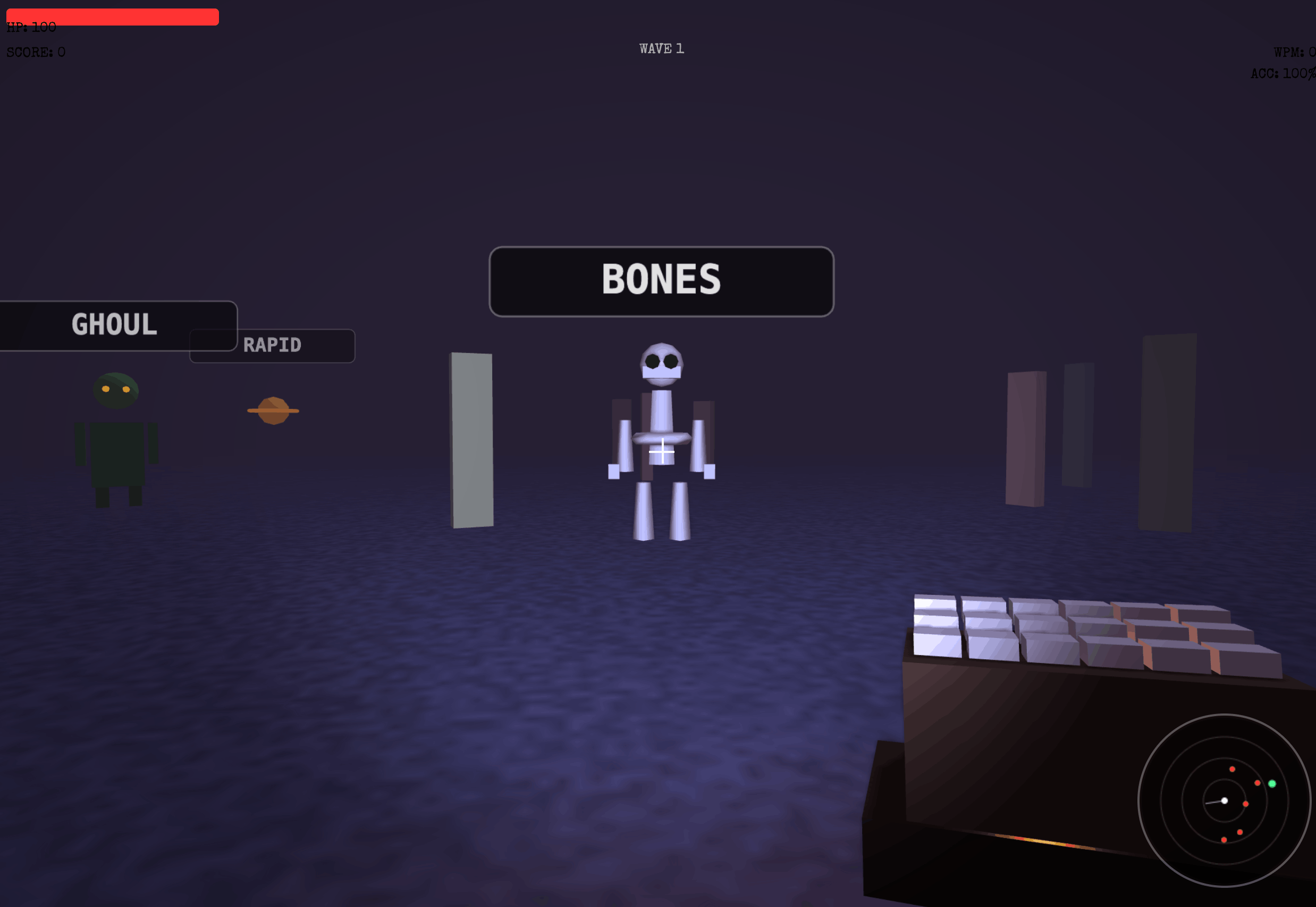
Decrypt said it ran Bonsai 27B itself. For coding, the model still benefits from iteration. Single-shot prompts do not compete with frontier cloud models, the article said, but that matters less when the model is local and free. The publication used it on a browser-based first-person typing horror game called Zombie Type. After two rounds of vibe coding, the model produced clean collision detection, proper scoring logic, and graphics that held together. Decrypt said the model understood structure early, with the second pass refining the work instead of rebuilding it.
The article also noted that some generated assets, including skeletons, looked more elaborate than those produced by GPT 5.6 Sol. It added an important qualification: that does not mean Bonsai is better overall, only that on this specific task it made a cuter skeleton while the “AI king” made a weaker stylistic choice. The game is available for testing through the link cited in the article.
Creative writing drew a more mixed assessment, and the article noted that the standard is more subjective. In broad terms, Bonsai was not especially imaginative on a zero-shot prompt. Even so, Decrypt said the model produced stories with consistent internal logic, pacing, and arc, performing better than or on par with Claude Haiku, and in lower-effort settings on similar prompts even comparing with Sonnet. For a model that runs entirely on a user’s own hardware and carries no API cost, the article said that is a notable result. The story it generated has been posted in Decrypt’s GitHub repository.
DSpark and Apple talks
PrismML is also shipping a DSpark speculative decoding layer alongside the model. It works as a lightweight drafter that proposes blocks of candidate tokens, which the main model then verifies in a single forward pass instead of generating output one token at a time. On an H100, the article said this raises throughput by 1.37x without changing output quality, because the verification step preserves the exact output distribution. On Apple Silicon, it is not yet enabled by default, but the article says it delivers a real gain for GPU serving.
Apple’s involvement adds a commercial angle. PrismML CEO Babak Hassibi told CNBC that the company is in early talks with Apple, which is evaluating the compression technology for possible on-device applications.
Hassibi also said a compressed Gemma model is next in the pipeline, followed by larger frontier models. The 1-bit Bonsai 27B is available now as a free download under Apache 2.0.