


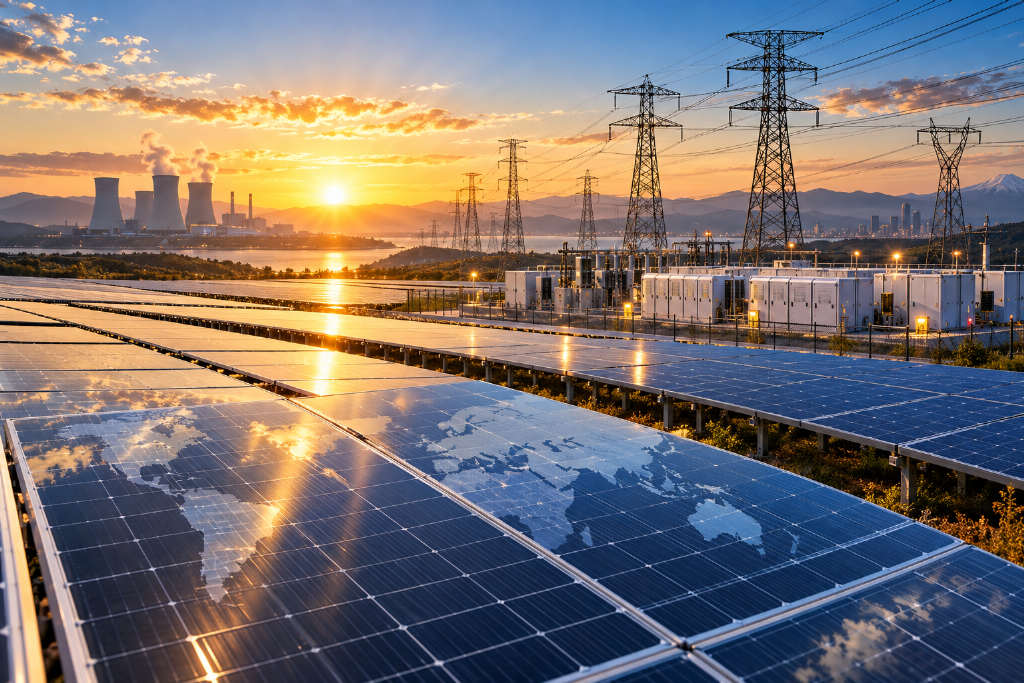
Global solar power generation has overtaken nuclear, according to data from Ember covering the 12 months through September 2026. Ember said solar output was 13% higher than nuclear over that period.
Dave Jones, Ember co-founder, told BBC: 「Solar is generating more electricity than all the world’s nuclear power plants combined. That statistic really is quite crazy.」
Solar and nuclear were nearly level in 2025
On Ember’s annual figures, global solar generation reached 2,779 TWh in 2025, while nuclear produced 2,812 TWh, leaving the two almost tied. In 2026, solar moved ahead.
The longer-term shift is sharper. Ten years ago, solar accounted for 1% of global electricity. By 2026, that figure is set to reach nearly 10%. Nuclear generation, by contrast, has stayed broadly flat since 2000, while solar has grown by about 2,700 times over the same period.
Lower costs were the first major driver
The first force behind solar’s expansion was price. Solar became the cheapest electricity source in history in 2020. Costs kept falling after that as scale increased, efficiency improved, and panels used less silicon and silver.
Rosenow said China’s manufacturing scale and current overcapacity pushed module prices to record lows. The sharp drop from 2023 to 2024 moved the market into what Jones described as an era of power that is "ridiculously cheap."
Jones said: 「A panel itself is unbelievably cheap, well below $100, and it can generate electricity for 30 or 40 years.」
Higher diesel prices accelerated adoption in Africa and Pakistan
The second driver came from fuel prices. The Russia-Ukraine war and the U.S.-Israel war against Iran pushed diesel prices higher. In parts of Africa, where grids are unstable and households rely on diesel generators, rooftop solar panels became an alternative. The article says those panels are almost all imported from China, and that about 100,000 panels are installed across Africa each day.
Pakistan saw an even faster shift. In 2019, solar accounted for less than 2% of the country’s electricity generation. It now stands at 24%. The article attributes that jump to expensive and unreliable grid power, along with low-cost solar panel imports from China.
Jones also said much of the local boom has been funded directly by consumers, adding that people can afford the systems without taking out loans.
Batteries helped solve the daily timing problem
The third driver was batteries. Solar only generates during the day, so dispatchable supply usually requires storage alongside it. Battery costs have also gone through a major decline.
Rosenow said that in sunny regions, solar plus storage is now usually cheaper than building new fossil-fuel power plants. In his words, batteries have "basically solved the daily problem of moving midday sun into the evening."
In California, during the 7 p.m. to 9 p.m. evening demand peak in the first half of 2026, more than one-quarter of electricity supply on average came from solar and batteries.
The next limits are the grid and long-duration storage
Even with lower costs, solar still faces physical limits. It only generates in daylight, and output drops in cloudy weather, rainy seasons, and winter. Batteries can shift midday electricity into the evening, but the article says there is still no cheap long-duration storage option that can cover several days of weak sunlight or seasonal swings.
Solar’s concentration around midday also puts pressure on the grid. The higher solar’s share rises, the more flexibility the grid needs in real time. Without that, systems can end up with too much electricity during the day and not enough in the evening.
Solar farms also require large amounts of land, and some regions have already seen pushback. Supply chains are another constraint. Global solar panel production is heavily dependent on China, and U.S. tariffs have already raised costs. Rosenow said that if Chinese panels become harder to import, this growth wave will not move as quickly.
IEA sees solar output doubling from 2025 to 2030
IEA expects solar generation in 2030 to be double its 2025 level and to surpass hydropower, making it the world’s third-largest electricity source.
Rosenow added a condition: if Chinese solar panels become harder to import, that timeline will slow.