
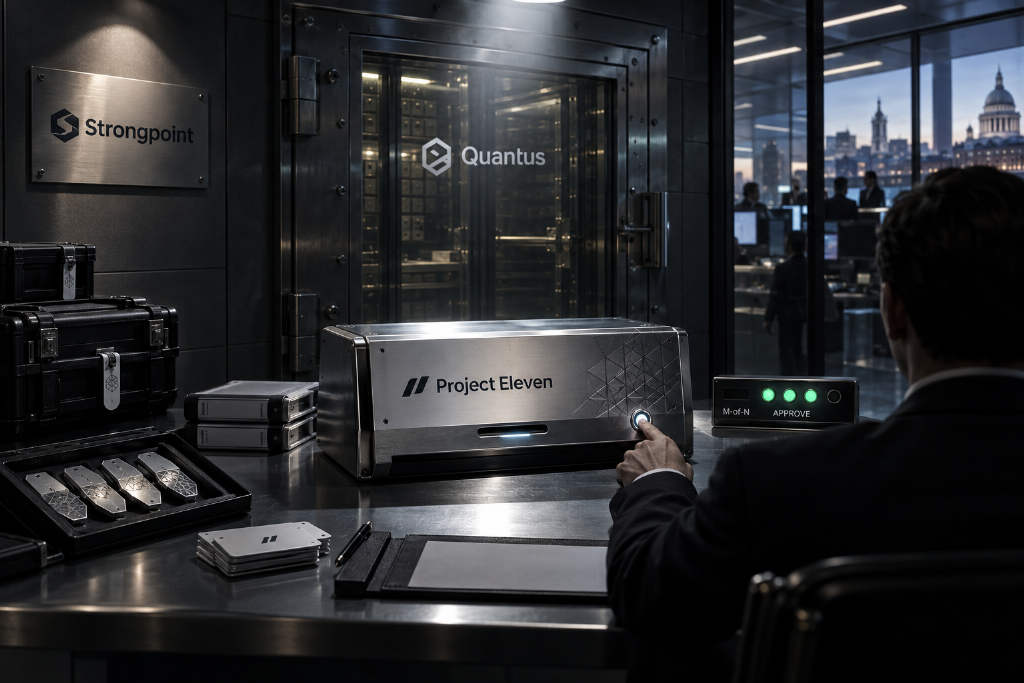
Project Eleven, which focuses on defending against future quantum computing attacks, is planning to integrate the privacy-oriented proof-of-work blockchain Quantus into its institutional custody platform, Strongpoint, in the first quarter of 2027, according to CoinDesk.
Once the integration is completed, institutions would be able to manage Quantus keys and approve transactions through hardware security modules, internal policy controls, and audit systems.
Designed for a world with multiple signature schemes
CoinDesk said the significance goes beyond one blockchain. Networks including Bitcoin and Ethereum are unlikely to adopt the same post-quantum signature schemes or the same migration paths. For banks holding multiple assets, that could mean adapting to several new forms of cryptography at the same time while keeping control over transaction approvals, signing, and audit functions.
Project Eleven co-founder and CEO Alex Pruden said the transition could become an obstacle to institutional crypto adoption, adding that institutions are already preparing for a post-quantum transition outside blockchain environments.
Quantus uses ML-DSA for keys and signing
Quantus co-founder and CEO Christopher Smith said AI is accelerating everything, including quantum hardware and quantum software, and that the tail risk of a sudden quantum attack needs to be included in all portfolio decisions as part of fiduciary duty.
According to the report, Strongpoint separates the institutional control layer from the signature scheme used by the underlying blockchain. That means custodians can keep approval workflows, hardware key storage, and audit trails even if a chain adopts different cryptographic systems.
Quantus uses ML-DSA, a post-quantum signature standard selected by the U.S. National Institute of Standards and Technology, for key generation and transaction signing.