
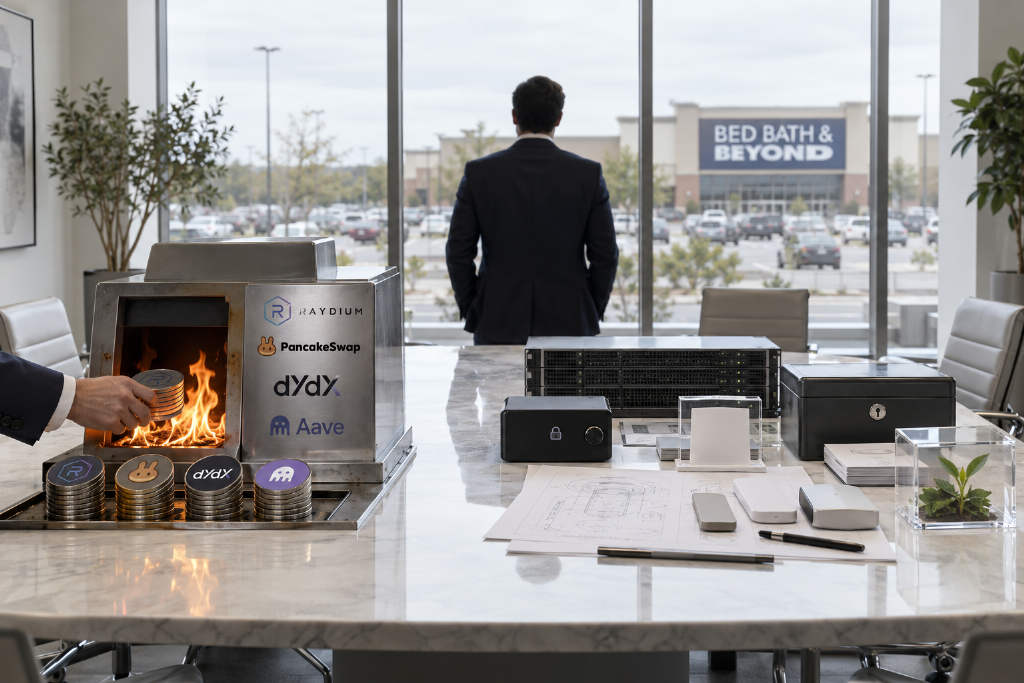
A MarsBit article by Danny argues that protocols that route most of their revenue into token buybacks and burns are not necessarily acting in tokenholders’ best interests. The key question, he writes, is not whether buybacks reduce supply, but how much capacity a protocol has left to keep operating, investing, and surviving after those buybacks are made.

Bed Bath & Beyond as the opening example
The article begins with Bed Bath & Beyond. On April 23, 2023, the U.S. home goods retailer filed for bankruptcy protection and said it had secured about $240 million in debtor-in-possession financing to support the wind-down of its business and related proceedings. At that point, the company most urgently needed cash to keep paying creditors.
The irony, Danny writes, is that a little more than a year earlier the company had still been spending heavily on stock buybacks. In the fiscal year ended Feb. 26, 2022, Bed Bath & Beyond spent about $589 million in cash on share repurchases, while net cash from operating activities was only about $17.85 million. It also needed about $354 million in capital expenditures that year. In other words, operating cash flow did not even cover capex, yet buybacks continued.
The company was remodeling stores, upgrading digital channels and supply chains, and pushing private-label brands. The problem was that those turnaround efforts had not yet proved they could reverse the business, while large sums were already being sent back to the stock market. By the summer of 2022, some suppliers had begun demanding stricter payment terms, including prepayment. Suppliers were no longer willing to extend trade credit as before, and that set up what followed.
Danny does not say buybacks alone caused the bankruptcy filing. He notes that product strategy, competition, supply chain issues, and execution all went wrong. Still, those problems sat on the same balance sheet as the buybacks. Money spent in one place could not be spent elsewhere. The company bought back its own stock, but it did not buy back customers, and it did not make suppliers more willing to offer credit.
Competitive advantage takes money to build
From there, the article shifts to crypto. Whenever a protocol says it will use 80%, 90%, or even all of its revenue to buy back and burn its own token, Danny says he thinks of Bed Bath & Beyond. The market sees fewer tokens and a clear reason to buy, but he wants to know how much ability the protocol has left to keep building the business after the buyback.
Citing Michael Porter’s Competitive Advantage, the article says a business that wants to earn above-peer profits over time has to become harder to replace and build stronger advantages. Users stay because liquidity is deeper, trading is cheaper, products fit better, or switching costs are higher. Monopoly is not required, but a business with no differentiation will struggle to keep excess profits.
Building and deepening those advantages costs money, often a lot of it. Trading protocols need to maintain depth, expand distribution, and pay for research, development, and security. If they want to move from being a trading tool to becoming infrastructure, they also need to invest in an ecosystem so outside developers have a reason to build around them. Spending does not guarantee success, the article says, and Bed Bath & Beyond is a reminder of that. But when useful investment opportunities exist, buybacks carry an opportunity cost of their own. They can crowd out the next product, an important channel, or the runway needed to survive the next downturn.
Buybacks, by contrast, are easy to see in the secondary market. How much was spent, how many tokens were bought, and how much supply was burned can often be checked on-chain the same day. Communities can turn that into graphics immediately. Product improvements and channel building take longer and may fail. That, Danny argues, can train teams to put resources where applause comes fastest, while caring less about competitiveness two years later.
Why Apple is not a clean comparison
The article then addresses a common response: Apple buys back stock at scale, so why should decentralized protocols, launchpads, or PerpDex platforms not do the same? Apple spent about $94.95 billion on buybacks in fiscal 2024, but it also recognized $31.37 billion in R&D expense and $9.45 billion in capital expenditures that year. After deducting capex from operating cash flow, its free cash flow was about $108.81 billion, and buybacks accounted for about 87.3% of that figure. Danny’s point is that this is not the same as taking 90% of fees off the top.
Apple also ended the year with about $156.65 billion in cash, cash equivalents, and marketable securities. That number does not net out debt and is not all cash available for immediate use, but it shows that buyback ratios sit inside a much larger balance-sheet context. Quoting the $94.95 billion buyback figure while ignoring R&D, capex, and financial resources copies the action of a mature company without copying the conditions that made the action possible.
Apple sells products and services, absorbs those investments, and only then generates profits and free cash flow that can be allocated. A younger protocol that suddenly earns large fees during one market cycle, before proving whether users will stay, is borrowing the capital-return logic of a mature company while skipping the hardest part: turning temporary revenue into durable earning power.
The article adds that explosive cash flow is not the same as mature profitability. Bed Bath & Beyond is a reminder that even a long-operating company is not guaranteed to remain mature and stable forever. Competitive advantages erode, customers leave, and when reinvestment becomes necessary, management has to be willing to keep cash inside the business.
Protocol comparisons show why headline ratios can mislead
Danny then compares several protocols with buyback mechanisms.
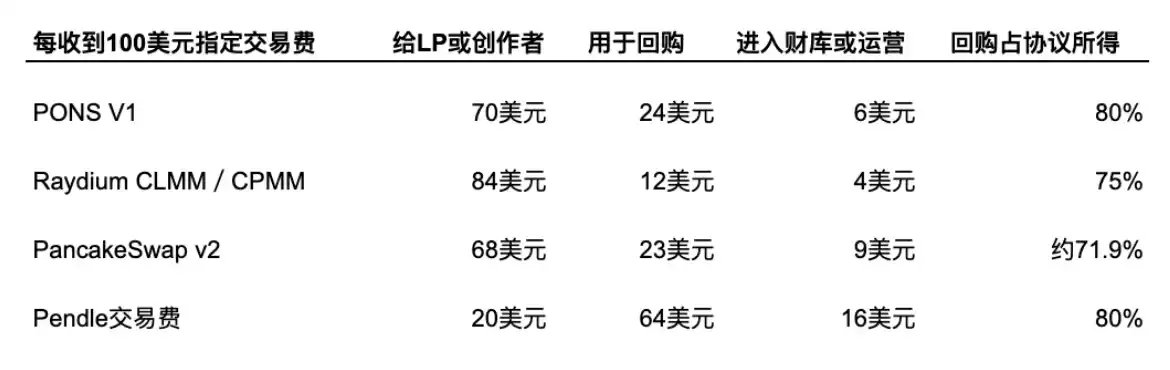
- PONS says in its V1 documentation that 80% of protocol fees go to buying back and burning PONS, while the remaining 20% pays for infrastructure and team expansion. The article asks whether that remaining share is enough to support operations and absorb risk.
- Pump.fun’s current official target is 50%, with a one-year programmatic buyback-and-burn schedule starting on April 28, 2026.
- Raydium’s CLMM and CPMM pools allocate 84% of total trading fees to liquidity providers, 12% to buying back RAY, and 4% to the treasury. On the surface, only 12% goes to buybacks. But after LP payouts, the protocol itself keeps only 16%, and three-quarters of that is converted into its own token.
- PancakeSwap v2 shows a similar pattern. Using protocol income as the denominator, the buyback-and-burn share is about 71.9%.
The article says those figures are based on official fee-split ratios and represent fee flow only. Raydium holds the bought-back tokens at the protocol level, while Pendle uses bought-back tokens for staking rewards. More importantly, the $6, $4, and $9 figures in the comparison table are not profit yet. They may still need to cover R&D, operations, and security costs.
That is why Danny says he does not like ranking protocols by buyback ratio alone. Protocol fees, foundation assets, and development-company funds may belong to different entities. A wallet that keeps buying tokens does not prove the broader ecosystem lacks money for R&D. On the other hand, a team holding a large amount of its own token does not mean it has the same amount of cash ready to pay bills. Only by looking across those accounts together can investors tell whether buybacks are funded by profit, surplus cash, or money the protocol may need later.
Cyclicality can break aggressive buyback promises
The article argues that crypto is an intensely cyclical industry. As one example, Coinbase’s transaction revenue fell from about $6.837 billion in 2021 to $2.356 billion in 2022, a drop of about 65.5% in a single year.
Decentralized protocols can see even sharper swings. Danny points to dYdX: when its buyback allocation was 25% in 2025, the average monthly buyback budget was about $339,000. In the first half of 2026, the allocation rose to 75%, yet the average monthly budget fell to about $183,000. The ratio tripled, but the buyback amount dropped about 46% because related net protocol revenue fell about 80%.
PONS offers another example. According to DeFiLlama data cited for Oct. 5, its combined protocol revenue over the past 30 days was about $22.70 million, while the past seven days came to about $1.68 million. On a daily basis, that works out to about $757,000 versus $240,000. The recent seven-day average was about 68% below the 30-day average. Danny argues that taking the hottest month, multiplying it by 12, and presenting the result as a stable annualized buyback capacity misses the volatility and can mislead teams about their own position.
He ties that back to Bed Bath & Beyond. When money gets tight, suppliers tighten payment terms and demand cash earlier. Crypto protocols face a similar problem. Revenue can fall 70%, but many costs do not fall with it and may become even harsher. The article also notes that customer-acquisition costs at a $1 billion FDV are not comparable to those at a $10 million FDV.
Security reserves may look inefficient until they are needed
Beyond operating costs, Danny says crypto has another expense category that cannot be ignored: security. The question is how much a protocol may need to pay out when an attack happens.
Citing Chainalysis, the article says funds stolen from crypto services totaled about $2.2 billion in 2024, about $3.4 billion in 2025, and about $5.0 billion in the first half of 2026. One Bybit incident in 2025 alone accounted for about $1.5 billion. For a protocol, Danny writes, security reserves are not there to cover average losses. They are there for the one event large enough to wipe out the treasury.
Ronin’s 2022 incident is used as a concrete example. The bridge lost 173,600 ETH and 25.5 million USDC. When the bridge reopened, the official disclosure said that after excluding the Axie DAO portion, the user-related shortfall stood at 117,600 ETH and 25.5 million USDC. Users wanted ETH and USDC back, not a reminder of how many native tokens had been burned in the past. Security reserves may look inefficient in normal times. They do not create buy pressure and they do not reduce supply. But they preserve a team’s ability to repair the business and restore market confidence. Once trust is damaged, raising money by issuing or selling the native token is usually far harder than it was in a bull market.
Aave as an example of buybacks yielding to operating reality
Danny says he pays more attention to a different kind of capital allocation. In Aave’s 2026 financial post, the protocol disclosed that roughly 10 months after launching buybacks, it had allocated $42 million and bought more than 205,000 AAVE. But borrowing-fee income had fallen about 25% from its peak, while service-provider costs and other growth needs were rising. The post therefore proposed cutting the annual buyback budget from $50 million to $30 million, a 40% reduction. The article notes that this was only a proposal, not a confirmed outcome.
Aave’s bought-back tokens also go into ecosystem reserves for rewards and other spending rather than being permanently burned. For Danny, the important point is that the proposal acknowledged something necessary: when operating conditions change, buyback policy should give way. A follow-up post on April 22 later said buybacks had been paused from April 19 because of the rsETH cross-chain bridge incident, with the stated reason being the need to preserve treasury capacity for potential losses.
The reverse case worries him more. If a team cannot reduce buybacks because doing so would damage the token’s main selling point, then capital allocation has started to constrain operations. The business needs money, but the market still expects buy pressure. To keep that promise, a protocol may end up relying on fundraising, foundation token sales, or another round of incentives.
Complex buyback structures can blur what is really happening
The article also examines more complicated mechanisms. After an upgrade on June 17, 2026, Aster began using 99% of daily platform fees to buy back ASTER. Those bought-back tokens are distributed to veASTER holders, while the protocol burns an equivalent amount from reserves, prioritizing team allocations until total supply falls to 3 billion tokens. Danny says this combines market purchases, reward distribution, and inventory burns in one structure.
PancakeSwap, meanwhile, has proposed a target of at least about 4% net annual deflation while also running incentive issuance. For secondary-market traders, the article asks, does that mean supply is going up or down?
Burning team inventory can reduce future overhang and has long-term value, Danny writes, but that approach fits mature projects better. If bought-back tokens are redistributed, they may re-enter circulation. Looking only at a lower total supply, without checking circulating supply or how much cash left the system, can turn three separate positives into one message that few people fully understand. For a still-growing decentralized protocol, he says, that may amount to unnecessary drag.
When buybacks become a token-selling model
By this point, Danny says his concern is no longer just how money is divided. It is whether the project’s operating goal itself has shifted, with making the token easier to sell and more liquid gradually becoming more important than growing the business. For protocols that market high buyback ratios as a core feature while saying little about reinvestment and risk reserves, he is more inclined to view them as business models oriented around selling tokens.
When a protocol promises to use most of its revenue for buybacks, it gives the secondary market a simple reason to buy: the platform earns money every day, buys tokens every day, and keeps reducing supply. Buyers may be more willing to take the other side, and trading activity can feed price discussion, social distribution, and attention. In that sense, the article says, buyback spending also functions as marketing spend. It creates buy pressure while advertising why others should buy.
Here, “selling” does not necessarily mean the team is directly selling tokens. It means the mechanism is designed first to make the market more willing to buy, hold, and trade the token. Fees become the buyback budget, buybacks become the purchase thesis, and secondary-market heat becomes evidence of growth. If success is ultimately measured by token price, volume, and discussion, the line between running a token and running a business starts to blur.
The article places this next to the “high FDV, low float” discussion. The mechanisms are different: high valuation and low float rely on limited supply to shape price and then extend that price into other venues to obtain liquidity, while buyback-and-burn may at least use cash earned by the business. They are not the same thing. But if both designs center on supporting price and manufacturing scarcity so the next buyer is willing to step in, while durable competitiveness becomes secondary, they may still serve similar interests.
Buybacks should not come before product, security, channels, and ecosystem
Danny’s broader point is that competitive advantage cannot simply be purchased, but maintaining product quality, security, channels, and ecosystem usually requires ongoing investment. Buybacks should not come ahead of those needs. That is especially true when team and early-investor tokens are still unlocking while the protocol is also using revenue to buy tokens in the market. In that setup, buybacks provide demand, and a more active secondary market can improve exit conditions for sellers.
Secondary-market excitement and genuine business advantage are not the same thing, he writes. Someone may buy a token because the buyback ratio is high, but that does not mean they will use the protocol. Even if they do, it does not mean they will stay once subsidies shrink and market conditions cool. Users who arrive because of price can leave because another token rises faster. Attention can bring traffic, but it does not automatically create loyalty, pricing power, or a product competitors cannot copy.
Price-driven attention still has value. It can attract developers, market makers, and distribution partners, which may deepen liquidity and improve products and eventually create a network users do not want to leave. But every step in that chain requires spending and proof. Danny says more convincing evidence would be growth in users without extra incentives, repeat usage, lower acquisition cost per user, and how much cash remains after subsidies. If most of the money keeps going to buy pressure while too little is left to turn attention into product, channels, and customer relationships, then the project is simply paying to maintain heat.
Risk reserves do not rise automatically with online enthusiasm either. Bullish posts on social platforms do not pay for security audits, payroll, or compensation after an incident. In a downturn, business revenue, token prices, and market attention can all fall together. A mechanism that relied on buybacks to sustain excitement may lose its funding source at exactly the moment support is needed most. Danny says the dYdX data point, where the buyback ratio rose but the budget fell, is a clear warning.
The conclusion: early buybacks can obstruct long-term strength
The article does not reject returning excess cash to the market. For asset-light protocols with strong competitive positions, limited reinvestment opportunities, and ample reserves, a high buyback ratio can make sense. The standard, Danny says, is always the same: how the capital is used and whether that use increases long-term value.
But if the business is not yet stable and reserves are not yet sufficient, permanently using most revenue to buy and burn tokens is not something he is willing to endorse lightly. He returns one last time to Bed Bath & Beyond. When the company filed for bankruptcy protection, the stock it had repurchased in the past could not be turned back into cash flow, nor could it restore supplier trust. That does not prove every buyback is wrong. It does, however, remind holders that the value a business leaves them depends in the end on whether it can keep operating and whether it can win back customer trust after a downturn.
If a protocol can tell the market every day how many tokens it burned but cannot explain how secondary-market attention becomes a harder-to-replace business and a thicker cash buffer, Danny says he sees that more as a way of selling tokens than as a reason to hold them for the long term. Buybacks may help a token find the next buyer. Only the ability to keep operating gives the people who stay a reason not to rush to find one.