
Source: 51 Insights | Marc Baumann
Translated and republished by TechFlow
Marc Baumann’s central claim is blunt: for roughly 15 years, crypto investors were told that buying tokens was the way to back infrastructure. That promise, he argues, has now broken down. The framework behind it was formalized in 2016 as the fat protocol thesis, which held that applications would be commoditized, protocols would capture value, and tokens would represent a claim on that protocol layer. In Baumann’s view, that bargain no longer works.
June was supposed to validate the thesis
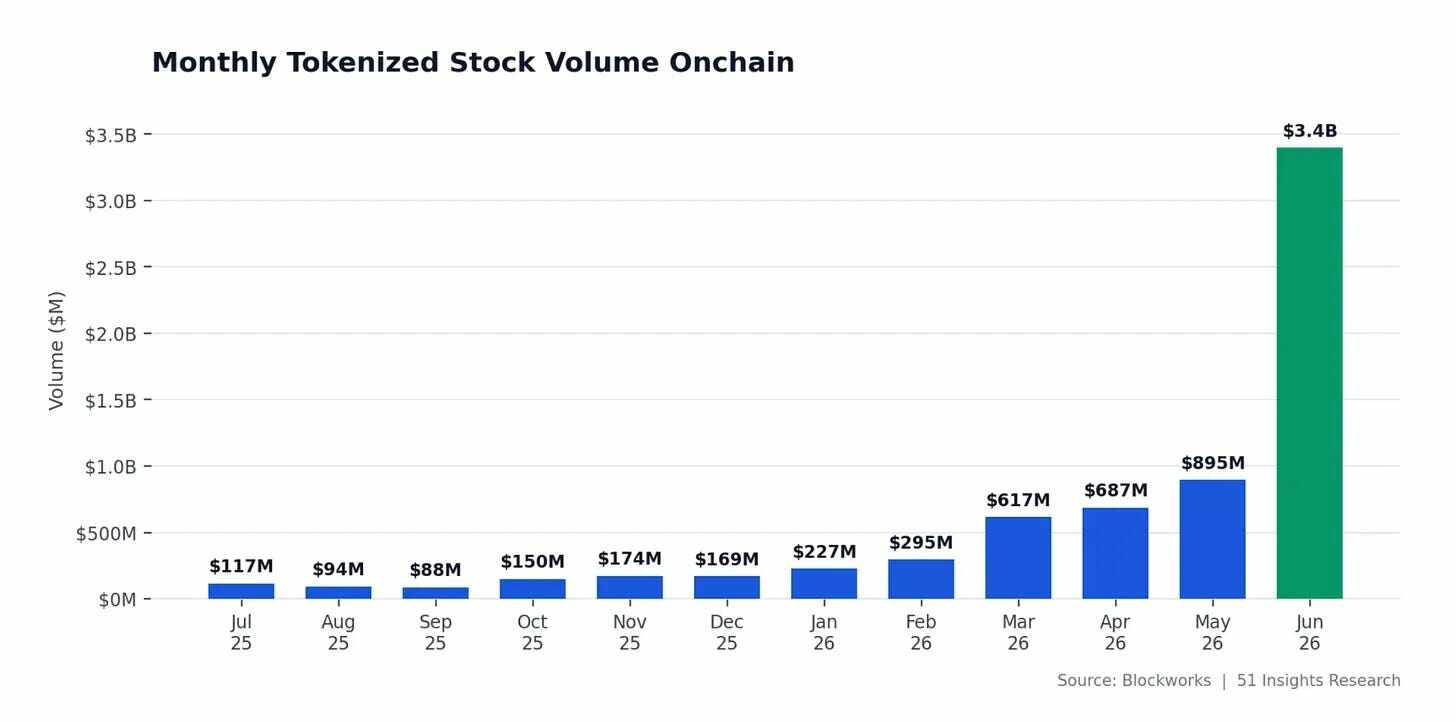
Baumann frames June as the kind of month that should have confirmed the old model. Tokenized stocks recorded a monthly on-chain trading record of $3.86 billion in June, up 145% from the prior month. The catalyst, according to the essay, was SpaceX’s June 12 Nasdaq listing and its $7.5 billion financing round, followed the same day by the launch of tokenized SpaceX shares on Solana.
Tokenized SPCX alone accounted for $1.19 billion in trading, or about 31% of all tokenized stock volume that month. Solana handled roughly 96% of that activity. On June 23, tokenized assets overtook meme coins in share of Solana spot trading volume for the first time, while active addresses retested yearly highs and throughput approached record levels.
Yet SOL did not respond the way the fat protocol thesis would suggest. Baumann writes that the token traded around $77, down about 50% over the past year and 73% below its peak, with mid-June marking its lowest level since December 2023.
His point is not that the data were weak. It is that even in one of the strongest possible usage cases, price did not follow. Many market participants would explain that through macro pressure, ETF outflows, or simple patience during a bear market. Baumann offers a different reading: the link between value creation and token ownership has fractured, and value is moving away from the token layer toward the equity of infrastructure companies that often have no token at all.
Where the value events actually happened
He supports that argument with a list of transactions and capital-markets events that, in his reading, show where money is really being made:
- Stripe acquired Bridge in February 2025 for $1.1 billion.
- Mastercard signed a deal in March to acquire BVNK for as much as $1.8 billion. The article adds that Coinbase had previously come close to buying BVNK for about $2 billion before that deal fell apart in November.
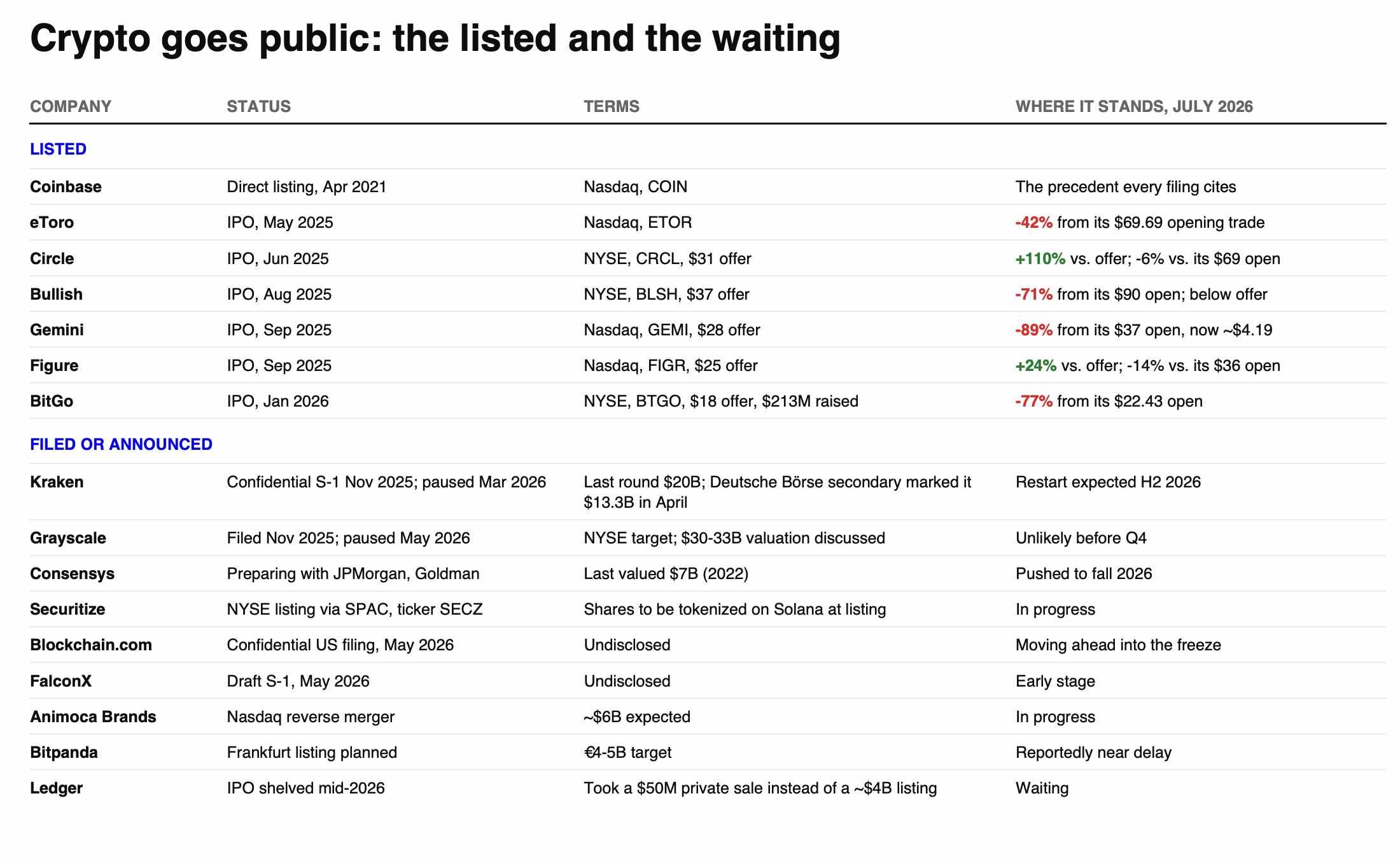
- Kraken agreed in December 2025 to acquire Backed Finance, the issuer behind xStocks, as part of preparation for a 2026 IPO.
- Securitize is listing its common stock on the New York Stock Exchange and tokenized those shares on Solana on the first day of trading.
None of those value events, Baumann argues, took place at the token level. Every one of them took place in equity.
Why equity keeps the economics
The explanation, he says, is not dramatic. It is legal. Equity carries an enforceable claim on cash flow. Most tokens do not.
That difference matters when tokenized stock trading scales. Even with $3.86 billion of stock activity moving across Solana, the network only collected fractions of a cent per transaction because near-zero fees are part of the product. The meaningful economics — mint and redemption spreads, custody fees, and market-making profits — go to issuers, brokers, and exchanges. Tokens get the headlines. Companies book the revenue.
The Ethereum breakdown: $1,538 versus $816,000
Baumann then turns to Robinhood’s chain as a cleaner dissection of the same issue. Robinhood launched its own chain on July 1, built on the Arbitrum stack as an Ethereum Layer 2, and offered tokenized stocks to customers in more than 120 countries. Within a week, it was processing $568 million in daily trading volume.
He cites ARK Invest’s Lorenzo Valente, who published a revenue breakdown showing that the chain had generated about $816,000 in total revenue since launch. Robinhood kept about 89%, Arbitrum took 10%, and Ethereum earned just $1,538 for settlement.
That is the base layer, in a real operating example, capturing 0.15% of the economics. For Baumann, this directly clashes with the old protocol thesis. The financial instrument that actually captures Robinhood chain’s success already exists, he writes: HOOD, which trades on Nasdaq. There is no Robinhood chain token, and in his telling, no one misses having one.
The internet already ran this experiment
To push the point further, Baumann compares crypto infrastructure to early internet infrastructure. Protocols such as TCP/IP, HTTP, and SMTP created enormous value but did not capture it. The firms that captured it were built on top: Google, Amazon, Netflix, and Airbnb.
He also revisits the telecom buildout of the late 1990s, when carriers laid more than 80 million miles of fiber in an effort to own internet growth. George Gilder, one of the era’s most outspoken evangelists, argued that there would be “no losers” in a trillion-dollar market. Within a year, two of the carriers he promoted had gone bankrupt. More than $500 billion was wiped out, 216 telecom companies failed, and 85% of fiber was still dark in 2005.
That dark fiber later made bandwidth cheap enough for businesses such as YouTube to exist. The pipes created value. Companies built on top of the pipes captured it. Baumann’s argument is that Layer 1 networks are replaying the same trade.
The structural flaw in token financing
From there, the essay moves to a harsher conclusion. A large share of token projects from the past decade, Baumann says, would not have been financeable in traditional markets. They had no revenue, no enforceable claim on future revenue, and no credible plan to produce either. In equity markets, those companies would not have been funded. In crypto, many were funded at scale because tokens solved a problem that securities do not: they allowed early investors to exit before the underlying business had created real value.
He cites Binance Research, which documented in 2024 that only 13% of token supply was circulating at listing, while about $155 billion of locked supply was scheduled to hit the market between 2024 and 2030. Venture funds could buy at private-market prices, wait through a one-year cliff, and then sell into loosely regulated secondary markets instead of waiting seven to 10 years as equity investors typically do. The other side of that trade, he writes, was retail.
Baumann also notes that even venture participants have acknowledged the dynamic. He quotes Dragonfly’s Haseeb Qureshi, who described price discovery in such launches as taking place in private markets that were “manipulated, delusional, or both.”
His argument is not that fraud is required for the system to fail. In fact, he says the more troubling part is that the structure can be fully disclosed and legal while still paying people not to build durable value.
Celestia and Polkadot as case studies
Baumann uses Celestia and Polkadot to show that this disconnect between usage, fundamentals, and token price is not confined to one network.
Celestia’s token, TIA, launched with 8% annual inflation and climbed to nearly $20.85 in February 2024. On Oct. 30, 2024, a cliff unlock released 176 million tokens, nearly doubling circulating supply. Early backers sold over the counter, buyers hedged through perpetuals, and another roughly 409 million tokens are set to unlock through early 2027, according to the article. TIA now trades below $0.40, down about 98% from the high.
The usage side, Baumann says, never justified that emissions schedule. Over one recent 24-hour period, the entire network generated just $89 in fees while carrying a market capitalization near $370 million.
He treats that not as an outlier but as a pattern. Polkadot, he notes, was a top-five asset in 2021 with a valuation above $50 billion. On June 28, DOT hit an all-time low of $0.7993, six years after launch. It now trades below $0.90, roughly 98% beneath its peak and even below its 2020 launch price.
What makes the example notable in Baumann’s telling is that Polkadot did many of the things token holders had asked for. In March, the network set a hard supply cap of 2.1 billion DOT and cut issuance by more than half. That same month, it obtained a Nasdaq-listed spot ETF, while continuing to rank near the top in developer activity. Fundamentals improved. Price still made new lows. His conclusion is that price was never tightly bound to fundamentals in the first place.
Even Solana, the strongest counterexample, shows the break
Baumann is careful to say that Solana is the strongest counterexample available. It has real fee capture, real staking economics, and some of the deepest usage in the industry. That is exactly why June matters so much in his framing. If a network with those characteristics still cannot convert record activity into token-price support, then weaker tokens have even less of a case.
The uncomfortable asymmetry for public investors
The essay then arrives at what Baumann sees as the central asymmetry. The layer available to public investors is the layer that does not capture much of the value. The layer that does capture value usually sits inside private companies, often until they are acquired by firms such as Stripe, Mastercard, or Kraken, or until they approach an IPO.
He does address the obvious pushback: what about buying these firms after they list? Crypto companies raised $3.4 billion through IPOs in 2025, and the 2026 pipeline is taking shape, he writes. But public markets have also been ruthless in reviewing them. Gemini is down 89% from its opening price, BitGo is down 77%, and Bullish is down 71%.
By contrast, companies with recurring revenue tied to actual usage have held up better. Circle still trades about 110% above its issue price, while Figure remains about 24% above its issue price. Equity is not a magic wrapper in Baumann’s framing. It is simply a claim on cash flow, and where cash flow is real, that claim has held up even through a severe crypto downturn.
A bear market as a full audit
Baumann says this bear market is functioning as a full audit. Every leg down separates a claim on something real from a claim on attention. The repricing does not stop at one asset class; it has also hit exchange stocks geared to trading volume. What is being marked to market, in his telling, is a decade of crypto capital formation, and the market is placing value where legal claims on real cash flow actually exist.
The counterarguments he leaves open
The essay does leave room for rebuttal. Tokens can be programmable claims, Baumann writes, and claims can be redesigned. Fee switches, buybacks, and revenue-sharing structures could reconnect usage and price. Solana’s Alpenglow upgrade, combined with a genuine regulatory framework, might be one path toward doing that.
He also notes Haseeb Qureshi’s point that 13% circulating supply at launch was normal in the last cycle as well, so the structure itself is not new. What may be new is that the marginal buyer is no longer showing up. Another possible pushback is that this may simply be beta divergence: tokenized real-world assets are up 40% year to date while the broader crypto market is down about 20%, so the gap could narrow if macro conditions improve.
Baumann’s own bet is that the gap will not close very much because the divergence is contractual rather than cyclical. The fat protocol thesis said value would aggregate at the protocol layer and that the token was your share of that value. What this cycle shows, he argues, is something different: value is aggregating in the hands of entities with legal claims, and those claims were never in the tokens. They were on the cap table all along.