
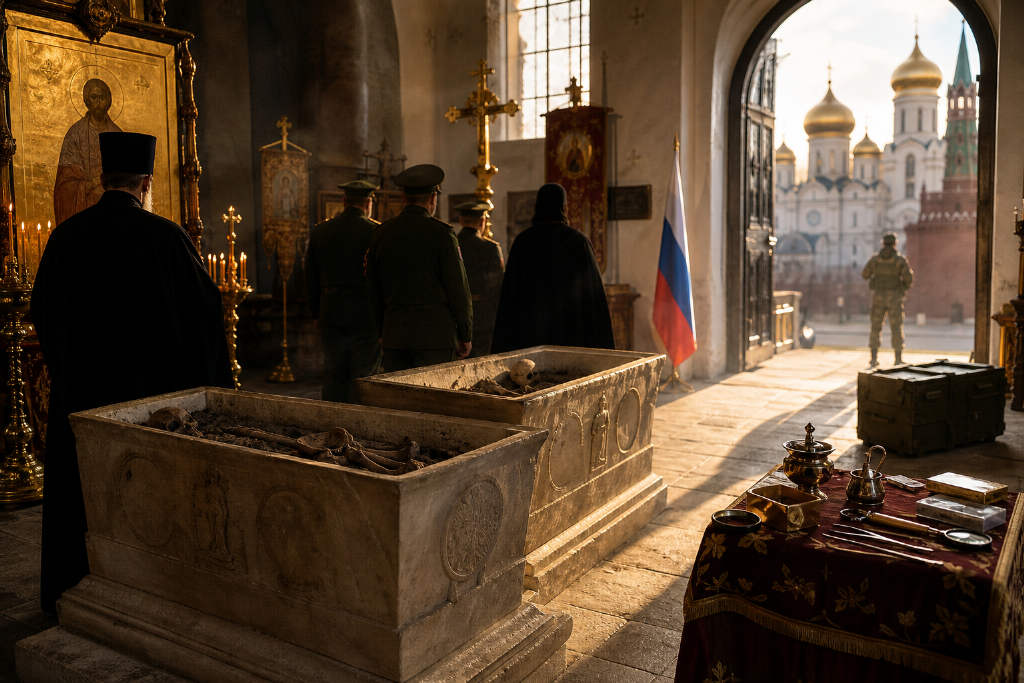
Russian President Vladimir Putin on Aug. 20 entered the Archangel Cathedral in the Kremlin, lit a candle beside an opened white stone sarcophagus, and listened as specialists explained whose remains were inside. Kremlin video from the visit showed a prayer service that explicitly mentioned a victorious army, the Russian nation, and the president himself. After the rite, Putin walked over to inspect two opened tombs.
The remains were identified as those of Dmitry Donskoy, the 14th-century Grand Prince of Moscow who defeated the Mongol Golden Horde at the Battle of Kulikovo in 1380. He died in 1389 at age 39 and was canonized by the Russian Orthodox Church in 1988 during the millennium of the baptism of Rus. The bones were unearthed in July during emergency repair work in a basement beneath the cathedral’s south wall. The report said the skeleton was almost complete, missing only part of the left heel bone. Three coffins were discovered during the same repair work, and the location itself surprised historians, who had believed Donskoy had been buried on the other side of the church.
Church plans to send part of the remains to the front
The remains are not headed to a museum. Patriarch Kirill has already ordered that the bones be divided and placed into reliquaries, with one portion set to be sent to the Ukrainian front line for Russian troops to venerate, according to the report. Vakhtang Kipshidze, deputy head of the church’s department for relations with society and the media, said soldiers should be given a chance to pay respects as soon as possible and that bringing relics into a combat zone was an appropriate way to raise morale. The report said Putin signaled approval inside the cathedral.
This would be the third batch of relics sent into the war zone. The article frames that decision against Russia’s public push for military AI, robotics and automated command systems. Two months ago, Defense Minister Andrei Belousov said the Russian military was integrating artificial intelligence, robots and automated command systems into force management. In April of last year, Putin told the military-industrial commission that whoever moved faster in applying AI to warfare would gain a major advantage on the battlefield. In May this year, he said only three countries in the world had the capacity to develop sovereign AI, and Russia was one of them.
Now, as the report puts it, Russia is also trying to work out how to move a 637-year-old set of bones safely to Donetsk.
Earlier relic shipments were destroyed
This is not the first time Russia has sent saintly remains into the war. The report says that in the spring of this year, part of the relics of Alexander Nevsky were sent to the front at the suggestion of Belousov. By summer, they were being used in prayer services seeking relief from a fuel crisis, especially the restoration of fuel supplies to Crimea.
In mid-July, troops loaded those relics onto a truck and sent them toward an important site in Donetsk for another prayer ceremony. Multiple drones attacked on the way. The relics were completely destroyed, and three officers were killed on the spot, according to the report.
A year earlier, relics of St. Matrona of Moscow were also sent to the front and were destroyed by shelling. Belousov was said to have backed that effort as well.
Citing Nasha Niva, the article says concern has surfaced inside the Russian Defense Ministry that Belousov and Patriarch Kirill could clash over the failed transfers. One Defense Ministry source was quoted as saying: “We hope God will not abandon us. We believe that, despite this, new relics will still reach the front.”
The piece also says religion has been folded into the war effort in an institutionalized way. By the church’s own accounting, over the past three years it has baptized 42,000 soldiers at the front, built 140 field churches, and deployed 2,000 priests. In 2024, a document adopted by the World Russian People’s Council formally defined the war as a “holy war.”
Church declared identification before DNA could confirm it
On Aug. 18, the Russian Orthodox Church announced that the identification process had been completed and that the remains had been confirmed as Donskoy’s.
Days later, Nikolai Makarov, director of the Institute of Archaeology at the Russian Academy of Sciences and an academician, described the process in public. His wording, according to the report, was that DNA analysis had been carried out and samples had been taken, but they “did not provide personal information about Dmitry Ivanovich.” In practical terms, that means the DNA work did not prove the identity.
The church relied on another line of reasoning. It said the remains belonged to a man under 180 centimeters tall, aged between 35 and 45, who died of natural causes. The church concluded that those characteristics “correspond to written historical sources and historical testimony concerning the grand prince’s life and death.”
The report argues that this amounts to non-exclusion rather than confirmation. Donskoy died at 39, which fits the 35-to-45 range, but he would not have been the only medieval Moscow nobleman who fit that profile.
Makarov also said Russian laboratories have reconstructed some of the genetic characteristics of members of the pre-Mongol Rurik dynasty and that, in theory, those data could be used for comparison. He did not say what the comparison showed.
Russian journalist Ksenia Luchenko offered a sharper reading, saying the episode was clearly “not improvised” and had been prepared for quite some time. Historians and church officials already knew where Donskoy was buried, she said, and all that remained was to open the grave. She added: “Perhaps the authorities need another event combining mysticism and ideology, because momentum is fading.”
Putin’s own remarks in the cathedral also suggested planning in advance. He said, “I spoke with His Holiness yesterday, I know his plan, please pass on my regards to him.” The report reads that as evidence that the church and the Kremlin had discussed the matter before the tomb was opened.
The article draws a comparison with the Nazi-era ‘Holy Lance’ story
The report also reaches for a historical parallel. After the Anschluss in March 1938, the imperial regalia of the Habsburg dynasty were transferred from Vienna to Nuremberg under SS escort on Oct. 13 that year and stored at St. Catherine’s Church. Among them was a so-called Holy Lance, said in legend to be the spear used by the Roman soldier Longinus to pierce Jesus’ side. Over time it became known as the Spear of Destiny, wrapped in claims that whoever possessed it could shape the outcome of war.
The article then adds an important caveat. The claim that Adolf Hitler was obsessed with the lance’s supernatural power comes mainly from British author Trevor Ravenscroft’s 1973 bestseller The Spear of Destiny. Historians broadly regard that book as a mix of fact, folklore and the author’s own mystical interpretation. What can be established, the report says, is far narrower: the spear was moved by the Nazis, and it was returned to Vienna by U.S. forces in 1946.
That is where the article sees the distinction. Hitler’s supernatural story was largely written after the war and has been challenged by historians for decades. In this case, the footage came from the Kremlin itself.
Ukraine responds through foreign minister
Ukraine responded quickly. On Aug. 22, Foreign Minister Andrii Sybiha was asked about the matter during a joint press conference in Kyiv with German Foreign Minister Johann Wadephul.
According to the report, Sybiha said: “Putin has already started resorting to some strange, ridiculous things. They dug up the bones of Dmitry Donskoy. Our position is that if Putin is the only obstacle to peace, he should switch places with these remains.”
Why Donskoy was chosen
The report closes by noting why Donskoy carries symbolic weight. As a 14th-century ruler credited with defeating the Golden Horde in 1380, he has long served in Russian historical memory as a figure of weaker forces overcoming an external enemy. The article also notes that the Soviet Union used the same name during World War II in fundraising tied to tank production.