
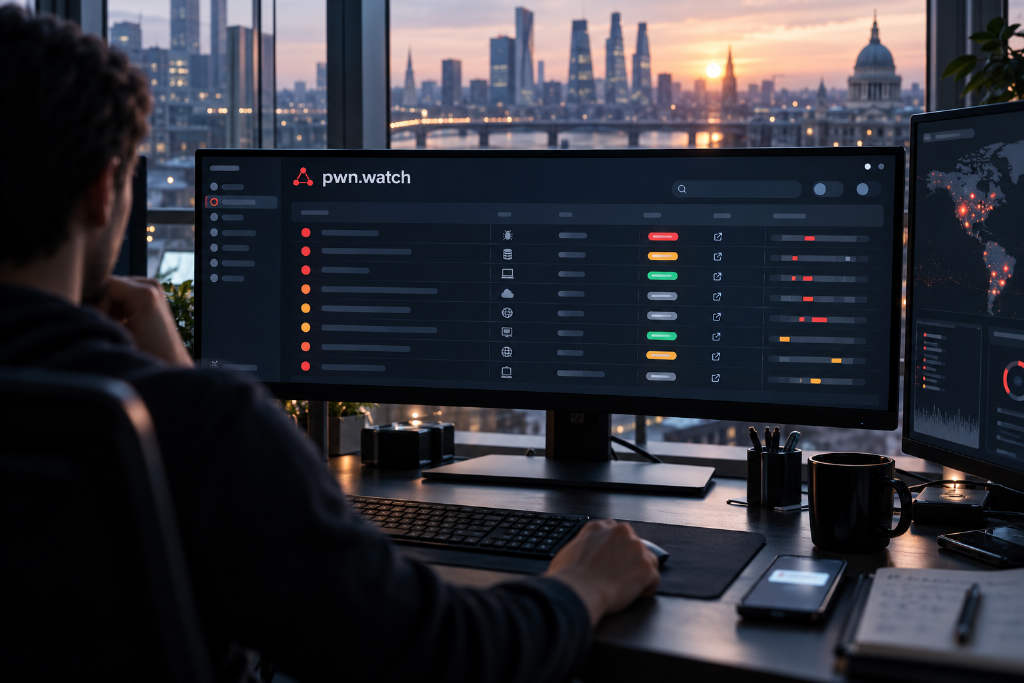
Developer kitze has launched pwn.watch, a site that puts ongoing security incidents from around the world on a single page. The tracker shows how severe each issue is, whether it has been fixed, and includes a ready-made remediation brief that users can copy into an AI assistant.
As of the morning of Oct. 23, pwn.watch listed 41 active incidents. Of those, 19 were marked critical, and 20 had not been fully remediated. The site says it has logged 240 incidents over the past 12 months.
What the site shows for each incident
pwn.watch groups live security events into a single view. Each entry includes a severity label, remediation status such as patched, partially patched, or no patch available, affected products and versions, the CVE identifier, a timeline, and links to the original advisory. The setup is meant to help security teams check whether software they use has been affected and whether a fix is already available.
Incidents currently in focus
One of the latest cases on the page involves major U.S. banks detecting third-party AI agents inside customer accounts. The source cited is an Axios exclusive that quoted anonymous sources. pwn.watch rates the incident as medium severity, saying the agents mostly relied on credentials voluntarily handed over by customers and that there had been no reports of account takeover or losses. The site’s recommendation is straightforward: do not give online banking credentials to AI agents.
For server administrators, the site points first to vulnerabilities that can directly compromise a host.
GitLab has patched CVE-2026-110264, an integer overflow bug in its built-in regular expression engine. According to the site, an unauthenticated attacker could execute code on self-hosted GitLab instances. The flaw carries a CVSS score of 10.0, and every version from 7.0, released in 2014, is affected.
Another item, PHP2Shell, refers to two remote code execution flaws in PHP core. Each has a CVSS score of 9.2. An unauthenticated attacker can execute code on servers handling web requests, with Apache’s mod_php mode described as especially risky. Patched releases 8.5.12, 8.4.27, 8.3.36, and 8.2.35 were issued on Oct. 21, but device vendors including QNAP were still preparing updates, so the site marks the case as partially patched.
Amazon honeypots recorded attack attempts four days before public disclosure. Still, Sansec said the public exploit code does not work against default installations, which means the odds of large-scale compromise appear lower than they did on the first day.
Built for AI-assisted remediation
A defining feature of pwn.watch is its AI-oriented workflow. Every incident page includes a "Copy brief for your AI" button. With one click, users can copy a remediation brief that covers affected versions, how to check whether a system is exposed, patch instructions, and mitigation steps, then paste it into an AI assistant.
The site also provides RSS, JSON, and llms.txt, and it does not require login or impose traffic limits. Users can filter incidents by stack tags such as node, php, python, and docker, track only the tools they use, and set email alerts so messages are sent only when a new critical incident appears.
Three caveats users should keep in mind
- The footer says the site is not security advice and that users should rely on vendor advisories before taking action.
- Severity ratings and remediation status are the site’s own editorial judgments. In the bank AI agent case, for example, pwn.watch assigned a medium rating because the sourcing was anonymous, so readers are still expected to review the original report.
- The homepage includes a sponsor section, and the first listing is kitze’s own paid community, Tinkerer Club.



