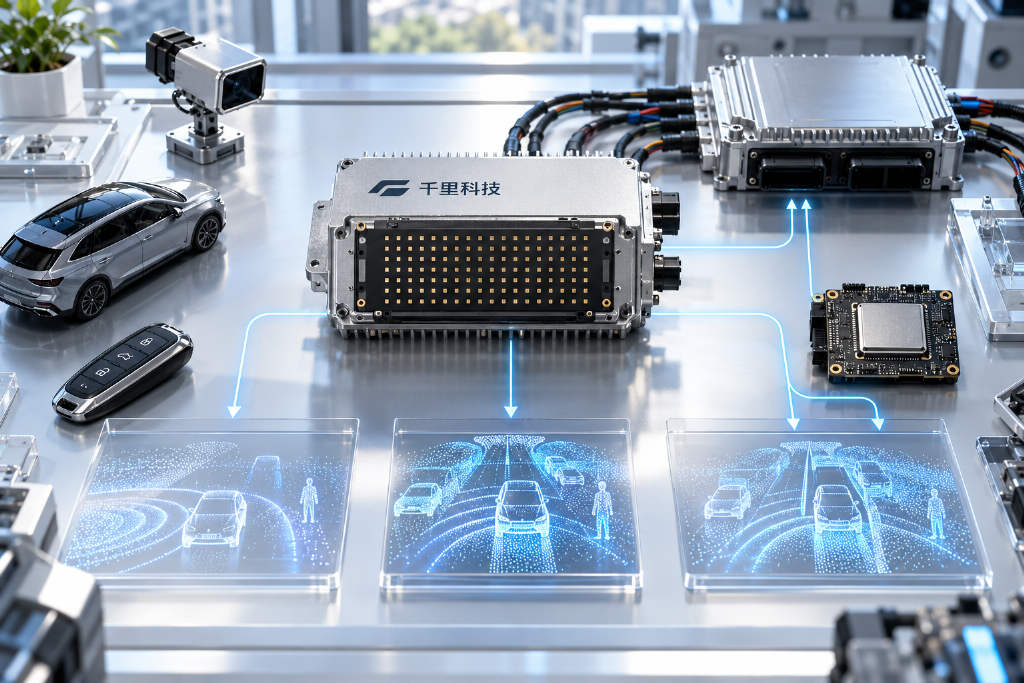
Qianli Technology has launched an AI-integrated 4D millimeter-wave radar equipped with a 10 TOPS NPU, adding local perception capabilities to the sensor itself. The company said the product supports three operating modes: a local edge mode that processes data on the radar and outputs structured perception results, a satellite architecture mode that sends raw data at high speed to a central domain controller for multi-source early fusion, and a compatibility mode that runs both paths at the same time.
According to the release, the radar uses an end-to-end model across the full chain from antenna design to point-cloud output. Qianli Technology said this delivers a 10x increase in point-cloud density, a 40% improvement in detection range, and a 95% ghost-target elimination rate. The design is aimed at vehicle systems spanning L2 to L4 functional levels, as well as the transition period toward centralized EE architectures.
The company is led by Yin Qi, while its affiliated company StepStar provides AI model support. Quantum Bit described the launch as an extension of the "AI + physical terminal" concept into autonomous-driving sensors, with model-driven iteration reshaping the underlying sensor architecture.
Qianli Technology has released an AI-integrated 4D millimeter-wave radar with a built-in 10 TOPS NPU. The product supports three operating modes: local AI perception, satellite architecture, and a compatibility mode.
Three operating modes
In edge mode, the radar completes processing locally and outputs structured perception results. In satellite architecture mode, the radar sends raw data at high speed to a central domain controller for multi-source early fusion. In compatibility mode, it performs both processes at the same time.
Performance and design
The radar uses an end-to-end model across the full chain, from antenna design to point-cloud output. According to the disclosed figures, point-cloud density increased by 10x, detection range improved by 40%, and the ghost-target elimination rate reached 95%.
Qianli Technology said the design is intended to meet needs across L2 to L4 functional levels and during the transition to centralized EE architectures.
Companies involved
Qianli Technology is led by Yin Qi, and its affiliated company StepStar provides AI model support. According to Quantum Bit, the launch is seen as an extension of the "AI + physical terminal" concept into the autonomous-driving sensor sector, using model-paradigm iteration to reshape underlying sensor architecture.
This article was originally published by Bit.Fan. For more cryptocurrency news and market insights, visit www.bit.fan. Disclaimer:
The market information, project data, and third-party content displayed on this platform are for industry information sharing only and do not constitute any form of investment advice or return commitment.
Cryptocurrency trading carries high risks. Users should fully assess their risk tolerance and make independent decisions. All profits, losses, and legal responsibilities are borne by the users themselves.