
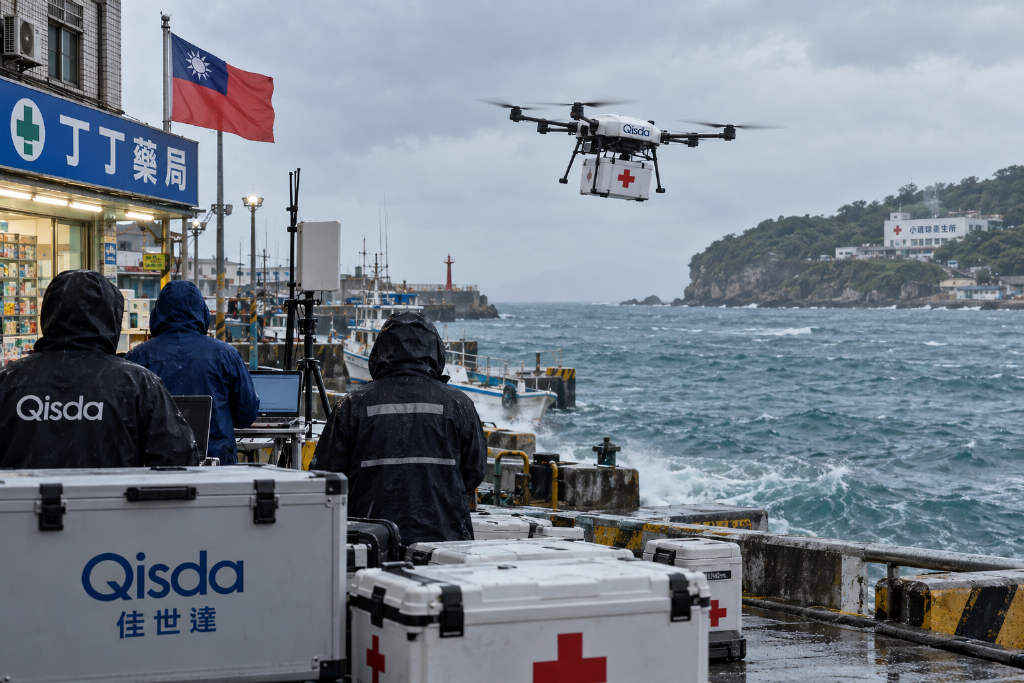
BenQ Health Life has presented a rural drone delivery and smart pharmacy telecare project at Taipei World Trade Center Hall 1, centered on a cross-sea medical delivery route from a Ding Ding Pharmacy branch in Donggang to the health center on Xiaoliuqiu. The project is being carried out by Ding Ding Pharmacy, backed by Qisda (2352), together with the Taiwan Drone Association, UniCo, and Carbon-Based Technology (7719), combining artificial intelligence, 5G communications, and drone logistics to address long-standing transport constraints affecting remote and offshore medical access.
More than 100 test flights completed on the Donggang-Xiaoliuqiu route
According to the project presentation, the team built its framework around Ding Ding Pharmacy's store network and the technical capabilities of the Taiwan Drone Association, UniCo, and Carbon-Based Technology. The operating model uses a vertical takeoff and landing drone paired with an AI task dispatch platform. So far, the program has completed more than 100 test flights and accumulated 1,700 kilometers in cross-sea flight distance.
The group said the medicine pickup process for island residents has been reduced from half a day to about 20 minutes. The drone used in the operation was supplied by Carbon-Based Technology. It was originally designed for offshore fishery patrol and maritime surveillance, then equipped with an intelligent image recognition system that can assess risks before departure and identify obstacles, vessels, and birds in real time during flight to improve safety over water.
Partners outline technical capabilities and possible next uses
Carbon-Based Technology Chairman Chen Wen-Hong said the vertical takeoff and landing drone platform deployed in the project was initially developed for offshore fishery patrol and maritime surveillance needs, with fixed-point vertical takeoff and landing, long-range navigation, and the ability to operate in maritime environments.
Taiwan Drone Association Chairman Chang Chun-Hao said the project shows how drones can move from maritime surveillance into medical logistics, while also building a body of test-flight data for offshore healthcare delivery. He said that if weather information and remote operations management continue to be integrated, drones could gradually expand into routine pharmaceutical transport, emergency medical supply delivery, disaster relief, and supply runs for remote areas.
Field validation completed and regulatory procedures cleared
The research team said it has completed real-world field validation and passed the Ministry of Health and Welfare's Good Distribution Practice standards for pharmaceuticals, along with related project permit procedures from the Civil Aviation Administration. The team said the next step is to develop fixed commercial routes and regular medical delivery services.
At this stage, several county and city health bureaus and medical institutions are already in talks on potential cooperation. The next phase will test the model across different medical settings as the team works to move AI-enabled smart healthcare into regular use.
Key points disclosed by the project
- Qisda coordinated Ding Ding Pharmacy, the Taiwan Drone Association, UniCo, and Carbon-Based Technology to establish a cross-sea medical transport and delivery route between Donggang in Pingtung and Xiaoliuqiu.
- The project integrates AI and 5G communications and has logged 1,700 kilometers of delivery testing.
- The medicine pickup process for island residents was reduced from half a day to about 20 minutes.
- The system uses a vertical takeoff and landing drone with intelligent image recognition and route risk prediction functions to improve safety over the sea.
- The project has passed Ministry of Health and Welfare GDP pharmaceutical distribution standards and Civil Aviation Administration project permit procedures, and is in discussions with multiple local health bureaus and hospitals on regularized cooperation.