
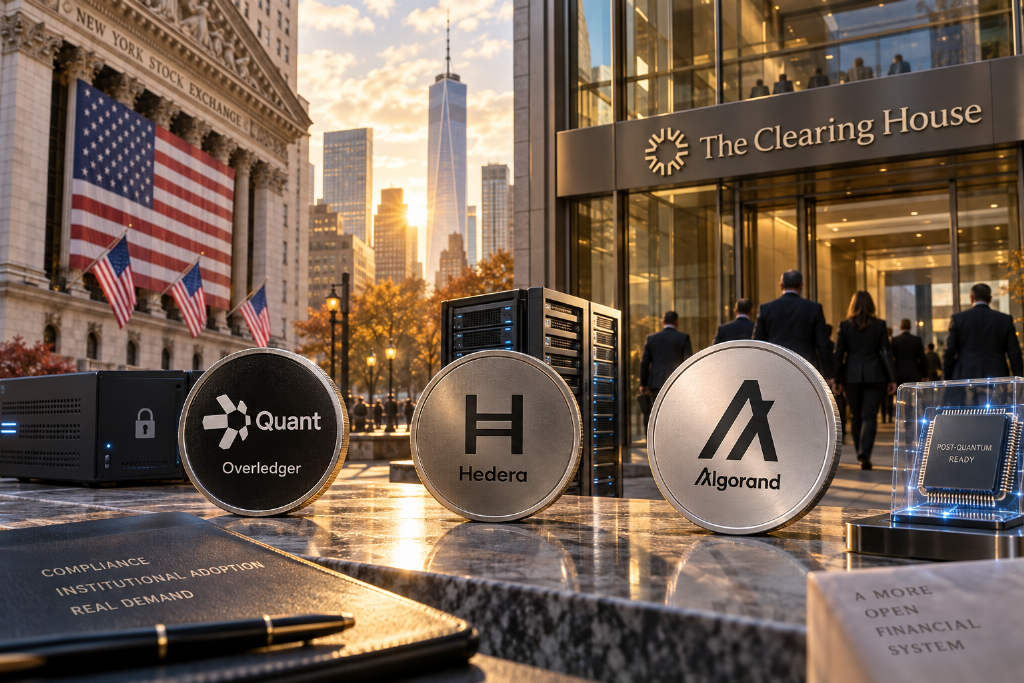
QNT, HBAR, and ALGO have each become focal points for traders, but the market is not buying confirmed token demand so much as a shared narrative: U.S. institutional crypto infrastructure.
On Sept. 28, Hedera’s HBAR jumped about 30% in a single day, rising from roughly $0.096 to $0.125. Over a similar stretch, Algorand’s ALGO gained more than 25% from its early-September low of $0.085 and moved above $0.11.
Before both of them, Quant had already taken the lead. After The Clearing House announced on Sept. 24 that it had selected Quant’s Overledger technology to power the interoperability layer of its tokenized deposit network, QNT started near $67 and surged more than 300% within a week, reaching as high as $330.
They are three different tokens with three different sets of catalysts. In the market, though, they have been placed inside one frame: “U.S. institutional tokens.” The harder question is how much of that frame is backed by facts already in place, and how much is still a story traders are choosing to price in.
QNT: the strongest catalyst, but also the easiest to overprice
The immediate trigger for Quant’s move was The Clearing House, or TCH, on Sept. 24. TCH is a payments infrastructure operator owned by 25 major U.S. banks and processes more than $2 trillion in transactions every day. It said it had selected Quant to build the interoperability layer for its tokenized deposit network.
That is one of the closest partnerships the crypto sector has seen with the core of the U.S. banking system. The market reaction was extreme. QNT posted a one-day gain of more than 60% at one stage, weekly gains ran above 300%, and RSI climbed past 96.
Still, the strength of the announcement should not be confused with confirmed token utility. The article notes that the TCH project timeline points to 2027, which means any actual on-chain rollout of tokenized deposits is at least a year away. More importantly, analysts cited in the piece said neither TCH nor Quant has made clear that the QNT token itself is indispensable to the project.
Quant’s Overledger platform does require QNT as an access licensing fee. That does not automatically mean enterprise deployment will create the same kind of token demand that retail traders are trying to front-run in the market.
Supply structure also matters here. QNT has a total supply of 14.61 million tokens, with about 12.07 million in circulation. That relatively tight float, combined with institutional narrative momentum, allowed leverage, short covering, and market positioning to amplify the move into what the article describes as a three-part resonance of narrative, small effective float, and derivatives.
Another date the market is watching is Sept. 28 to Oct. 1, when Quant is set to attend the Sibos 2026 financial infrastructure conference in Miami. As one of the banking industry’s biggest annual gatherings, any fresh partnership news from the event could act as another catalyst. It could also mark a point where bullish expectations run into reality.
HBAR: plenty of catalysts on paper, but each one needs discounting
HBAR’s rally has been tied to several developments rather than a single headline.
IDTrust and IBM Cloud Catalog
On Sept. 23, The Hashgraph Group said its IDTrust identity platform, built on Hedera technology, had been listed in the IBM Cloud Catalog. THG also received IBM Silver Partner status. That gives Hedera a real enterprise distribution channel, since IBM’s sales teams can recommend Hedera-based identity solutions to clients.
But this was not a fresh overnight order announcement. It was a development disclosed the previous week. So far, no related sales revenue or enterprise deployment figures have been disclosed. The IBM Cloud Catalog contains thousands of products. Being listed is a meaningful step, though it is far from proof of material adoption on its own.
BlackRock tokenization narrative
Another major talking point has been reports that BlackRock is tokenizing its ICS U.S. Treasury money market fund on Hedera through Securitize, with net assets above $40 billion.
The article argues that the headline number needs to be separated carefully. BlackRock’s BUIDL fund, which was previously launched on Ethereum, had about $552.4 million in assets under management as of Sept. 22. By contrast, the “$40 billion” figure refers to the size of BlackRock’s broader money market fund complex. How much of that will actually be deployed on Hedera, and on what timeline, has not been disclosed.
Canary HBAR ETF flows
The piece also points to continued inflows into the Canary HBAR ETF, ticker HBR. Since listing on Nasdaq in October 2025, the ETF held about 704 million HBAR as of July 30, with net assets of roughly $47.8 million. That represented about 1.5% of HBAR’s circulating supply. On Sept. 10, it posted net inflows of $818,000, its largest one-day intake since Aug. 25.
That shows steady demand, but the scale is still limited. By itself, it does not explain a 30% one-day jump in HBAR.
What derivatives data suggest
Derivatives positioning adds another detail. While HBAR’s price rose 18%, open interest actually fell 1.48%. The article reads that as a more typical spot-driven rally combined with a short squeeze, rather than a clean build-up of fresh futures longs.
ALGO: post-quantum security, AI payments, and a new CEO
Algorand’s September move has been less explosive than QNT’s, but the density of narratives around it is also notable.
On Aug. 22, Algorand rolled out its v5.0.0 post-quantum security upgrade. The article says that made it one of the first major public blockchains to deploy cryptography designed to resist quantum computing attacks. Then, on Sept. 9, former Chainlink executive William Herkelrath became CEO, a change that the market interpreted as a sign of a more institution-focused direction.
On Sept. 17, the U.S. Securities and Exchange Commission issued temporary exemptive relief allowing tokenized U.S. securities to trade in permissioned venues. That fit neatly into Algorand’s permissioned-architecture narrative.
There is also a more forward-looking storyline around AI payments. According to the article, Algorand’s x402 AI payment infrastructure has led Solana and Polygon in AI agent payment volume. The absolute numbers remain small, but the combination of AI and payments is clearly attractive in the current market.
On the supply side, ALGO has about 9.03 billion tokens in circulation out of a 10 billion total, meaning more than 90% of supply is already unlocked. That removes the risk of large future unlocks, but it also means any sustained upside has to come from new demand rather than from tightening supply.
One narrative, five tokens, very different levels of substance
The article also compares QNT, HBAR, and ALGO with XLM and XDC, both of which are often mentioned in the same conversation. All five fit, to varying degrees, under the labels of U.S., institutional, compliant, and infrastructure-focused crypto. What they do not share is the same quality of catalyst.
QNT
QNT has the clearest direct catalyst of the group. The TCH partnership is the only one among the five that directly touches core U.S. banking infrastructure. At the same time, a move from $67 to $280 in one week suggests the market has already pulled forward a significant part of the next one to two years of expectations. With RSI at 96 and shorts heavily squeezed, any update during Sibos could magnify volatility in either direction.
HBAR
HBAR may have the most impressive collection of enterprise names. Its governing council includes Google, IBM, Boeing, Samsung, and LG. It also has a spot ETF on Nasdaq and has picked up extra attention from the BlackRock-Securitize tokenization narrative. Yet the token still sits about 78% below its all-time high of $0.57. The core issue, the article says, is that large enterprise partnerships do not automatically become on-chain HBAR demand. IDTrust may be in IBM Cloud Catalog, but whether clients adopt it, at what scale, and how much HBAR that usage would consume are all still unclear.
ALGO
ALGO stands out for being closer to the technological frontier. Post-quantum security has earned serious recognition in technical circles, and the article notes that Google’s Quantum AI team has cited Algorand more than 30 times. The gap between technical validation and enterprise purchasing, however, is still wide. The new CEO gives traders more room to imagine an institutional pivot, but execution will take time.
XLM
Stellar offers a different example. The article lists a long resume: Mastercard-owned BVNK has integrated XLM for stablecoin payments across 130 countries; DTCC included Stellar in its Russell 1000 tokenization project; Bank of America has tested the USBDC stablecoin on Stellar; tokenized real-world assets on the network reached $2.75 billion, ranking third; and the Protocol 28 upgrade went live on Sept. 17.
Even so, XLM spent 2025 in the awkward position of accumulating institutional milestones while its price kept falling. It remains down more than 70% from its all-time high. In that sense, XLM may be the clearest example of how institutional involvement and token demand can diverge.
XDC
XDC Network has a clearer niche in trade finance and supply-chain finance, with real project deployment in Japan. But its market capitalization, trading volume, and community attention all sit below the first four names. If there is a rotation across institutional tokens, the article suggests XDC would likely be one of the later names to be called.
Why the rotation thesis is spreading
A trading theory circulating widely on social media says capital will rotate in sequence from QNT to HBAR to XLM to XRP, with each token getting a one- or two-day breakout window. The article says there is no historical data backing that theory.
Its popularity still says something important. What the market is trading right now is not a common on-chain metric or a shared valuation model. It is a set of identity markers. These tokens are being grouped together because they can all be presented as closer to the themes of U.S. finance, institutions, compliance, and financial infrastructure.
In the current market, that label is being treated as a middle ground: safer than meme coins, more elastic than Ethereum, and with more upside imagination than Bitcoin.
What is real, and what is still being projected
The article’s bottom line is that only one catalyst in this cluster looks truly concrete so far: Quant’s tie-up with The Clearing House. Much of the rotation that followed looks more like capital searching inside the same narrative for names that have not moved yet.
That pattern is familiar in crypto sector rotation. The key distinction is whether traders are buying a catalyst the market has not fully priced, or a narrative that may already be priced but has not yet had its turn.
For the first type, the case is about what has actually changed. For the second, position sizing may matter more than picking the right ticker.