
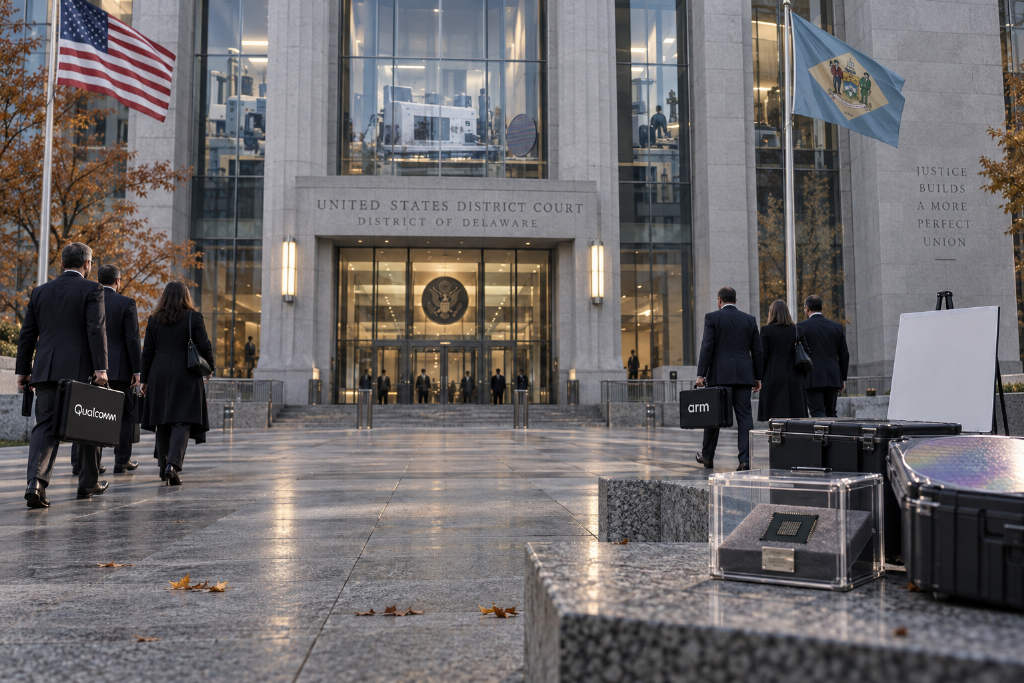
Qualcomm’s case against Arm Holdings began a five-day jury trial on Monday, Oct. 5, in the U.S. District Court for the District of Delaware, according to court disclosures in case 1:24-cv-00490.

Qualcomm alleges that Arm failed to provide chip testing tools required under their agreements and leaked a 2024 threat letter about terminating a key license, conduct that Qualcomm says hurt its chip collaboration talks with Meta Platforms. Based on those claims, Qualcomm is asking for relief that would let it stop paying Arm royalty fees for as long as five years, with the amount potentially reaching billions of dollars.
In the same consolidated litigation, Qualcomm is also seeking to force access to Arm’s V10 instruction set architecture.
Qualcomm seeks up to five years without royalty payments
Arm said in a quarterly filing with the U.S. Securities and Exchange Commission that Qualcomm first sued in April 2024. Qualcomm then amended its complaint twice in 2025 and again in March 2026, adding breach claims that included allegations that Arm failed to negotiate certain license terms in good faith.
Qualcomm’s case centers on two main claims. First, it says Arm refused to deliver chip testing tools that Qualcomm was entitled to receive under the license agreements. Second, Qualcomm says Arm leaked to the media a 2024 threat letter tied to the termination of a key licensing agreement. Qualcomm says that leak directly damaged its chip deal discussions with Meta Platforms.
During opening statements, Qualcomm lawyer Karen Dunn pointed jurors to Qualcomm’s 2021 acquisition of chip startup Nuvia and cited internal documents that, she said, showed Arm executives had described Qualcomm as an “enemy” and were worried about a decline in royalty revenue. Dunn said Arm responded by breaching contracts and disrupting Qualcomm’s business relationship with Meta, including through what she called a “coordinated media leak.”
As one of Arm’s biggest customers, Qualcomm is asking the court for an unusual remedy: permission to stop paying Arm royalties for as long as five years. The sum involved could reach billions of dollars.
Judge Maryellen Noreika, who is overseeing the matter, is weighing whether to strike down that contractual theory. If that happens, Qualcomm would not be able to directly stop future royalty payments and would instead be limited to seeking a smaller amount of damages.
Arm rejects the allegations
Arm has denied Qualcomm’s claims across the board. In opening statements, Arm lawyer Gregg LoCascio said the case is really about using litigation as leverage in a business dispute. He presented evidence to the jury and argued that Qualcomm had failed to show any actual injury. “They have not been hurt at all,” LoCascio said.
Arm also argued that the potential chip transaction with Meta cited by Qualcomm was speculative and that Arm did not cause any concrete harm. Arm also turned the point back on Qualcomm, saying Qualcomm itself had leaked nonpublic details to the media regarding an antitrust investigation involving Arm, and therefore could not seek damages over the disclosure of the termination letter.
In its latest annual report, Arm said Qualcomm accounted for 9% of its total revenue in the fiscal year ended March 31, 2026. Arm wrote in the filing: “We cannot provide any assurance as to the outcome of any litigation or how litigation may affect our relationship with Qualcomm or revenues from Qualcomm.”
Separate bench trial will examine the V10 licensing dispute
Alongside the five-day jury trial, Noreika is also set to preside over a parallel bench trial in the same consolidated case. That proceeding will examine whether Arm acted in good faith during negotiations with Qualcomm over a license for the next-generation V10 instruction set architecture.
Court filings show that Qualcomm’s amended complaint goes beyond the testing-tools and leaked-letter claims. It also alleges that Arm breached its duty to negotiate in good faith over a V10 license. Those issues are being heard in the same case, but the contract-breach claims are going to a jury while the V10 good-faith issue will be decided by the judge.
The filings show a sharp dispute over licensing terms for Arm’s next-generation V10 architecture. Arm tried to rely on agreements with other licensees, including Ampere and Apple, as benchmarks to argue that its V10 offer to Qualcomm was reasonable. Qualcomm pushed back, saying Arm was cherry-picking favorable agreements and that Qualcomm needed access to the full set of relevant deals to test Arm’s position. The court record also shows that Arm made a V10 offer to Qualcomm on Dec. 10, 2025.
Qualcomm and Arm’s current license agreement runs through 2033. In its complaint, Qualcomm said: “There is no alternative or substitute for a v10 (Arm’s next-generation instruction set architecture) license, and the consequences of Arm’s failure to negotiate in good faith cannot be remedied by damages.”
That argument goes to the kind of relief Qualcomm wants. Qualcomm says that if the court awards only money damages while it still cannot obtain a V10 license, it could face a structural disadvantage in the next generation of chip competition. On that basis, Qualcomm is seeking more than compensation. It wants Arm to carry out its good-faith negotiation obligation in a way that results in an actual V10 license.
Arm is trying to knock out that claim through motion practice. In a letter filed with the court on Feb. 13, 2026, Arm said its motion to dismiss specifically asks the court to reject Qualcomm’s allegation that Arm breached the implied covenant of good faith and fair dealing because Qualcomm did not obtain a V10 license. Arm argues the claim should be dismissed for two reasons: first, it seeks to impose restrictions beyond what the parties actually agreed to in their contracts; second, the claim is time-barred.
The report was sourced from the WeChat public account Xinzhixun and edited and written by Xinzhixun-Langkejian. The original headline was: Qualcomm sues Arm, seeks five years without royalty payments and compulsory V10 instruction-set licensing.