
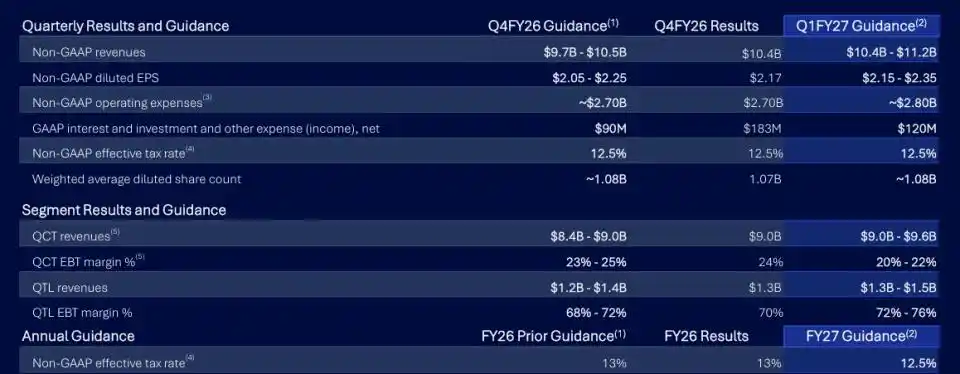
Qualcomm reported fiscal 2026 fourth-quarter and full-year results on Nov. 4 in the U.S., with its handset chip business showing the steepest decline. Fourth-quarter revenue was $10.322 billion, down 8% from a year earlier. Non-GAAP net income fell 28% to $2.332 billion, and adjusted earnings per share came in at $2.17. For the full fiscal year, revenue was $43.120 billion, down 3%, while non-GAAP net income dropped 15% to $11.311 billion.
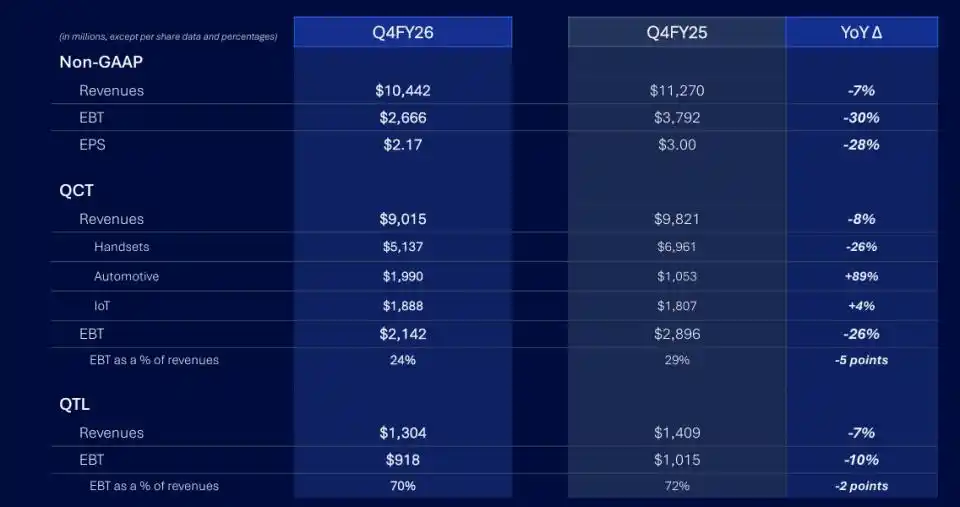
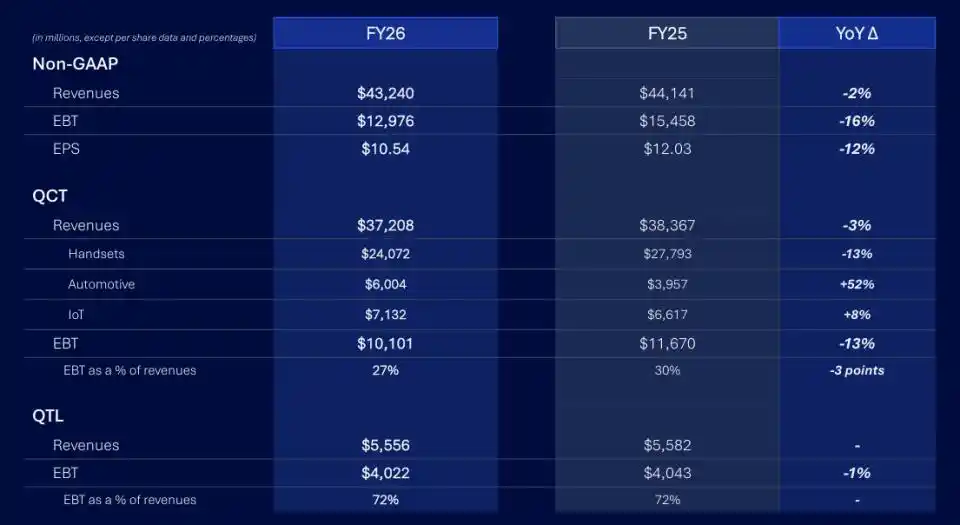
Handset chips remained the biggest drag. Revenue from the segment was $5.137 billion in the fourth quarter, down 26% year over year, and $24.072 billion for the full year, down 13%. At the same time, automotive revenue reached a quarterly record of $1.990 billion, up 89%, while IoT revenue rose 4% to $1.888 billion.
Qualcomm is pushing harder to build growth outside smartphones. The company reiterated its target of $5 billion in data center revenue for fiscal 2027 and said custom chip projects with two large cloud service providers are expected to start contributing revenue in the first quarter of that fiscal year. Management also said non-handset revenue is expected to grow by more than 60% in fiscal 2027.
Investors are not fully convinced yet. Qualcomm shares fell about 5% in after-hours trading at one point after the earnings release. Rising memory prices are affecting handset makers’ purchasing plans, and Apple’s in-house modem chips are cutting into Qualcomm’s traditional market. Automotive revenue is still growing quickly, and data center orders are moving into the revenue-recognition stage, but the scale and margins of those newer businesses have yet to prove they can close the gap left by smartphones.
Memory costs reshape handset demand and procurement
Higher memory prices are changing product planning and purchasing cycles for smartphone makers. As memory takes up a larger share of bill-of-materials costs, vendors are facing more pricing pressure. Some are adjusting product mixes, cutting back on higher-cost configurations, and shifting to older-generation chips or lower-priced options. That has weighed on global smartphone shipments and chip demand.
Chief Executive Officer Cristiano Amon described rising memory prices as an important factor behind the contraction in the smartphone market. Chief Financial Officer Akash Palkhiwala had also said that some handset makers are changing chip choices in premium products or moving to previous-generation chips, putting pressure on Qualcomm’s product mix and QCT gross margin.
On China, management said handset chip revenue bottomed in fiscal 2026’s third quarter, though the pace of recovery remains uncertain. Palkhiwala said Chinese handset makers had been buying chips based on market demand while also working through channel inventory. As inventory declines, procurement is starting to reflect underlying demand more directly.
Qualcomm said smartphone chip revenue from Chinese OEM customers posted double-digit sequential growth in the fourth quarter. Even so, total handset chip revenue disclosed by the company rose only about 1%, to $5.137 billion from $5.086 billion in the third quarter.
The company is also raising prices to deal with higher supply-chain costs. Palkhiwala said Qualcomm is implementing price increases across several end markets, with adjustments in the double digits. Some customer contracts have not expired yet, so those increases will be phased in through contract renewals and new product cycles. Qualcomm expects the measures to gradually improve QCT gross margin over the next several quarters.
Amon said the chip price increases are mainly meant to pass through wafer, manufacturing, and other input costs. Compared with the rise in total handset costs caused by memory prices, he said the impact remains limited, and Qualcomm has not seen a fundamental change in demand for premium smartphones.
Apple-related business is also shrinking. Qualcomm had already warned that revenue tied to Apple would decline faster because its modem share in the new iPhone generation came in below the previously expected 20%. On the earnings call, management said Apple-related revenue is expected to fall about 50% sequentially from the fourth quarter to the first quarter of fiscal 2027. Growth in Android business will offset part of that decline, but not all of it in the near term.
Qualcomm still holds a strong position in Samsung’s premium smartphone lineup. Amon said Snapdragon chips are currently used in about 70% of Samsung flagship models. He also pointed to new opportunities tied to on-device AI agents. Chinese smartphone makers are preparing to launch new on-device agents and task orchestration features, which Qualcomm believes could support demand for high-end phones.
Autos, IoT, and licensing support results while data center revenue begins to arrive
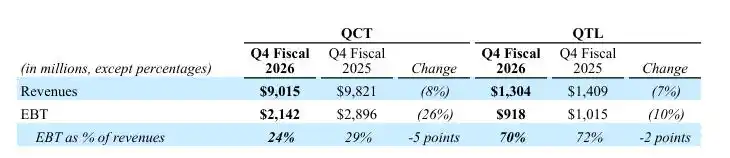
As handset revenue weakens, automotive and IoT stood out in Qualcomm’s latest report. In the fourth quarter, automotive revenue rose 89% year over year to $1.990 billion, while IoT revenue increased 4% to $1.888 billion. Combined, the two businesses generated $3.878 billion in revenue, up 36%.
For the full fiscal year, automotive revenue was $6.004 billion, up 52%, and IoT revenue was $7.132 billion, up 8%.
Growth in automotive came from stronger demand for in-vehicle computing platforms, digital cockpit systems, and advanced driver-assistance systems. Qualcomm said in its earnings materials that it expanded its partnership with BMW and will serve as the main computing chip supplier for the automaker’s next-generation ADAS and digital cockpit programs across multiple future vehicle projects.
IoT was supported by demand for industrial networking and robotics products. Revenue in the segment rose 4% in the fourth quarter and 8% for the full year. Qualcomm is extending that business beyond consumer electronics into industrial edge computing, robotics, and networking equipment.
The QTL licensing business was relatively steady. Fourth-quarter QTL revenue was $1.304 billion, down 7% year over year. Full-year QTL revenue was $5.556 billion, roughly flat from the prior fiscal year. Full-year QTL pretax profit was $4.022 billion, with a pretax margin of 72%, keeping it as an important profit source for the company.
Qualcomm recently renewed long-term patent licensing agreements with Apple, Huawei, and Transsion. On the earnings call, Palkhiwala said QTL continues to operate under the current licensing model. If device selling prices rise but remain within the royalty cap, that may provide some revenue upside. Once prices move above that cap, licensing revenue does not continue to increase.
Data centers are now Qualcomm’s most important new growth area. The company is building out custom chips, AI accelerators, high-bandwidth computing products, and server-class CPUs, with products scheduled to launch in stages.
Amon said Qualcomm’s custom chip projects with two large global cloud service providers have already entered wafer production and will begin contributing revenue in the first quarter of fiscal 2027. Palkhiwala said the company has already received purchase orders for both projects and expects revenue to start ramping in the December quarter before expanding as the programs move forward.
Beyond custom silicon, Qualcomm is developing a high-bandwidth computing product known as HBC. The design integrates compute units with high-density memory to improve power efficiency, memory utilization, and total cost of ownership. The company said the first-generation HBC product has taped out, with the first commercial product expected in mid-2027.
Its server CPU is planned for fiscal 2028. Qualcomm wants to use its low-power computing technology to expand from custom chips into the data center CPU and AI accelerator markets. The company said it is in talks with several large data center companies on long-term cooperation, though it has not disclosed customer names.
Qualcomm reiterated its target of $5 billion in data center revenue for fiscal 2027 and said it expects data center revenue to exceed $15 billion in fiscal 2029. It also set a combined fiscal 2029 revenue target of more than $24 billion for automotive and IoT, and raised its non-handset revenue target to $40 billion from a previously stated $22 billion.
That growth plan still comes with margin pressure. In response to analyst questions, Palkhiwala said Qualcomm’s traditional businesses usually carry gross margins in the 48% to 50% range and should return to that level as price increases take effect. Early data center revenue, however, will mainly come from custom chip projects, where gross margins are materially lower than in Qualcomm’s existing businesses and could offset some of the improvement elsewhere.
Fiscal 2027 outlook points to faster transition, but smartphones remain the swing factor
For the first quarter of fiscal 2027, Qualcomm expects revenue of $10.4 billion to $11.2 billion and non-GAAP earnings per share of $2.15 to $2.35. QCT revenue is projected at $9.0 billion to $9.6 billion, including data center business, while QTL revenue is expected at $1.3 billion to $1.5 billion.
The company expects non-handset revenue to grow by more than 60% in fiscal 2027 and said that increase could offset Apple-related product revenue recorded in fiscal 2026. Amon said fiscal 2027 will mark an inflection point for growth in Qualcomm’s non-handset revenue.
Still, pressure in smartphones has not gone away. On the earnings call, management said the global smartphone market in 2027 could decline by a low double-digit percentage from 2026, with the impact concentrated in the low-end segment. Palkhiwala said QCT Android revenue is currently down about 20% year over year, with an earnings-per-share impact of more than $1.50. That pressure could ease gradually if market conditions stabilize.
Before the earnings release, analysts had already split on Qualcomm’s handset outlook. Some believed recovering demand from Chinese smartphone makers, Samsung’s premium product mix, and automotive growth could support results. Others were concerned about constrained memory supply and weak smartphone demand, arguing that Qualcomm’s expectations for Android in fiscal 2027 still carry uncertainty.

Analysts also pressed management on data center profitability during the call. Qualcomm acknowledged that custom chip projects start with lower gross margins than its traditional businesses, but said there is room to improve both scale and profit mix as the portfolio expands into AI accelerators, high-bandwidth computing, and server CPUs. The company has not disclosed the identities of the two custom-chip customers or provided a breakdown of revenue and margins by project.
On capital spending, Qualcomm’s fiscal 2026 capital expenditures were about $2.494 billion, up from $1.192 billion in the prior fiscal year. Research and development expense reached $10.207 billion, up about 13%. Operating cash flow for the year was $11.145 billion, down from $14.012 billion a year earlier. Qualcomm is also integrating Modular to strengthen software capabilities for data centers and edge AI.
For shareholder returns, Qualcomm returned $11.671 billion in fiscal 2026 through stock buybacks and cash dividends, including $7.817 billion in repurchases and $3.854 billion in cash dividends.
Qualcomm’s business transition has moved into the revenue stage, with custom chip projects for two cloud service providers set to contribute starting in the first quarter of fiscal 2027, while automotive keeps growing at a fast pace.
Even so, smartphone chips remain the company’s largest single source of revenue. Memory costs, end-market demand, and shrinking Apple business are still set to shape near-term performance. Whether data center revenue scales as planned, and when its lower initial margins improve, will remain central to Qualcomm’s ability to sustain overall profitability during a weak smartphone cycle.
This article is based on a report from Tencent Technology. Written by Xiaojing and edited by Xu Qingyang. Contributing translator: Jin Lu.



