
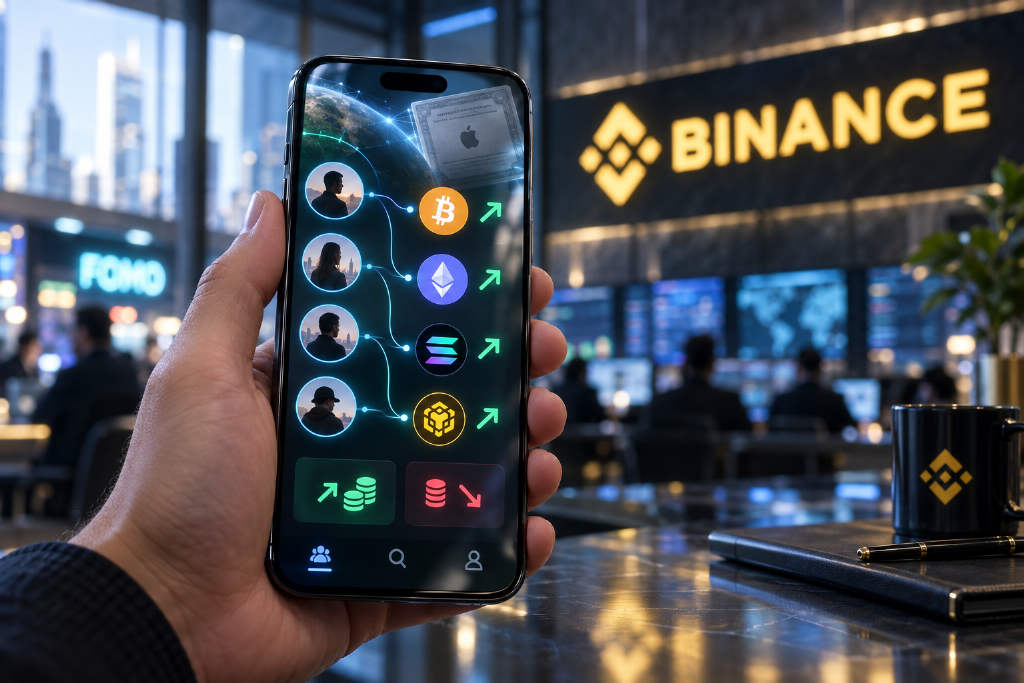
Ran Neuner, founder and CEO of Crypto Banter, said he expects crypto exchanges to lose traders to apps centered on seeing and following other people’s trades.
Speaking on a show covered by Unchained, Neuner said, “I believe that crypto exchanges are going to be replaced by social trading apps.” He named Binance as one exchange he expects to be replaced.
The model he pointed to
Neuner cited FOMO as the model, describing it as an app that lets users follow other traders and get alerts on what they buy. He said he was not predicting that FOMO itself would take Binance’s place.
What he expects instead is a stronger version of that product. According to Neuner, there will be “a version of FOMO” that combines a social network with trading and is “much more fun than trading on an exchange.”
Why he thinks this is happening now
Neuner said brokers such as Robinhood and eToro have tried social trading for years. In his view, those efforts were limited by Nasdaq trading hours and know-your-customer rules.
He said tokenized stocks remove the market-hours constraint. “Now you can tokenize any stock that you want. It trades 24/7, 365.”
Unchained also noted that on Sept. 17, the U.S. Securities and Exchange Commission granted a five-year innovation exemption for onchain trading of tokenized shares that carry full shareholder rights, though the exemption does not apply to synthetic stock tokens.
The revenue figures he cited
Neuner said crypto apps, led by social trading apps, are already generating revenue. He called that one of two reasons he sees this cycle as crypto’s “first real bull market.” The second reason, he said, is AI agents transacting on blockchain rails.
He said Hyperliquid and Pump.fun make as much as $5 million on some days, while FOMO makes about $1 million a day.
According to DefiLlama, all three averaged more than $1 million in daily revenue over the 30 days through Sept. 27. Hyperliquid brought in about $55.2 million, FOMO about $32.7 million, and Pump.fun about $32.4 million.
How privacy fits in
Host Laura Shin asked how social trading fits with the rally in privacy coins and returned to the issue near the end of the interview.
Neuner said traders will likely disclose some positions while keeping others private. “I think you’re also gonna have some money that you show and some money that you don’t show,” he said.