
Most public blockchains will eventually disappear, according to Raoul Pal, founder of Real Vision, who argues that the outcome is less a scandal than a basic feature of how crypto markets price risk.

Pal wrote that many investors still hold a chain they bought in the last cycle because they thought it could become the next Ethereum. The pitch was familiar: better technology, a persuasive founder, a compelling story. In hindsight, many of those networks now look like ghost towns, with only a small number of validators still running, a few wallets moving tiny amounts of tokens back and forth, and token prices sitting far below where believers first entered.
Citing CoinGecko, Pal said more than 13 million tokens had stopped trading by the end of last year, with most of those failures occurring in 2025. Many of the public chains underneath them, he said, are headed for the same fate.
He said that over the past 13 years, every bear market has brought the same reaction on social media: crypto is a scam, crypto was always a casino, this was obvious from the start. Pal’s view is different. The mass extinction is not proof of wrongdoing by itself. It is what happens when venture-style bets are marked to market every second.
He said he wrote in December 2020 that tokens are effectively venture investments with live pricing. If early-stage seed deals were repriced continuously in public, the pattern would look the same: about 80% go to zero, 19% create some value, and 1% generate most of the returns. Crypto, in his telling, simply broadcasts that process in real time, and the constant repricing makes people panic.
Pal used Real Vision as an example. If the company had been valued every day from the day it was founded, he said, its implied value probably would have come close to zero around six times. Project value comes from adoption and, eventually, revenue. Most projects never get there.
That is why, in his framing, the real question was never whether most public chains would die. They will. The real task is figuring out which ones survive and how to spot them before the market settles the issue.
The internet bust is the closest historical parallel
Pal said the right precedent is the collapse of the internet bubble.
He recalled writing in November 2018, during a deep Bitcoin bear market, that crypto looked a lot like the internet in 2000 and 2001: huge ideas, weak business models, and too much built too early. Even so, he believed some projects would rise from the wreckage. What he could not know then, and says nobody could know, was which projects would become the winners.
That uncertainty matters. In 2000, he said, nobody could reliably identify the eventual champions. Infrastructure had been overbuilt, the Nasdaq fell 78% from its peak over two and a half years, and most assets were wiped out. Yet a small number of companies later used the fiber infrastructure left behind by failed firms and grew into some of the largest businesses in the world. Looking back, the crash was only one stretch of a much larger uptrend. Living through it felt like the whole idea had broken.
Pal said large platform markets have tended to end the same way ever since. Cloud computing was left with roughly five major leaders. Operating systems and mobile phones also concentrated most of their value in the top four. Public blockchains, he said, belong to the same category.
A blockchain is an economy, not just a token
If blockchains are platform markets, then the product is block space, Pal wrote.
The winners are the networks that make their block space more attractive through technology, narrative, or both, and pull users and capital onto the chain. Everything else is packaging.
That is why he said general-purpose chains should not be treated like ordinary companies or reduced to a token chart. Ethereum, Solana and Sui, in his description, are standalone economies with their own GDP, money supply and monetary policy. They should be assessed the way one would assess an economy: by looking at the amount of economic activity actually taking place onchain.
Four ways a project can survive
Pal said the market structure is simpler than many people think. In his view, there are only four viable paths.
- First, become a standalone economy. He named Ethereum, Solana, Sui and a small number of other chains as networks with enough throughput, composability and developer density to support a global tokenized economy.
- Second, dominate a vertical niche. His example was Hyperliquid, which he described as an integrated exchange that happens to use a blockchain as its execution layer. A specialist exchange can be a strong business, he said, but its upside is capped by the size of its niche. It should be valued like an exchange with a moat, not like an open-ended economy.
- Third, operate as a layer-2 network. These businesses build on top of a layer-1 and rent the underlying security. Some L2s may become good businesses, he said, but they are closer to franchises, like stores built on Shopify. If an L2 dies, its state can move elsewhere. That portability is one reason they do not capture value the way a base layer can. The L1 owns durable data guarantees; the L2 leases them.
- Fourth, the special case of BNB. Pal said the market prices BNB as if it were a standalone economy, but he does not think it is one. Because it is not decentralized, he argued, its real foundation is Binance’s balance sheet. That can still be a good business, but it is fundamentally a centralized platform token wearing an L1 wrapper.
Why most chains fail
The rest of the market, meaning the large number of chains launched over the last two cycles, does not fit those four categories, Pal said. They are general-purpose chains trying to compete with standalone economies without the conditions needed to win. They are not specialized enough to own a niche. They are not centralized enough to lean on the balance sheet of a major platform. They are simply “a blockchain,” and a blockchain without a moat eventually trends toward zero.
He called that the structural reason. At the practical level, he said, token issuance mechanics are what often finish the job.
Pal said he has studied low-float, high fully diluted valuation, or FDV, tokens since the summer of 2024, and his conclusion has not changed: the market dislikes them. Because circulating supply is small at listing, these tokens often fall 70% or more almost immediately as traders price in future unlock pressure. In a bull market, a low-float token can still surge if there is real demand behind it. In a bear market, though, unless unlocks are largely complete or demand is both real and durable, these assets tend to underperform badly. For chains without a moat, he said, the demand is never real in the first place. They get a burst of attention, but attention rarely turns into lasting adoption.
In that sense, issuance structure only speeds up the decline of undifferentiated chains. Even without that problem, he said, the market would likely reach the same destination.
A race toward near-zero cost
Pal argued that most valuation frameworks break down here because the core dimension of competition among public chains is operating efficiency.
The chains that win cooperative competition, he said, will keep pushing the marginal cost of a transaction closer to zero. If an analyst plugs that into a discounted cash flow model, the result can look backward: the leading chain appears less valuable than a challenger because it earns less fee revenue per transaction. In his view, that is a sign the model is wrong for the asset.
He suggested flipping the question. The value of Ethereum is not the fee earned on each transaction, he wrote, but what disappears if Ethereum shuts down: layer-2 networks stop functioning, much of the stablecoin market vanishes, DeFi, NFTs and tokenized assets are hit, and the possibility of building future financial infrastructure on top of that base weakens sharply. Nobody values TCP/IP by measuring the revenue of each packet, he said. The point is the internet built on top of it.
Pal added that this competition is likely to intensify as a new class of users arrives: AI agents. He said he has written before that AI agents cannot use the traditional banking system and will need onchain rails for settlement. Agents have no loyalty, in his telling. They will choose the cheapest, fastest and most efficient network each time, and they will leave the moment a lower-cost option appears. He said Solana and Sui have already pushed stablecoin transfer costs close to zero, which he described as Wright’s Law playing out in real time.
He did not argue that one chain will take everything. Some applications need Ethereum’s base-layer security, while others care mainly about speed. Different chains can serve different use cases. Even so, he expects the leaders to capture most of the market, leaving little room for the long tail.
Why common crypto metrics miss the point
Pal said he fell into the same trap himself.
Earlier this year, he tried to build a valuation framework for layer-1 blockchains using the same inputs many analysts track: FDV, total value locked, fee revenue, DEX volume and stablecoin market capitalization. At first, the correlations looked strong enough to suggest he was on the right path.
He later concluded that the framework was circular. TVL is denominated in the very token being valued. DEX volume rises and falls with speculative conditions, and fees move with volume. In other words, the model was using data derived from token price to explain token price.
So he stripped out price effects and converted the data into ratios less affected by token moves. He then took data from 12 blockchains at the January 2025 peak and asked a narrower question: was there any metric that could predict which chains would fall the least over the next 13 months?
His answer was that fee yield had no predictive power at all. In a bull market, fees mostly reflect speculative heat, not real value creation. TVL/FDV, which he described as crypto’s version of price-to-book, also failed.
The only metric that showed any relationship with returns was capital velocity, or how quickly capital moved through onchain exchanges. But the relationship ran in the opposite direction from what many might expect. In January 2025, Pal wrote, Solana’s capital turned over at 200 times its TVL, while Ethereum’s was 7 times. The faster the turnover, the worse the chain performed over the next 13 months. Chains where capital stayed put held up better.
His interpretation is that velocity reflects entropy, while sticky capital reflects order. When capital comes in and stays to be lent, swapped and restaked, it forms economic links and attracts more capital. Fast money that enters and exits quickly is treating the chain like a casino. Once the market cools, little remains. By that logic, the high trading activity celebrated near bull-market peaks can be a warning sign, while quieter chains with durable capital may prove more resilient.
What the survivors look like
From that work, Pal said he now focuses on three indicators that are not price-based.
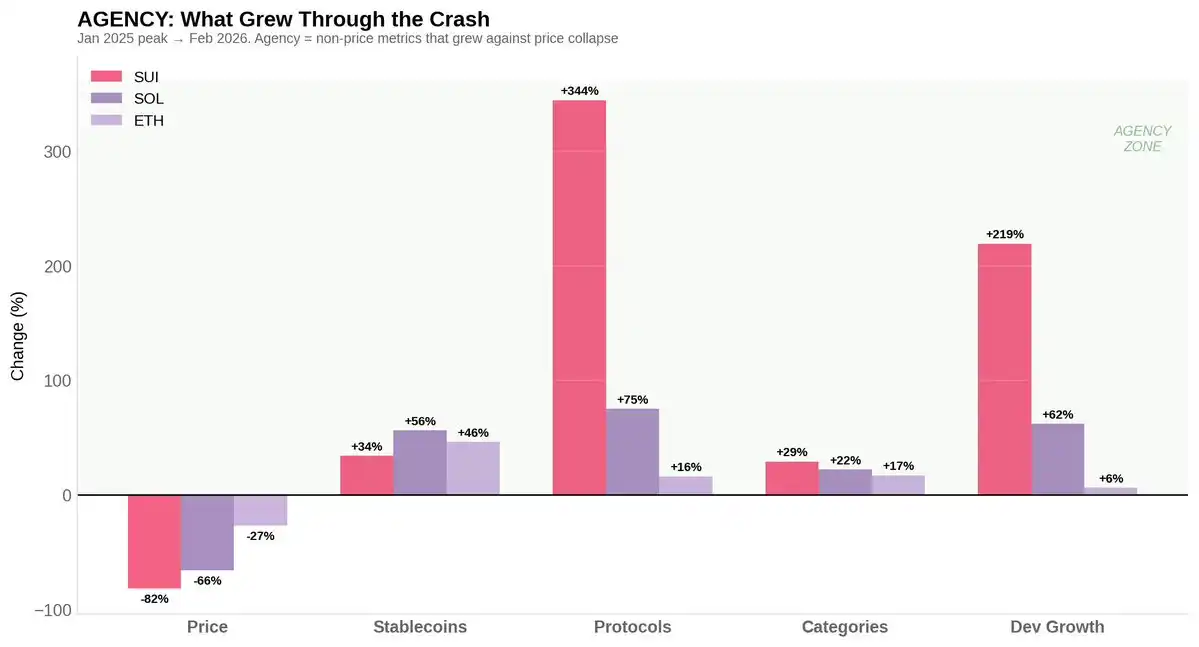
- First, whether economic density per user holds up during a sharp token drawdown. He gave one example from his dataset: from a December 2024 peak to February 2026, one chain’s token price fell 83%, TVL dropped 78%, and active addresses fell by three quarters. Yet the capital deployed per active user barely changed, staying around $2,100 at both the high and the low. In his reading, speculators and bots left, but the remaining users kept doing roughly the same amount of economic activity. Across the chains he studied, only three layer-1s preserved that density in a down cycle: Ethereum, Solana and Sui. Every other chain saw user economic density shrink alongside price. One well-funded major L1, he said, saw that figure collapse 83%, implying that retained users had largely stopped doing anything onchain.
- Second, whether stablecoin balances keep growing while the token falls. Dollar stablecoins onchain do not shrink just because the native token does, he said. If dollar balances continue to rise and stay on the network during a bear market, that suggests outside capital is making a longer-term choice. He said all three of those chains posted stablecoin growth during the downturn, and the chain whose token fell 83% still saw stablecoin balances rise by about half.
- Third, whether developers keep coming. Pal said this is the metric he weights most heavily. Developers are the scarcest form of capital in a blockchain ecosystem. Users can pull money out in minutes. Developers spend years learning a language and architecture, and switching is expensive. If developers keep moving to a chain during a bear market, he said, that signals that the people with the deepest industry knowledge are making a high-conviction choice at high switching cost. Price charts do not capture that.
Pal added a disclosure that he does work with the Sui Foundation. He said he only realized Sui was one of the three names that met his criteria after finishing the data analysis, adding that the data “does not lie.”
In his framework, the chains worth deeper study are the ones where wallet growth, onchain transaction value and developer participation all hold up even during a market retracement. If those conditions are absent, he said, what investors own is closer to a commoditized token than a durable network.
He closed by saying that these assets can still suffer 90% drawdowns along an S-curve of growth. But the few that survive can compound for years and keep making new highs. Thousands of projects will be filtered out before network effects fully take hold. More long-tail tokens will launch every cycle, he wrote, and many investors will keep hunting for 100x returns in that tail while missing the main trend in front of them. The better focus, in his view, is adoption rather than price.
Most projects will die. The small number that do not will define the market.



