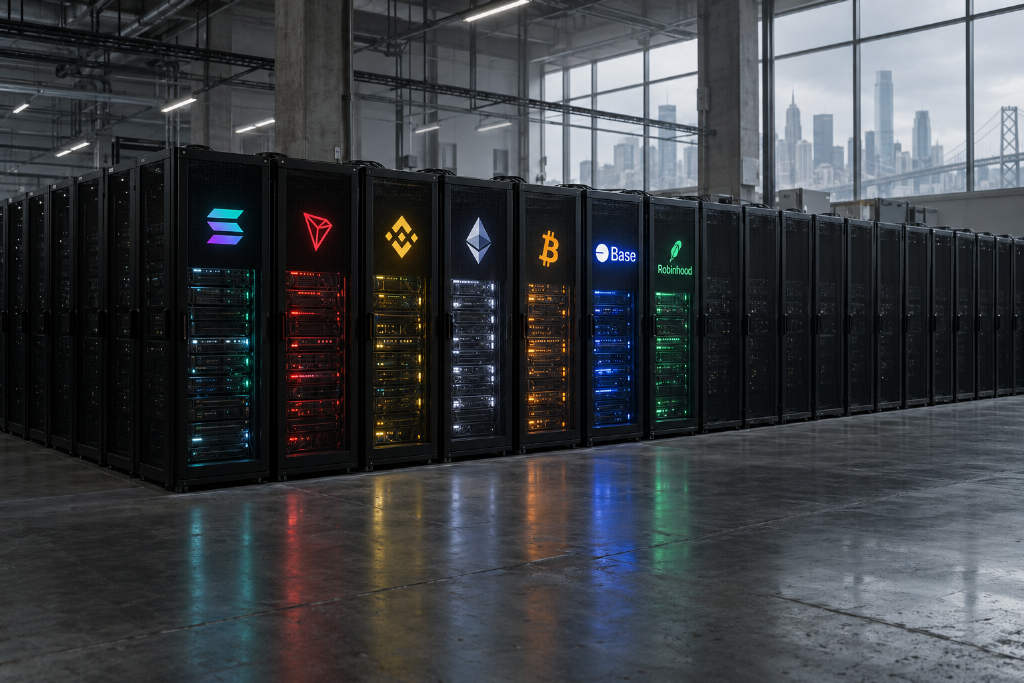
DefiLlama2026-10-03 12:25:37DefiLlama: 443 of 558 blockchains generated less than $10 in fees over 24 hoursDefiLlama data shows that fee generation across most public blockchains remained extremely low over the past 24 hours. Out of 558 chains tracked, 514 posted less than $1,000 in fee revenue. Within that group, 443 chains brought in less than $10, and 399 recorded zero fees during the period. Only seven blockchains crossed the $100,000 mark in 24-hour fee revenue. Solana led the list with $1.09 million, followed by Tron at $922,900, BSC at $793,900, Ethereum at $435,000, Bitcoin at $325,600, Base at $114,800, and Robinhood Chain at $100,900. The figures were cited by Techub News based on DefiLlama data.170
RWA2026-10-01 23:56:58Tokenized real-world assets reach $46.2 billion in market value across 36 blockchainsTokenized real-world assets, or RWAs, have reached a total market value of $46.2 billion and are now spread across 36 blockchains, according to a Techub News item citing Crypto Briefing. The brief report points to continued growth in the sector, showing that tokenized versions of traditional assets are expanding their footprint across multiple chains. At the same time, the report says the market still faces notable constraints. It identifies regulatory uncertainty and differences across markets as key challenges alongside that growth. No further breakdown of asset categories, chain distribution, or regional details was provided in the source item.130
Arbitrum2026-08-19 11:04:17From Arbitrum to MegaETH, blockchains are moving closer to building their own appsForesight said public blockchains, from Arbitrum to MegaETH, are increasingly stepping in to build applications themselves rather than staying limited to base-layer infrastructure. The core point in the brief is that liquidity has become the only real moat in the market. At the same time, the gap between blockchain revenue and application revenue continues to widen. The note frames this shift as part of a broader change in how chain teams position themselves inside the crypto stack, with competition no longer confined to infrastructure alone. Instead, application ownership and direct participation are becoming more central to strategy. The source did not provide additional figures or a longer breakdown, but it highlighted Arbitrum and MegaETH as examples in this trend.1040
blockchains2026-08-10 13:24:48Big-Funded Blockchains See Daily Revenue Fall to Near Zero, Foresight Article SaysA Foresight article argues that a large share of heavily funded blockchains have failed to turn capital and narrative into meaningful revenue. Citing a dataset seen on X and dated to July 29, the piece lists several layer-1 and layer-2 networks excluding Ethereum and compares their historical fundraising totals with daily revenue. EOS was shown with $4.2 billion raised and $0 in daily revenue, while Flow posted $4, zkSync $270, 0G $3, Tezos $29, Somnia $400, Celestia $58, Polkadot $0, Berachain $30, and Walrus $325. The article uses those figures to trace a rough history of crypto infrastructure narratives. It points to EOS and the “Ethereum killer” phase after Ethereum’s 2017 ICO-era rise, then to Polkadot and Cosmos as part of a multi-chain push meant to avoid ecosystem concentration. It also highlights more targeted chains tied to sector-specific narratives: Flow for NFTs and gaming, Berachain for DeFi, and 0G for AI. Its core argument is that crypto does not need so many smart-contract layer-1s, and that narrative alone is not enough to sustain them. The author says real revenue should be treated as a central metric when assessing chain value, and suggests the same cycle may repeat as new themes emerge and venture capital backs new purpose-built blockchains.530
Aave2026-08-06 03:15:23What remains for smaller blockchains after Aave pulls their lending marketsAave’s decision to shut down lending markets on six blockchains has reopened a basic question for smaller chains: what survives once lending disappears. In the source article, author Vaidik Mandloi argues that a lending protocol is not an isolated app but the base layer that keeps a chain’s broader financial stack working. Oracle feeds, DEX liquidity, stablecoin support and liquidations all depend on enough activity and revenue to justify their ongoing costs. On the six chains Aave is leaving, quarterly revenue per chain was below $5,000, while deposits had already fallen 95%, making that economic case hard to sustain. The article points to Harmony and Fantom as earlier examples. After major bridge failures, both networks saw stablecoins depeg, oracle systems break down and credit markets fail to recover. It also revisits Sonic, Fantom’s reboot attempt, where incentives, token airdrops and market-making support briefly boosted TVL but did not create lasting borrowing demand. By contrast, DeFi lending as a whole is still growing fast, according to the article, but that growth is concentrating on Ethereum and a small number of larger networks such as Base and Arbitrum. The conclusion is not that on-chain credit is shrinking, but that smaller chains are finding it increasingly difficult to support the fixed costs required to keep a lending market alive.1830
Visa2026-07-30 09:20:48Visa CEO says stablecoin strategy will stay neutral across currencies and chainsVisa CEO Ryan McInerney said on the company’s July 28 earnings call that Visa will keep a neutral approach to stablecoins across multiple currencies and blockchains, rather than backing a single winner. He said the company’s role is to help clients connect securely to the stablecoins and networks that gain adoption. McInerney also said Visa is one of more than 140 supporting companies behind Open Standard, while stressing that this should not be read as an exclusive commitment to Open USD. The comment draws a line between Visa’s support for an industry standard effort and any suggestion that it is tying its long-term stablecoin plans to one token. Visa’s stablecoin platform, launched on July 16, initially supports Open USD. At the same time, the company said the platform will remain interoperable with its existing global settlement products. The remarks were reported by crypto.news.1820
LayerZero2026-07-26 02:34:36LayerZero to End Offchain Support for 20 Chains as Stargate Users Face Asset Withdrawal DeadlinesLayerZero said it will phase out offchain support for 20 low-activity blockchains, with the first shutdown taking effect on July 30. The move covers LayerZero Labs-operated DVN and Executor services, while Stargate v2 will also drop support for five of those chains: Botanix, EDU Chain, Aurora, Taiko, and LightLink. The company warned that users who do not bridge or redeem affected assets before each chain’s cutoff date could lose access to their funds. The timeline is split across four dates: July 30, July 31, August 28, and September 30. LayerZero also provided chain-specific instructions for Stargate users holding assets such as USDC.e, wETH, USDT, S*USDC, and S*ETH. In several cases, users are asked to bridge assets back to Stargate Pools or withdraw liquidity before support ends. LayerZero said the shutdown applies to its managed offchain services rather than onchain Endpoint contracts, which remain deployed and immutable. Even so, without official verification and execution services, cross-chain messaging on those networks will effectively lose LayerZero’s operational support. The announcement points users toward deeper-liquidity destinations including Ethereum, Arbitrum, Base, and BSC.3690
Robinhood2026-07-24 08:25:16Robinhood Says Decentralization and Liquidity Drove Its Ethereum Layer 2 ChoiceRobinhood said it chose to build an Ethereum Layer 2 instead of launching a new Layer 1 because of decentralization concerns on some networks, stronger infrastructure, and access to interconnected liquidity.260