

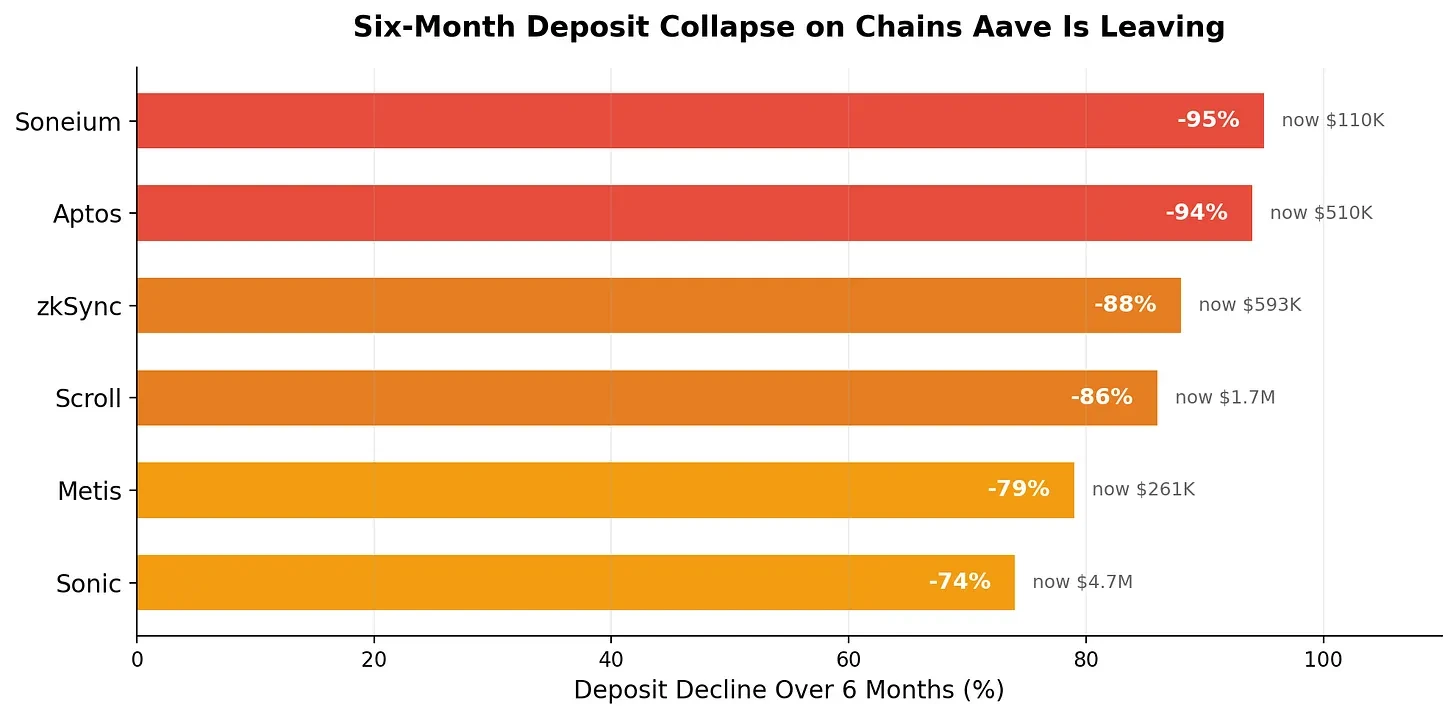
Aave said it will shut down lending markets on six blockchains, each of which generated less than $5,000 in quarterly revenue. Based on Aave’s usual 13-cent share of every $1 of interest, the article says its earnings from Mentis and Aptos were roughly enough to pay for dinner.

The gap with its larger deployments is stark. Aave’s Ethereum deployment brought in $142 million last year, and the protocol has kept expanding to newer networks such as Linea. Its V4 version has already crossed $300 million in deposits.
The article, written by Vaidik Mandloi and translated by Chopper for Foresight News, asks what happens after Aave leaves. It is not just a question of whether another protocol takes its place. If no one does, some chains may permanently lose the ability to support credit markets.
What follows when the largest lending venue exits
The piece first looks at earlier cases.
One is Harmony Protocol. In June 2022, its core cross-chain bridge, Horizon, was hacked for about $100 million. Aave, then the chain’s largest lending protocol, froze all reserves on the network. Later that year, the community floated a rescue proposal, but 99% of Aave token holders voted it down. The article argues that Harmony’s eventual collapse can be traced back to the complete loss of lending liquidity.
At first glance, it may seem easy to fork Aave and redeploy it on Harmony. The code is open-source, and putting a lending protocol on-chain can take less than a day. But that misses the infrastructure required to keep a market alive.
A lending venue needs ongoing operations. It needs funded oracles to price collateral. It needs enough DEX liquidity so that collateral can be sold automatically during liquidation without creating more than 40% slippage. It also needs stablecoin issuers willing to support native redemption on the chain. In practice, that means issuers such as Circle and Tether must mint natively on the network, allowing users to move from USDC to fiat without relying on a bridge.
After Harmony’s bridge failed, stablecoins on the network depegged, oracle feeds broke down and liquidations stopped working. The full stack that supported lending failed together. The article’s point is simple: once borrowing demand is gone, there is little business incentive left for anyone to pay to rebuild that stack.
The second example is Fantom. In 2023, Fantom was also hit by a bridge hack. Before the incident, the article says 78% of the chain’s market cap depended on that bridge. After the attack, bridged USDC on Fantom fell to about $0.22, collateral values collapsed and many positions became undercollateralized.
That case matters because Fantom was once the crypto industry’s third-largest DeFi chain, with real users and real lending demand. Even with that base, it still failed to rebuild a functioning credit market. For a network already losing users, the cost of restoring oracles, stablecoins and other core infrastructure can exceed any realistic return, while the users who once needed the system have already moved on.
Sonic showed the limits of incentive-driven demand
Fantom later tried to restart under a new name, Sonic, leaning on capital and incentives to change the trajectory. The article says the project launched a $190 million token airdrop. On day one, Aave, Silo and Euler were all live, with Wintermute providing market-making support.
That did not produce durable demand. The piece says the project was hit by sybil activity, and that depositors and borrowers were often the same users. They deposited assets to collect airdrop points, then borrowed against those same assets to maximize rewards. TVL, in that setup, was inflated because the same capital was counted repeatedly through leveraged loops.
The article draws a distinction between reward farming and genuine borrowing demand. On Ethereum, users may borrow to loop stETH or to fund trading strategies. Those uses exist whether or not a protocol is handing out incentives. On Sonic, the article argues, once incentives disappeared, so did the demand.
The numbers it cites are severe. After Wintermute’s partnership ended, TVL on the chain fell 98%, the token dropped below $0.01 and both founders resigned from the board. Subsidies and market-making deals, in this reading, can create the appearance of a lending market but cannot keep one running over time.
The chains Aave is leaving now may be in even worse shape
The article then turns back to the current exits, naming Soneium, Aptos, Zksync and Scroll among the chains affected. It argues that their position is worse than Harmony’s or Fantom’s was, because deposits are already down 95% and quarterly lending revenue is below $5,000.
Harmony and Fantom at least had native borrowing demand before their bridge crises. These six chains, the article says, never developed that demand in the first place. On average, each raised $250 million and still deployed what the article calls the most cost-efficient lending protocol in DeFi. Even so, real usage did not follow.
Oracle operators, market makers and stablecoin issuers may be next
Aave’s withdrawal is presented as the start of a broader chain reaction. The article argues that Aave has been a core piece of financial infrastructure on these chains, not just another app.
Nearly all Chainlink oracle feeds on those networks have effectively relied on Aave to justify maintenance costs because Aave was the biggest user. Once Aave leaves, oracle providers have to decide whether maintaining feeds for a chain with no active lending market still makes sense.
Market makers face the same question. If lending fades, liquidation activity and DEX trading linked to credit markets also weaken. Stablecoin issuers, the article adds, are unlikely to offer native issuance support to a chain generating less than $1,000 in monthly revenue.
That is why the article describes the process as self-reinforcing. One service provider leaving makes it easier for the next one to leave because each provider’s economics depend on the others still operating.
Capital and infrastructure then move faster toward chains where liquidity is deeper and lending still works. Every small chain that loses another piece of infrastructure strengthens the pull of larger networks and weakens the business case for the rest to maintain their own credit stack.
The article treats lending as the base layer of a chain’s financial system. Without it, many yield strategies stop working because they depend on posting one asset as collateral to borrow another. Efficient liquidity provision also becomes harder, since concentrated liquidity positions often rely on borrowed funds. Once lending disappears, the financial applications built on top of it lose their footing, developers leave, on-chain activity drops and infrastructure providers have even less reason to stay.
Aave’s revenue threshold points to the true cost of staying live
Against that backdrop, Aave has set a threshold for future deployments on new chains: at least $2 million in annual revenue. The article says that figure roughly matches the cost of maintaining the oracle feeds, risk monitoring and liquidation systems needed to keep a lending market operating on a single chain.
Its conclusion is that the old model no longer works. Raising hundreds of millions of dollars for a chain and launching quickly with liquidity subsidies is not, in the article’s view, a sustainable approach.
The pattern exists outside crypto too
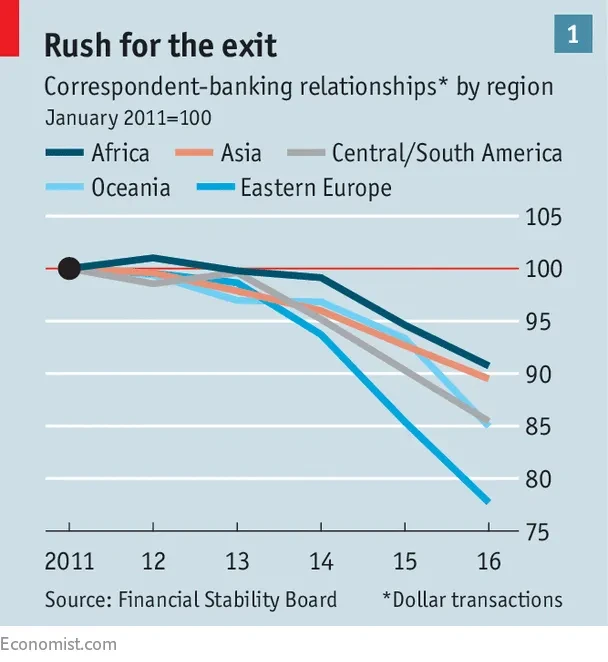
The article compares the situation with correspondent banking. It argues that the problem is not unique to crypto. Any sector with high fixed costs and a small addressable market can run into the same economic limits.
After 2008, large banks around the world started cutting correspondent banking relationships with some smaller countries. The logic, the article says, is similar to Aave’s. Anti-money laundering controls and regulatory reporting create fixed costs for every relationship, and some low-volume cross-border businesses simply do not earn enough to cover them.
From 2011 to 2022, the number of active correspondent banking relationships worldwide fell 30%, according to the article. In Pacific island countries, U.S. dollar clearing routes shrank by more than 60%, and some countries were left with only one correspondent bank. The problem became severe enough that the World Bank had to commit $69 million to keep the last remaining clearing providers operating in eight Pacific nations.
The difference is that traditional finance still has backstops. Central banks, development institutions and the World Bank can step in with subsidies. Crypto usually does not. The article says that is the reality these chains are facing now.
It adds that a mid-sized bank can spend $15 million to $40 million a year on compliance alone. Even the World Bank’s $68 million, the article notes, only preserved the final U.S. dollar clearing line for eight countries. By comparison, Aave’s total cost for risk monitoring contracts across all chains is only $5 million to $8 million, yet the six chains being discussed cannot even cover their share of that amount.
DeFi lending is not shrinking. It is concentrating
The article closes by arguing that DeFi lending itself is not in retreat. Growth remains strong, but it is becoming more concentrated.
Morpho’s TVL rose from $105 million to more than $8 billion in one year. Euler expanded from $6 million to $300 million in just a few months. Aave V4 passed $300 million in deposits within months of launch, and Societe Generale became the first traditional bank to connect to a DeFi lending protocol.
In that picture, credit markets are alive. The concentration point matters more. Resources are flowing to Ethereum and to a small number of Layer 2 networks such as Base and Arbitrum, rather than being spread across dozens of chains.
The earlier assumption behind many new chains was that if infrastructure was cheap to deploy, then every chain could build its own financial system. The article says that idea was only half right. Launching a chain may be cheap, but running a full credit stack on it is not.
Today, Ethereum and the top three chains account for 90% of TVL across Layer 2 networks, according to the article. The rest are left fighting over a sliver of value, and that revenue may not even cover the cost of a single set of Chainlink feeds. The ending is blunt: some of these chains may one day be left with an Aave fork that runs on flawed oracle support, and some may be left with nothing at all.