
Raoul Pal says the familiar formula for building wealth has stopped doing what people expect it to do. Save cash, contribute to retirement accounts, buy index funds, maybe add property, then mix in bonds and some gold for diversification. The statements get bigger over time, but real freedom often does not. In his view, that disconnect is not necessarily a personal failure. It reflects a portfolio model designed for a different macro era.
Pal writes from experience. He says he used to be a hedge fund manager, and for the past 21 years has written research for hedge funds and family offices. The framework behind the classic portfolio, he argues, was built for conditions that have now changed materially.
The economy, he argues, now runs on debt
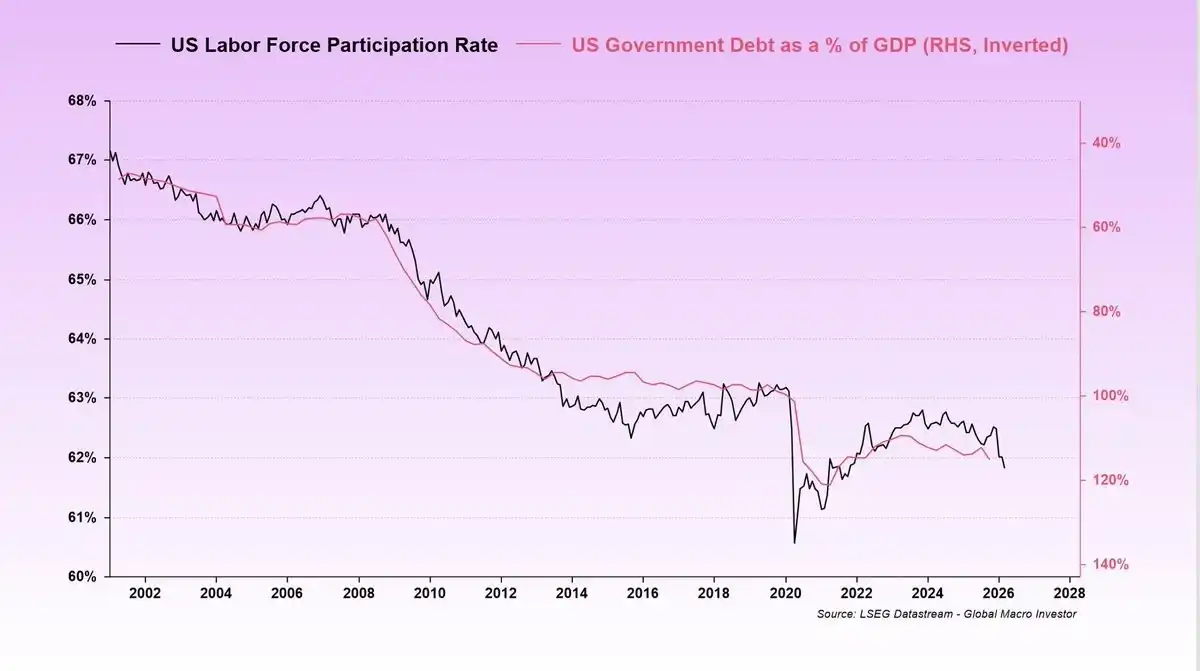
Pal starts with a simple view of economic growth. A country can grow wealth in only three ways: by adding more labor, by increasing output per worker, or by taking on more debt.
For most of the last century, the first two drivers did the heavy lifting. Populations expanded. Technology improved productivity. Debt played a supporting role. He says that is no longer the case. Birth rates began falling decades ago, and productivity growth has been weakening as well. That leaves debt as the main engine.
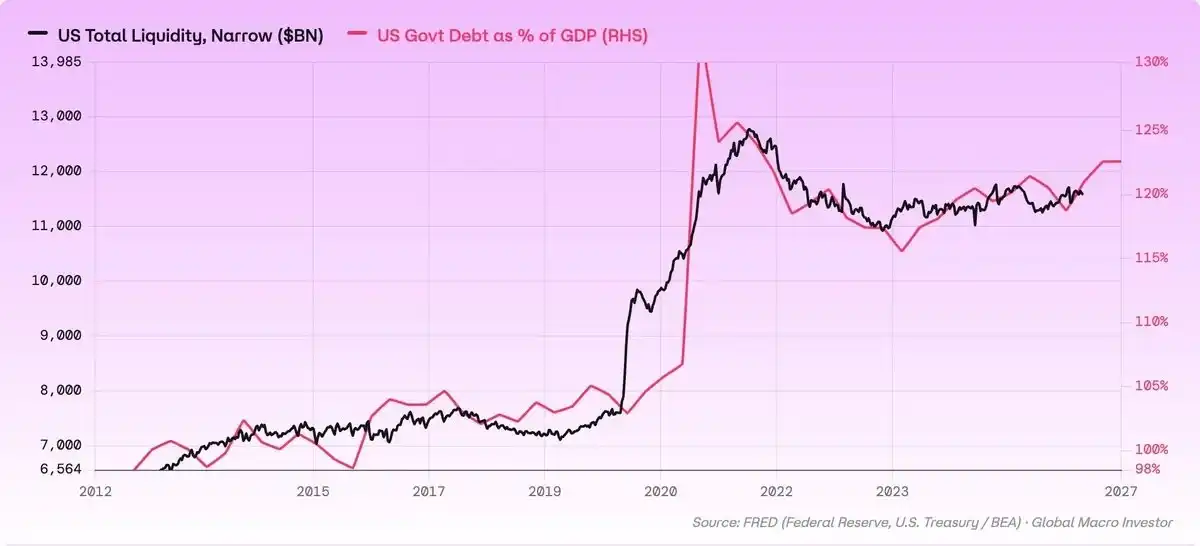
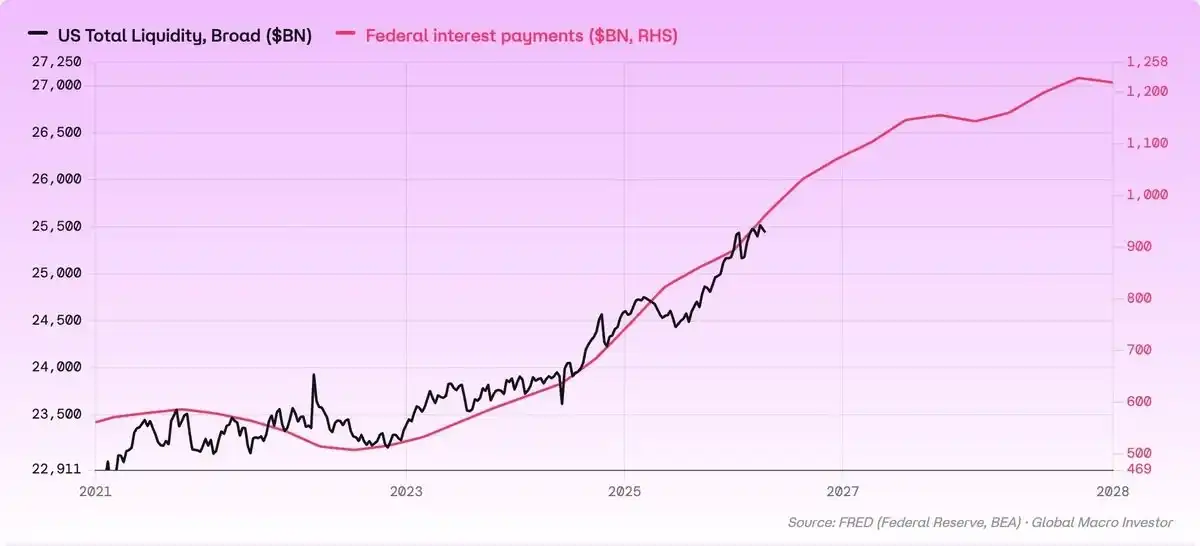
Debt brings interest costs, and Pal says the politically workable way to deal with that burden is usually more money creation. Governments borrow more, interest compounds, central banks supply money to absorb debt, and holders of cash watch purchasing power erode year after year.
His key macro input is global liquidity, which he defines as the total stock of money and credit in the financial system. He says it expands at roughly 8% a year. If the supply of money rises at that pace, scarcity falls by the same order, and currency value is diluted. On top of that, he adds the ordinary inflation rate that dominates headlines, around 2% to 3% for daily expenses and rent.
Put together, Pal arrives at a real hurdle rate of 11% a year. That is the line he uses to separate nominal gains from actual wealth growth. Returns above 11%, he says, increase purchasing power. Returns below it may still look fine on paper, but they represent a slow loss of economic freedom because the unit of account itself is shrinking in value.
That reframes the portfolio question. Instead of asking which assets look safe and balanced, he asks which ones have a credible path to beating 11% annualized.
Why he thinks bonds, housing and gold fall short in different ways
Pal starts with bonds. Most people own them, he says, without really confronting what they are: a loan that pays fixed interest and returns principal at maturity. The problem is that the coupon is typically set against conventional inflation, not against currency dilution. A 4% government bond may honor every promised payment, but if the money in which it is denominated is losing value at 8% a year, the investor still ends up poorer in real terms by the time principal comes back.
His take on real estate is more nuanced. He says the old inflation-hedge logic still exists: borrow at a fixed rate and buy a hard asset priced in a currency that keeps weakening. The real burden of the debt declines over time, and the asset price tends to rise with money supply. He says plainly that he owns real estate himself.
Still, he argues that an earlier generation did not become wealthy from property simply because houses were magical assets. A major part of the windfall came from the mortgage backdrop. Buyers who used leverage near the start of a 40-year rate-cutting cycle benefited from ever-lower rates and higher valuations. That trade, he says, cannot be repeated now that rates first fell to zero and then moved higher again.
He adds that good mortgages are harder to obtain, housing remains expensive relative to income, and mortgage rates are high. Even for those who can finance a purchase, he says real estate has not kept pace with the expansion in global liquidity since 2007. House prices may be up in nominal dollar terms, but their purchasing-power profile is weaker than many assume.
Gold gets a more careful treatment. Pal does not dismiss it. He separates what gold can do from what it cannot. He notes that the metal has had a major rally: it broke above $5,500 an ounce in January, hit an all-time high, then traded back near $4,600 by late August when he wrote the piece, leaving it up by about one-third for the year. Financial media, he says, even gave the move a name: the debasement trade.
That performance easily clears his 11% hurdle. But he argues that if gold is measured against the size of central bank balance sheets over the past 15 years, it has mostly tracked monetary expansion rather than created a separate compounding engine. In other words, gold can preserve purchasing power against monetary debasement. He does not dispute that role. What he disputes is the idea that gold generates new wealth through an expanding user base or an operating ecosystem.
That distinction matters to his broader thesis. Preserving wealth and compounding wealth are not the same thing. Gold, in his framework, is built for the first task, not the second. Its price depends heavily on how anxious markets feel about the monetary system. It can perform very well during those periods, but over decades it does not benefit from a rising network of users in the way technology or crypto can.
Equities do better than those assets in his ranking, especially broad index exposure. He puts the S&P 500 at about 13% annualized over the past 10 years, which gets over the 11% hurdle. But he also says that result was delivered during one of the strongest index bull markets in financial history.
Why he singles out technology and crypto
Pal says only two categories have truly and consistently cleared the bar in a meaningful way: technology assets and crypto assets.
He compares 10-year annualized returns because a decade captures at least one severe drawdown while also sitting fully inside a debasement-driven macro cycle. His figures are straightforward: gold at roughly 12%, the S&P 500 at roughly 13%, the Nasdaq 100 at roughly 20%, and Bitcoin at 58% to 70% depending on the starting date and methodology.
The spread is obvious. But the logic behind it matters more to him than the headline number. If returns are only luck, the framework has little practical use.
His argument is that both technology and crypto are driven by user-adoption curves rather than by the static characteristics of conventional value assets. He invokes Metcalfe’s law: as a network gets larger, the value to existing participants rises. Adoption does not move in a straight line. It tends to follow an S-curve, with slow early growth, a steep middle phase, and then saturation later on. As long as an asset remains in the steep phase of that curve, he says, its return profile can outrun monetary expansion for structural reasons rather than speculative excitement alone.
That leads to the next question. Are these adoption curves already near the end? Pal says no. He argues that the next major wave of participants will not be limited to human users.
Why diversification no longer offers the same protection, in his view
The classic portfolio was built on the assumption that bonds, gold, real estate and equities represent distinct risk buckets. Hold all four, and one shock should not take down the whole allocation. Pal says that assumption held for a long time.
He thinks the break came after 2008. Since then, liquidity has become the dominant force in asset pricing. Those four assets no longer map cleanly to four independent risks. They are, in his description, different expressions of the same macro variable.
Bonds are a liquidity trade. Gold is a liquidity trade. Real estate moves with liquidity cycles. Index funds are, in his words, better-packaged liquidity assets. He is not rejecting diversification outright. He says he diversifies his own holdings. His issue is with the composition of the traditional basket: three of the four categories do not beat the 11% hurdle, and the fourth only clears it under exceptional conditions. The result is a diversified-looking portfolio that still leans on one macro driver while failing to keep up with the expansion of money supply.
So the central question changes. The number of positions matters less than whether the capital earmarked for growth is actually placed in assets capable of long-term compounding. If every diversified holding still trails the hurdle rate, the comfort is psychological more than financial.
Where value may settle inside crypto
Inside crypto, Pal says the more useful question is not whether the sector can compound, but where in the stack that value will accrue. Application-layer protocols can produce very high returns, he writes, and the payoff can exceed that of base-layer chains if an investor identifies projects tied to real commercial demand.
The difficulty is selection. Base-layer chains host settlement for the wider ecosystem, so value can accrue to infrastructure even if investors cannot reliably predict which individual application will win. If economic activity keeps moving on-chain, he argues, owning the settlement layer may offer a lower-upside but lower-difficulty way to express that thesis, with substantial room for growth still ahead.
This is also why he thinks standard equity valuation tools are a poor fit for crypto. He says the industry borrowed stock-market metrics such as fee multiples, revenue growth and value-locked ratios without first proving that they work for blockchain networks. At GMI, he writes, the firm back-tested valuation metrics across 12 major public chains and found that none of them reliably predicted future returns. The one variable that did have predictive value was whether capital entering an ecosystem stayed there over time.
His reason is simple. A public blockchain is not a company that buys inputs and sells a product at a markup. Its value comes from the full set of applications built on top of it, not from fees alone. Valuing Ethereum only through fee collection, he says, would be like trying to estimate the value of the internet in 1998 by looking only at email service charges.
AI agents as the next wave of network users
Pal says that is also why he chose to write this essay now instead of waiting two years. Most market-sizing reports, in his view, still embed the same hidden assumption: users are human, they transact at human speed, they make a few payments, a few queries, a few actions each day or month.
He expects that assumption to break down soon. AI agents, as he defines them, are software systems that can perceive, decide and act without direct human prompting. He says the forecasts he has seen suggest that non-human intelligent identities inside companies could eventually outnumber human employees by 80 to 1.
Those agents cannot open bank accounts, he argues. They have no legal personhood, cannot visit a branch, and cannot function well with payment systems that shut settlement windows at 5 p.m. and take three days to move money. What they need is programmable money on infrastructure that runs continuously. Public blockchains already provide that, he says, while traditional finance does not.
He points to a group of developments that he sees as early signs of that demand. Anthropic has open-sourced its Model Context Protocol. Google has introduced Agent2Agent and released a preview of WebMCP, allowing websites to expose functions directly to agents instead of forcing them to imitate human clicks. Coinbase has restarted the x402 protocol so agents can pay one another over HTTP.
For Pal, these products matter because they imply real settlement demand before any speculative wave is required. Whether speculative capital shows up or not, he says, business usage can keep growing.
His warning: no all-in bets, and no leverage
Despite the force of his argument, Pal spends considerable time on risk. He says concentration invites survivorship bias. The market celebrates stories of people who went all in on a single asset and became wealthy. It rarely hears from the far larger group that concentrated heavily, got liquidated and disappeared.
For that reason, he says plainly that he does not advise putting all capital into one position. In his framework, once an investor identifies a genuine long-duration growth theme, long-run outcomes are driven mainly by two variables: how much capital is allocated to that theme and how long it is held.
Then comes what he presents as a hard rule: do not use leverage. Not a little leverage, not “careful” leverage, not leverage paired with stop losses. The reason is that leverage strips away the core advantage of a long-term thesis. If an asset falls 50%, a leveraged position can force an exit even when the 10-year view is ultimately correct. A violent two-week selloff can liquidate the investor long before the thesis has time to play out.
For most people, Pal favors a layered structure. Keep some traditional assets for stability and peace of mind. Allocate a meaningful share to long-term growth themes. Size the volatile portion so that even a 50% drawdown would not force a panic sale. Then direct the rest of one’s attention back to life rather than to constant trading.
He says that after 13 years of watching crypto, the investors who achieve long-term compounding are usually not the ones trading constantly. During a crash, the drawdown feels overwhelming. On a much longer chart, it can look like a minor fluctuation. Doing nothing, he says, is itself a strategy, though very few people follow it successfully.
The real opportunity cost, in his framework
Pal closes with the same threshold that anchors the essay. If an investor’s compound annual return falls below 11%, then the wealth earned through labor buys less freedom each year. That is the opportunity cost he wants readers to focus on.
He does not offer a fixed allocation model. He says he does not know each person’s debt burden, time horizon or tolerance for risk, and anyone who assigns portfolio weights without those three inputs is effectively guessing with someone else’s money.
What he does offer is a filter. Measure every asset against an 11% annual hurdle. If it cannot clear that line, then no matter how comfortable it feels to hold, it may be draining time and freedom rather than building them.