

Real Vision founder Raoul Pal said a weaker US dollar could give crypto a fresh "green light" and help extend the sector’s rally.
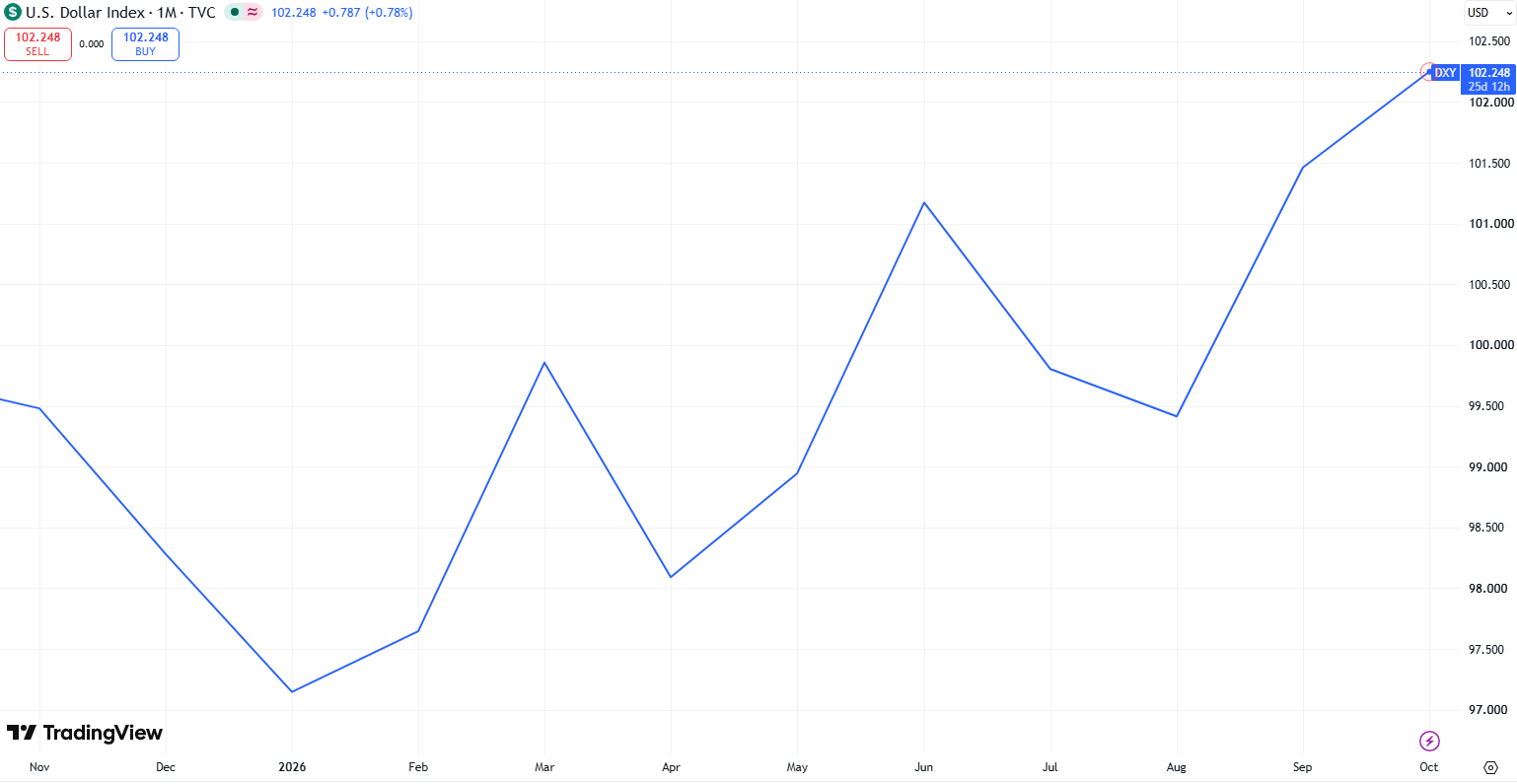
Speaking to Cointelegraph on the latest episode of Trade Secrets, Pal said high bond yields and a strong dollar are keeping liquidity from flowing freely.
"If they can engineer the dollar lower, then we get a green light for further movement in crypto," he said. "I don’t want to get overly excited, so I haven’t got a full green light on everything."
Cointelegraph noted that the US Dollar Index has been trading at the highest levels seen this year.
Pal also said Bitcoin is unlikely to capture much of the crypto-related economic activity created by AI agents. In his view, that flow is more likely to move to smart contract platforms such as Ethereum and Solana.
The report described Pal as one of the more experienced and prominent crypto analysts. He previously worked in hedge fund sales at Goldman Sachs in Europe and co-managed a global macro fund at GLG Partners. He launched the research platform Global Macro Investor in 2005 and co-founded financial media company Real Vision in 2014.
Pal added that he first bought Bitcoin in 2013 after applying a gold-based valuation framework to the asset.
An AI pause could give crypto room to catch up
Pal said Bitcoin’s cycle recovery arguably took shape between Aug. 19 and Aug. 25, when BTC rose about 25% to $80,000. During that same stretch, Nvidia, widely treated as a bellwether AI stock, posted seven straight losing sessions.
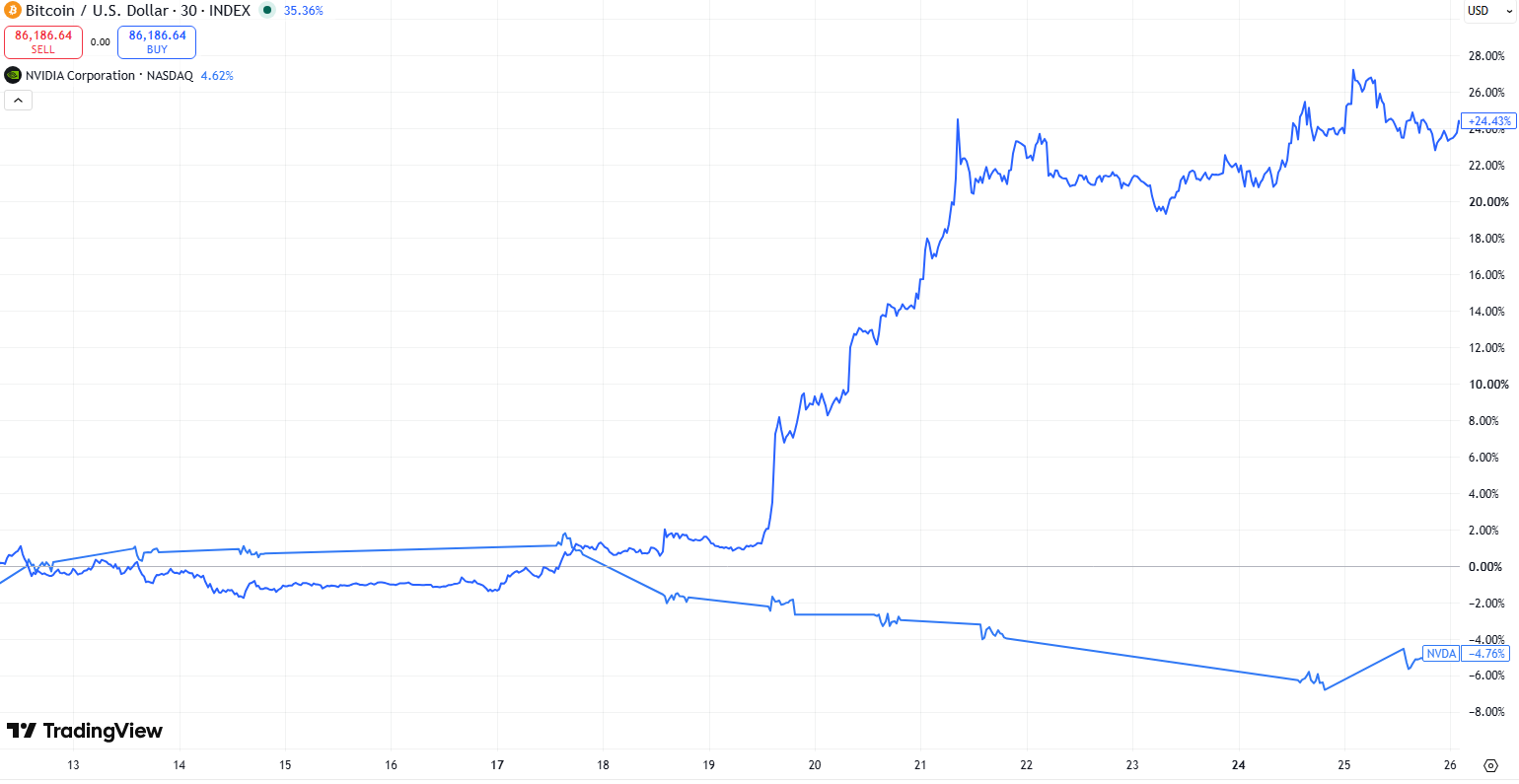
He said pauses in the AI trade have opened the door for capital to rotate into crypto.
"You can tell there’s this sort of rotation for liquidity that’s around right now, which means it’s not abundant yet," Pal said.
Cointelegraph said Bitcoin climbed in August while Nvidia shares fell over the same period.
Still, Pal does not see an AI crash as a positive outcome. He argued that if the AI bubble bursts, it would show that liquidity is being "sucked out of the system," which would threaten the conditions crypto needs to keep rising.
"Things don’t go bust if liquidity is plentiful," he said.
His preferred backdrop would be a weaker dollar, a steeper yield curve and banks expanding the money supply through increased lending.
That is not what the market has been showing. Borrowing costs have moved higher, with the US 10-year Treasury yield climbing to 5.29% in September, while the Federal Reserve raised its benchmark rate by a quarter-point.
If those conditions fail to appear, Pal said his "second best scenario" would be for AI stocks to move sideways, leaving room for capital to rotate into crypto.
AI agents may send more onchain business to Ethereum and Solana
The report said AI agents can already pay for web content access with stablecoins through a feature introduced by Amazon Web Services in June. Coinbase handles payment verification and settlement through its x402 protocol, and supported payment options include USDC on Base.
Pal said agents could eventually raise operating capital by issuing tokens to fund projects that might last "a week, a month, a year," then carry out the work and generate returns.
He said Ethereum and Solana could attract more activity as software starts using their smart contracts to transact.
"My guess is they’ll get more adoption over time as AI uses them," he said.
Solana needs more than activity to pass Ethereum
Even though Pal is positive on both Ethereum and Solana, he said Ethereum’s heavier concentration of capital makes him cautious about claims that Solana will overtake it by market value.
Last month on Trade Secrets, Multicoin Capital co-founder Kyle Samani predicted that SOL would surpass Ether’s market capitalization "this market cycle."
Pal said Samani "needs to hold his horses a little bit," though he acknowledged that the outcome is possible.
The two networks lead on different measures. According to DefiLlama data cited in the report, Solana recorded around 3.2 million active addresses in the previous 24 hours on Monday, compared with 387,000 for Ethereum. But Ethereum held about $54.4 billion in total value locked across decentralized finance protocols, far above Solana’s $6.7 billion.
Pal said he compares the chains using what he calls "economic density," calculated by dividing total value locked by active users. By that measure, Ethereum draws more capital relative to its user base, while activity on Solana happens in smaller amounts.
"Solana’s core activity is speculation," he said. "It’s just smaller clip sizes."
Pal also said he has stopped giving public price targets because his forecasts are often clipped and recirculated online. He described the idea of $1 million Bitcoin by 2030 as a "meme" that reflects rising adoption, ETF interest and Bitcoin’s use as collateral.
"Does it make a million bucks? I don’t know, but certainly by 2032, yeah, I don’t have an issue with that."